How do you manage reputation for an executive going through a public legal dispute?
Counsel sets the boundaries of what can be said, and communications operates strictly within them. Inside those limits the work is a factual response only where the litigation permits, AIQ monitoring of how AI engines absorb the story, and authoritative content covering the executive's broader record so the dispute does not become the canonical narrative.
A public legal dispute is one of the highest-stakes executive reputation situations, and it only works when counsel, communications, and the reputation program operate as one. Counsel sets the boundaries of what can be said publicly given the litigation, and every communications decision stays inside those boundaries.
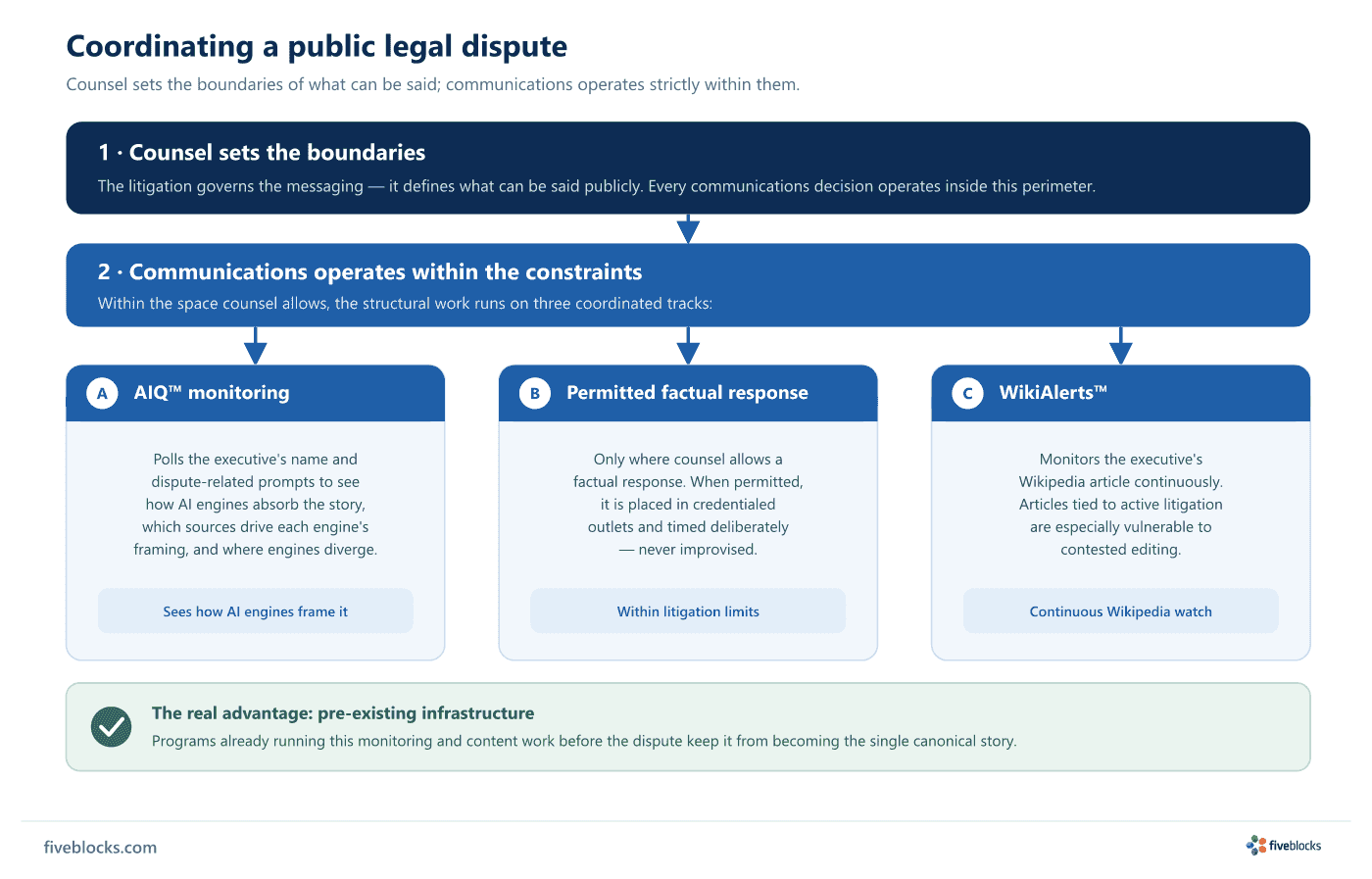
The hierarchy: counsel first, comms within the constraints
The litigation governs the messaging, not the other way around. Within the space counsel allows, the structural work runs on three tracks:
- AIQ monitoring. Polling the executive’s name and dispute-related prompts shows how AI engines are absorbing the story, which sources drive each engine’s framing, and where the engines diverge.
- Permitted factual response. Where counsel allows a factual response, place it in credentialed outlets and time it deliberately. Never improvise it.
- WikiAlerts™ on Wikipedia. Monitor the executive’s article continuously, because articles tied to active litigation are especially vulnerable to contested editing.
Pre-existing infrastructure is the real advantage
The work is operationally heavy through the dispute and through the rebuilding period after it resolves. Programs that come through these situations well usually had the monitoring and content infrastructure in place before the dispute began. That is what keeps the dispute from becoming the single canonical story: the executive’s broader record is already well-sourced and visible.
Last reviewed: 19/05/2026
