How do you manage reputation when named in a lawsuit?
Being named in a lawsuit sets off a predictable sequence online: the complaint gets covered, AI engines pick up the plaintiff's framing, and the branded SERP fills with one-sided filing coverage. The reputation response runs alongside legal counsel and has four parts: daily AIQ monitoring on the specific narrative threads, authoritative owned content on the broader operating record (not the matter itself), and factual-error corrections submitted through editorial channels.
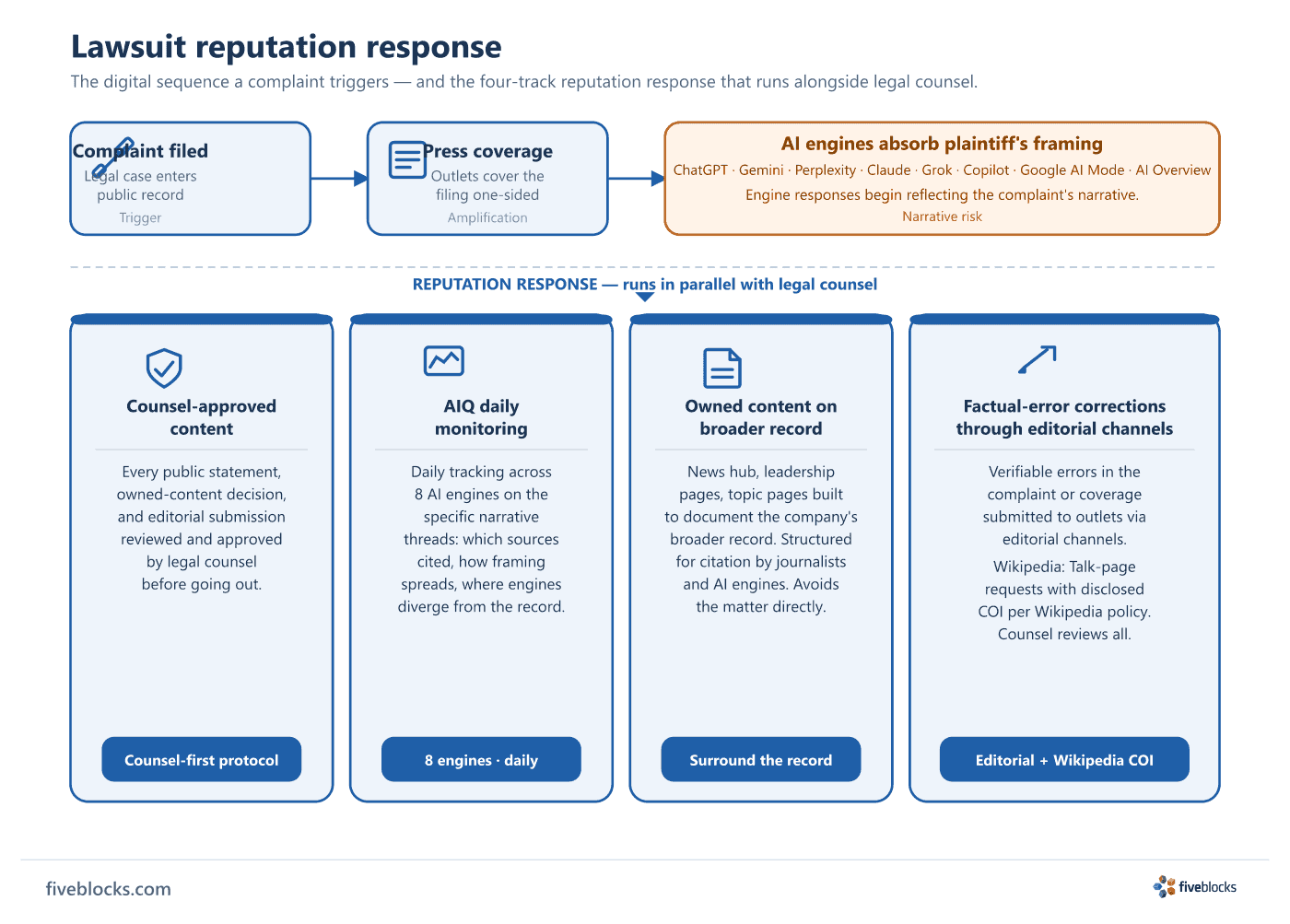
Being named in a lawsuit sets off a predictable sequence online. The complaint gets covered in the press, AI engines pick up the plaintiff’s framing in their responses, and the branded SERP fills with coverage that reflects only the filing. The reputation response runs alongside the legal response, and counsel approves every public-facing element.
The four-part reputation response
- Counsel coordination on all communications. Legal counsel reviews and approves every public statement, owned-content decision, and editorial submission before it goes out. Reputation work stays inside the lane counsel defines rather than running on its own.
- Daily AIQ monitoring on the specific narrative threads. AIQ runs daily across the eight AI engines it currently tracks: ChatGPT, Gemini, Perplexity, Claude, Grok, Copilot, Google AI Mode, and AI Overview. It tracks which sources get cited, how the plaintiff’s framing spreads, and where engine responses diverge from the factual record. That data feeds the reputation response and, where useful, gives the legal team a read on how the matter is being characterized publicly.
- Authoritative content on the broader operating record. Owned properties, the news hub, leadership pages, and relevant topic pages document the company’s broader record: operations, values, customer commitments, and track record. The content is built so journalists and AI engines can cite it. Counsel usually does not want the specific matter discussed directly, so the content covers the record around it rather than the filing itself.
- Factual-error corrections through editorial channels. Where the complaint or the coverage contains verifiable factual errors, correction requests go to outlets through their editorial channels. Wikipedia errors are handled through Talk-page edit requests with disclosed conflict of interest, per Wikipedia’s paid-editing policy. No corrections are filed without counsel review.
Why the work matters after resolution
The reputation infrastructure built during the matter is what stakeholders see for years afterward. Litigation residue, filing coverage, and the AI engine responses drawing on it, often outlasts the press cycle by months or longer. The authoritative content and corrected source signals built while the matter is active become the foundation the resolution narrative sits on. Starting after the matter closes means starting from a weaker position than starting during it.
Last reviewed: 19/05/2026
