How do you handle reputation when a company is named in a class action lawsuit?
Class actions run for years, through filing, motion practice, certification, and settlement or trial, and the digital footprint persists across all of it. The reputation response is a continuous workstream: counsel-approved statements at each milestone, authoritative owned content on the company's broader operating record, IMPACT and AIQ monitoring for the full case duration, and source-level work at the points where the AI narrative tends to consolidate.
Class actions have a long arc (filing, motion practice, discovery, certification, settlement or trial) that often runs for years, and the digital footprint of the case persists across all of it. A reputation response tuned only to the initial press cycle will be out of position by the time the matter reaches the stages that matter most. The work is a continuous workstream, not a one-time response.
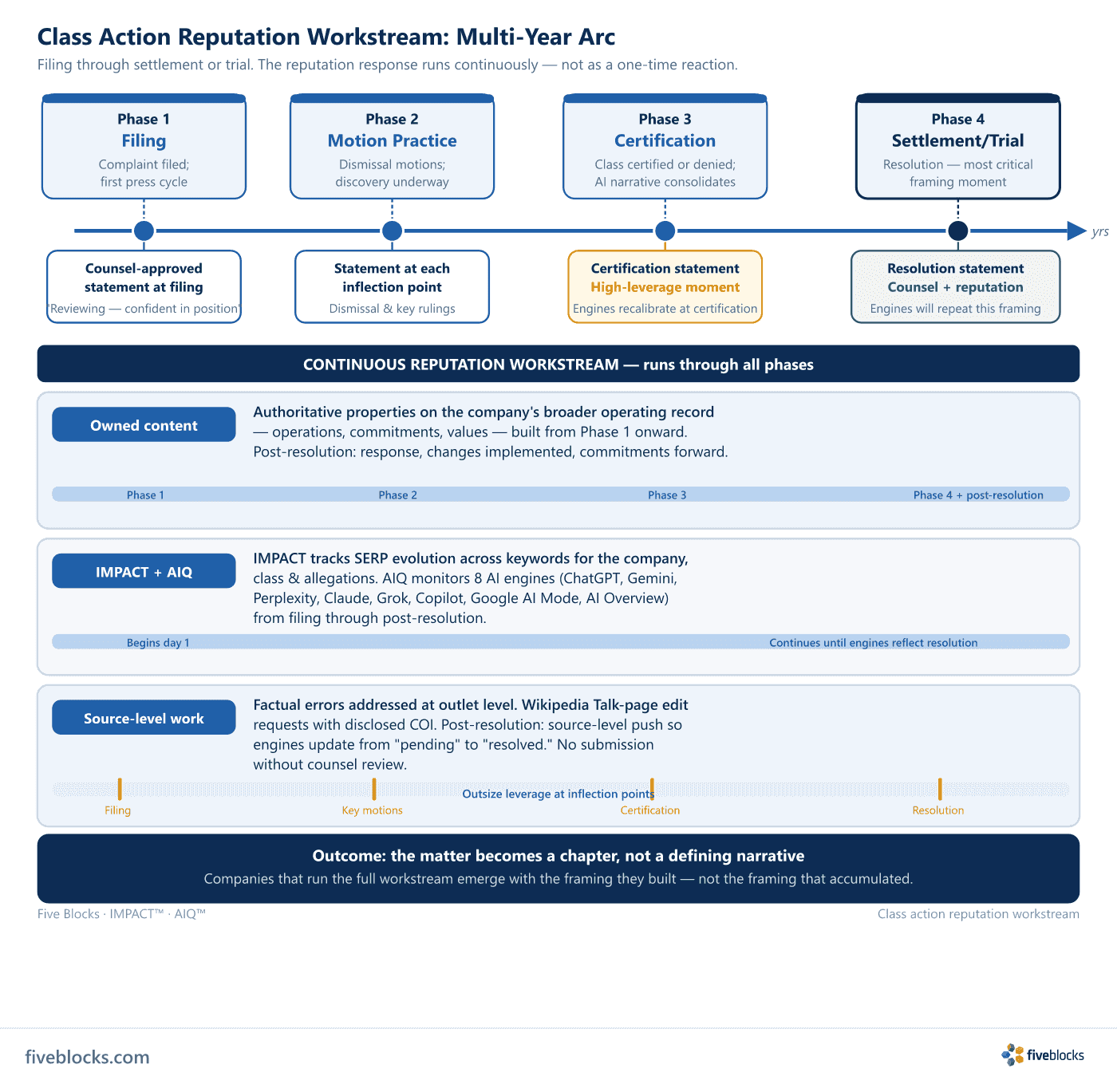
Phase 1: Filing and initial coverage
- Counsel-coordinated statement at filing. A factual public statement, scoped and approved by counsel, goes out at filing. It is usually brief: the company is aware of the filing, is reviewing it, and is confident in its position. Everything beyond that is counsel’s call.
- AIQ monitoring begins immediately. AIQ topics are set up across the eight AI engines AIQ currently tracks (ChatGPT, Gemini, Perplexity, Claude, Grok, Copilot, Google AI Mode, and AI Overview) to track how the complaint’s framing is entering AI responses from day one. The plaintiff’s account of events often becomes the engine’s working summary before any defense is public.
- Owned content on the broader operating record. Properties that document the company’s record, operations, commitments, and values are built out so AI engines and journalists have authoritative material to cite alongside the coverage. Counsel typically does not want the specific matter addressed directly; the content focuses on the record around it.
Phase 2: Motion practice and certification
- Milestone statement at each inflection point. Dismissal motions, certification rulings, and significant procedural developments each warrant a short factual statement, counsel-approved. The AI narrative often consolidates around certification: engines recalibrate what they “know” about the matter, and source-level interventions at this stage carry more weight.
- IMPACT monitoring on search landscape. IMPACT tracks how coverage of the matter is moving in the SERP across keywords related to the company, the class, and the allegations. This feeds both the reputation team’s prioritization and counsel’s view of public perception.
- Source-level work on factual errors. Coverage that contains verifiable factual errors is addressed through editorial channels at the outlet level. Wikipedia content about the company is addressed through Talk-page edit requests with disclosed conflict of interest, per Wikipedia’s paid-editing policy. No source-level submission is made without counsel review.
Phase 3: Settlement or trial resolution
- Resolution statement, counsel-coordinated. Settlement or verdict produces the most important statement of the matter’s lifecycle. How the company characterizes the outcome and what it means going forward is the text AI engines will absorb and repeat for years. Counsel and reputation work together on this language.
- Post-resolution source-level push. AI engines frequently keep describing a settled matter as ongoing or pending for months after resolution. Once the matter settles or a verdict lands, source-level work makes sure the resolution is reflected in the sources the engines weight. AIQ monitoring tracks whether the engines are updating their responses.
- Durable content for the post-resolution period. Owned content covering the company’s response, the changes implemented, and commitments going forward provides the factual foundation for the chapter-not-definition outcome.
The long-term principle
Companies that treat class actions as a continuing reputation workstream rather than a one-time press response usually come out with the matter as a chapter in their story rather than a defining narrative. The infrastructure built across the multi-year arc (authoritative owned content, corrected source signals, continuously updated AI monitoring) is what makes that outcome possible. Starting only at resolution means inheriting the framing that accumulated during the years before it.
Last reviewed: 19/05/2026
