How do you manage search results after a company settles a lawsuit?
After a settlement, reputation work runs in two streams: a legal-closure stream that produces authoritative resolution content and updates Wikipedia and Knowledge Panel signals, and a legacy-content stream that monitors AI narratives, earns coverage of the resolution as news, and requests source-level corrections. The SERP and AI narrative rebalance over roughly six to twelve months.
A settlement closes the legal matter, but the digital record of the underlying dispute often outlives the resolution by years. The response runs in two parallel streams: one establishes the resolution in the authoritative record, and one manages the legacy coverage that still describes the dispute as live.
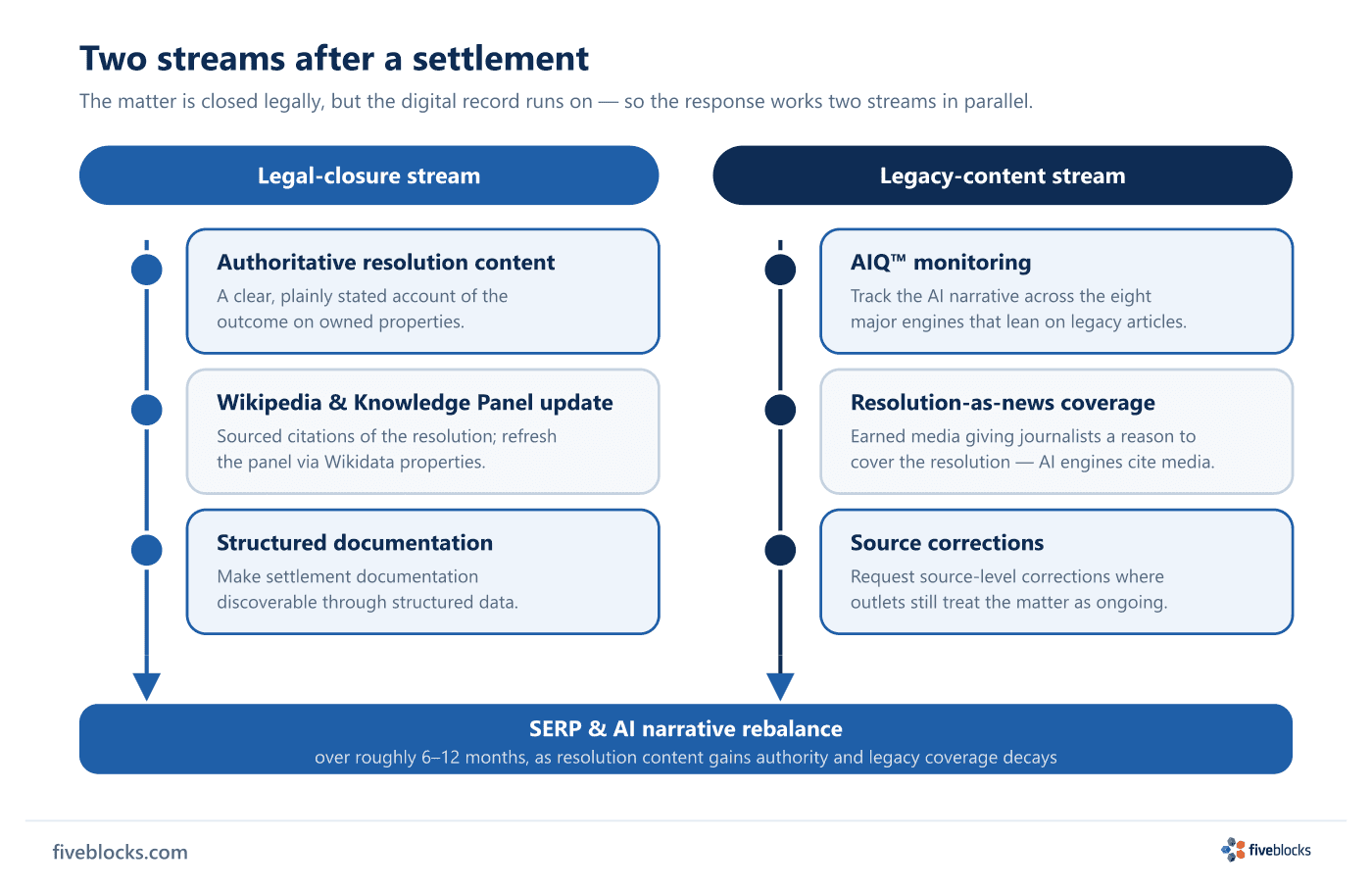
The legal-closure stream
This stream establishes the settlement in the sources engines treat as authoritative:
- Authoritative resolution content. Publish content on owned properties that covers the settlement factually, giving search and AI engines a clear, plainly stated account of the outcome.
- Wikipedia. Update the article with sourced citations of the resolution. Wikipedia feeds Google Knowledge Panels and is weighted heavily by the major AI engines, so it determines much of what gets surfaced about the matter.
- Knowledge Panel. Refresh the panel where applicable, including through the Wikidata properties that feed it.
- Structured documentation. Make settlement documentation discoverable through structured data.
The legacy-content stream
This stream manages the older coverage that engines still cite as if the dispute were ongoing:
- AIQ monitoring. Track the AI narrative across the eight major engines, which lean on legacy articles and can keep describing the matter as live long after closure. Uncorrected legacy errors can persist in AI training data for years.
- Resolution-as-news coverage. Pursue targeted earned media that gives journalists a reason to cover the resolution itself, since AI engines cite media coverage.
- Source corrections. Request source-level corrections where outlets are still treating the matter as ongoing.
The SERP and AI narrative rebalance over roughly six to twelve months as the resolution content gains authority and the legacy coverage falls in relevance.
Last reviewed: 19/05/2026
