How do you manage search results for a company that has been acquired?
After an acquisition, search work redirects deprecated domains where appropriate, updates Wikipedia and the Knowledge Panel to reflect the new ownership, refreshes authoritative third-party profiles, and produces canonical owned content that links parent and subsidiary entities.
An acquisition creates a specific handover problem. The acquired entity has years of accumulated signals – a Wikipedia article, a Knowledge Panel, third-party profiles, owned content – all pointing to its standalone identity, and the new ownership has to be reflected without erasing the entity’s history. The work updates each signal layer in turn and monitors AI narrative throughout.
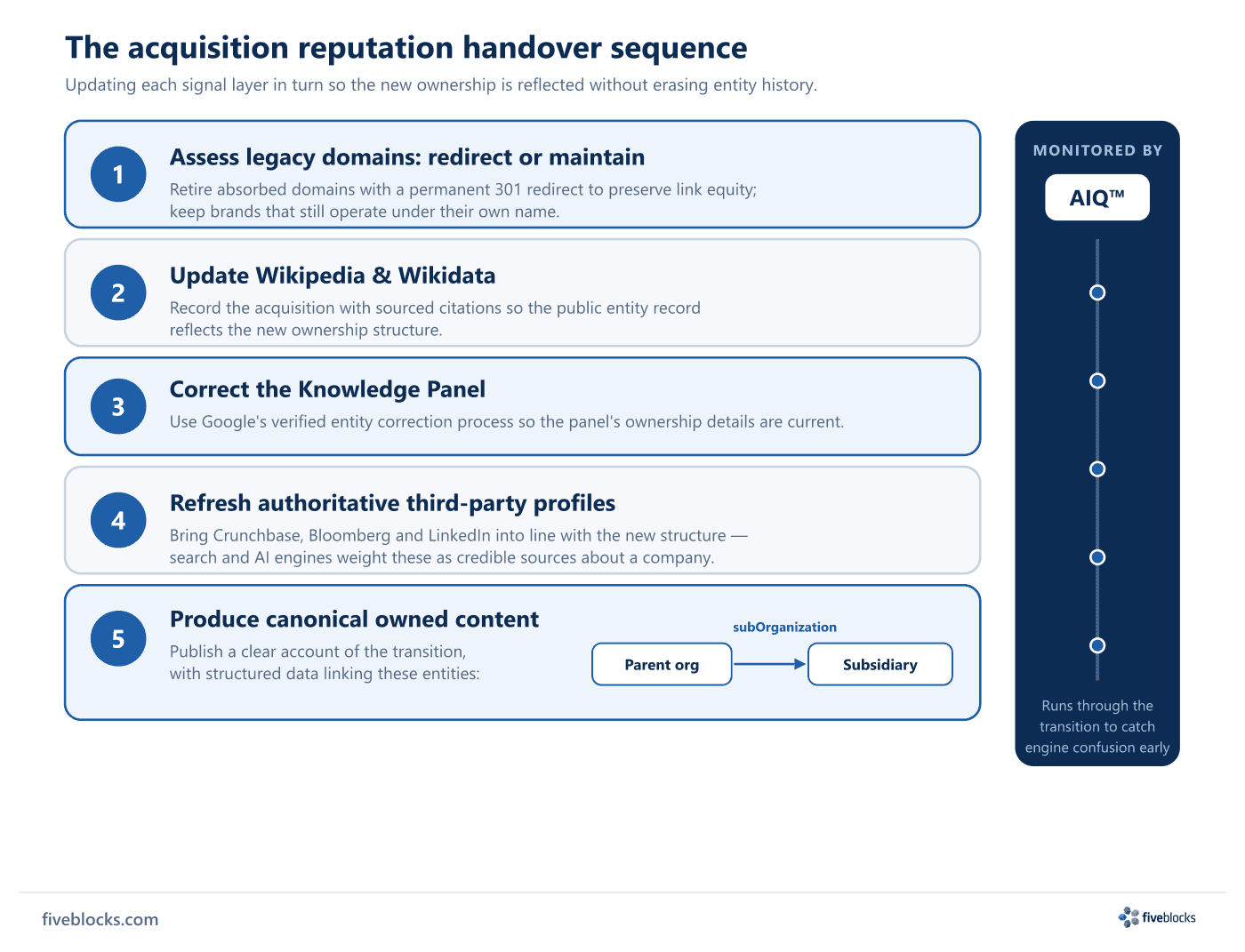
The acquisition handover sequence
- Assess legacy domains: redirect or maintain. Some acquired brands keep operating under their own name, so their existing footprint should be preserved; others are absorbed, and full redirection makes sense. Where a domain is being retired, a permanent (301) redirect to the new location preserves the link equity the old domain built up.
- Update Wikipedia and Wikidata. Record the acquisition with sourced citations so the entity’s public record reflects the new ownership structure.
- Refresh the Knowledge Panel. Use Google’s verified entity correction process so the panel’s ownership details are current.
- Update authoritative third-party profiles. Bring Crunchbase, Bloomberg, LinkedIn, and similar profiles into line with the new structure. Search engines and AI engines treat these as credible sources about a company.
- Produce canonical owned content. Publish a clear account of the transition on owned properties, with structured data that links the parent and subsidiary entities through
subOrganization(andparentOrganization) relationships.
Why the entity linking matters
Connecting parent and subsidiary through structured data tells Google and the AI engines how the two organizations relate, so they stop treating the acquired brand as an orphaned or conflicting entity. AIQ runs through the transition to catch engine confusion early, before a divergent narrative settles across the layers.
Last reviewed: 19/05/2026
