How do you manage search results when a company changes its name?
A company name change is a coordinated entity operation: update Wikidata first because it reaches the Knowledge Graph faster than Wikipedia, refresh the Wikipedia article through a Talk-page edit request, correct the Knowledge Panel while keeping the old name as alternateName, 301-redirect legacy domains, refresh authoritative directory listings, and publish transition content with structured data linking the old and new identities. AI engines reflect rebrandings with a lag, so the new name has to be pushed into every source the engines read at once and monitored until they catch up.
Managing search results through a company name change is a coordinated technical operation across three fronts at once: the structured entity records (Wikidata and the Knowledge Graph), the third-party sources the engines read (Wikipedia and authoritative directories), and your own properties. The work has to happen in parallel because AI engines reflect rebrandings with a lag – their training data is still anchored to the old name – so the new identity has to be pushed into every source an engine reads, then monitored until those engines align.
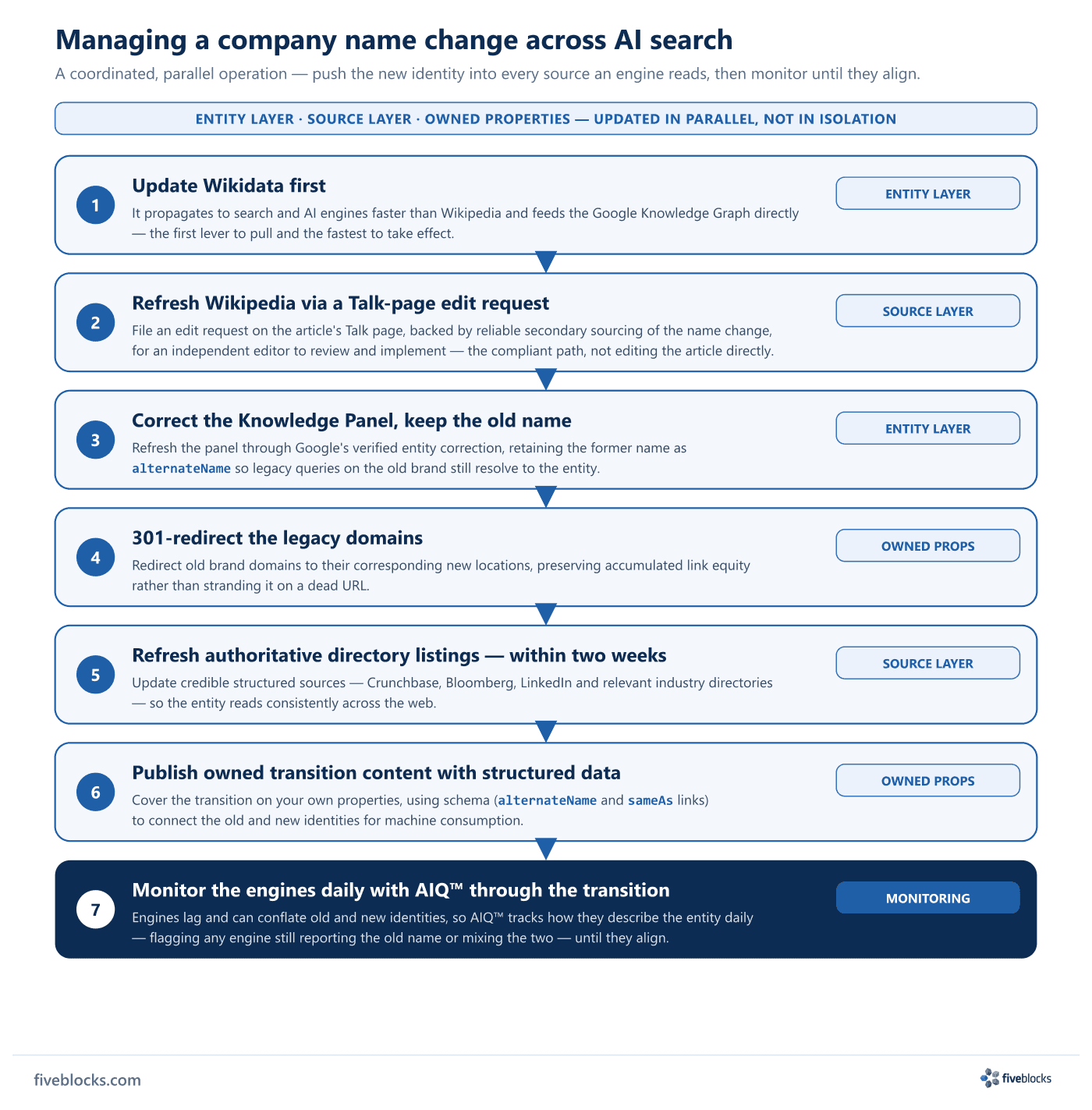
The name-change sequence
- Update Wikidata first. Wikidata reaches search and AI engines faster than Wikipedia and feeds the Google Knowledge Graph directly, so it is the first lever to pull and the fastest to take effect.
- Refresh the Wikipedia article through a Talk-page edit request. File an edit request on the Talk page backed by reliable secondary sourcing of the name change, which an independent editor reviews and implements. This is the compliant path for an interested party, rather than editing the article directly.
- Correct the Knowledge Panel, preserving the old name. Refresh the Knowledge Panel through Google’s verified entity correction process, and keep the former name as
alternateNameso queries on the old brand still resolve to the entity. - 301-redirect the legacy domains. Redirect old brand domains to their new locations. A 301 preserves the accumulated link equity rather than stranding it on a dead URL.
- Refresh authoritative directory listings. Update the business references engines treat as credible structured sources – Crunchbase, Bloomberg, LinkedIn, and relevant industry directories – so the new name reads consistently across the web.
- Publish owned transition content with structured data. Cover the transition on your own properties, using schema (for example,
alternateNameandsameAslinks) to connect the old and new identities for machines to read. - Monitor the engines through the transition. Because engines lag and can conflate the old and new identities, AIQ tracks how the AI engines describe the entity during the transition window and flags any engine that still reports the old name or mixes the two.
Why the order and the parallelism matter
Consistency across these signals is what raises an engine’s confidence in the new identity. Conflicting signals make engines hedge or fall back to the old name. Updating Wikidata first gets the machine-readable record right at the source that moves fastest, while the redirects, directory refreshes, and transition content close the loop so every place an engine looks tells the same story.
Last reviewed: 19/05/2026
