How do you manage search results for a company that has spun off a division?
Partition the parent's accumulated footprint across the two new entities: redirect legacy URLs, give the spinoff its own Wikidata entry, owned-site Organization schema, and directory listings, and refresh both Knowledge Panels. Weak infrastructure lets engines conflate the two, so both entities are monitored through the transition until each reads as separate.
A spinoff is the inverse of an acquisition. Instead of merging two footprints into one, a single entity is split into two, and the digital signals that accumulated under the parent – links, articles, directory entries, structured data – have to be partitioned across the new structure. The whole operation turns on one risk: conflation. When entity infrastructure is weak, search and AI engines confuse distinct entities, so until the spinoff has its own clean, separate signal layer the engines keep describing it as part of the parent. Give each entity its own complete reference set and keep them explicitly linked as predecessor and successor.
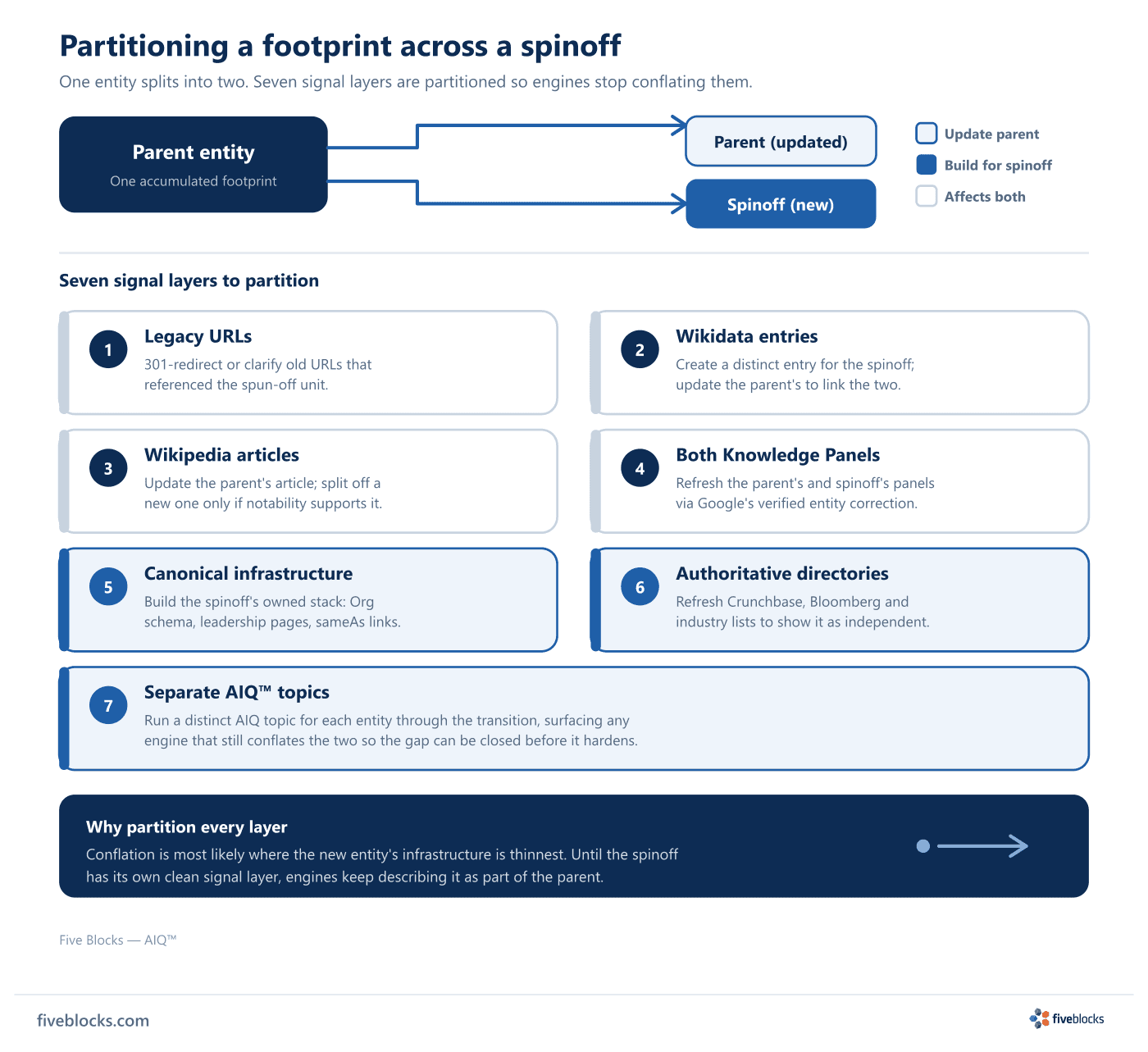
What a spinoff has to partition
- The legacy URLs. Identify which old URLs reference the spun-off business unit, then either 301-redirect them to the spinoff’s new domain – a permanent redirect preserves the accumulated link equity – or update them in place to clarify the post-spinoff relationship.
- The Wikidata records. Create a distinct Wikidata entry for the spinoff entity and update the parent’s entry to reflect the new structure. Wikidata items hold explicit parent-subsidiary and predecessor-successor relationships, so the two entries are connected machine-readably rather than left to be inferred.
- The Wikipedia articles. Update the parent’s article to describe the new structure, and create a separate article for the spinoff only where independent notability supports it – a standalone article is viable only when the entity meets Wikipedia’s notability bar in its own right.
- Both Knowledge Panels. Refresh the parent’s and the spinoff’s panels through Google’s verified entity-correction process. Panel facts are generated from the underlying sources, so the panels resolve correctly only after Wikidata, Wikipedia, and the structured data are corrected.
- The spinoff’s owned infrastructure. Stand up full canonical infrastructure on the spinoff’s own properties: a corporate site with Organization schema and sameAs links to its Wikidata and Wikipedia records, complete leadership pages, and clear canonical content – the same entity-signal stack a standalone company needs to be recognized.
- Third-party directories. Refresh the business references engines treat as credible structured sources – Crunchbase, Bloomberg, and relevant industry directories – so the spinoff is listed as an independent entity rather than a line item under the parent.
Why both entities have to be watched at once
The failure mode for a spinoff is not a missing fact. It is a blurred boundary: an engine that still folds the spinoff into the parent, or attributes the parent’s history to the spinoff. Conflation is most likely exactly where the new entity’s infrastructure is thinnest, so the spinoff’s signal layer has to be built out before the engines settle on an answer. AIQ runs separate topics for both entities through the transition and surfaces any engine that conflates the two, so the gap can be closed before it hardens.
Related
This answer covers the partitioning side of a corporate change. For the consolidation case – one footprint absorbing another – see the acquisition and rebrand entries, including How do you manage search results for a company rebrand? and How do you manage search results when a company is rebranding?
Last reviewed: 19/05/2026
