How do you rebuild search results after a negative news cycle?
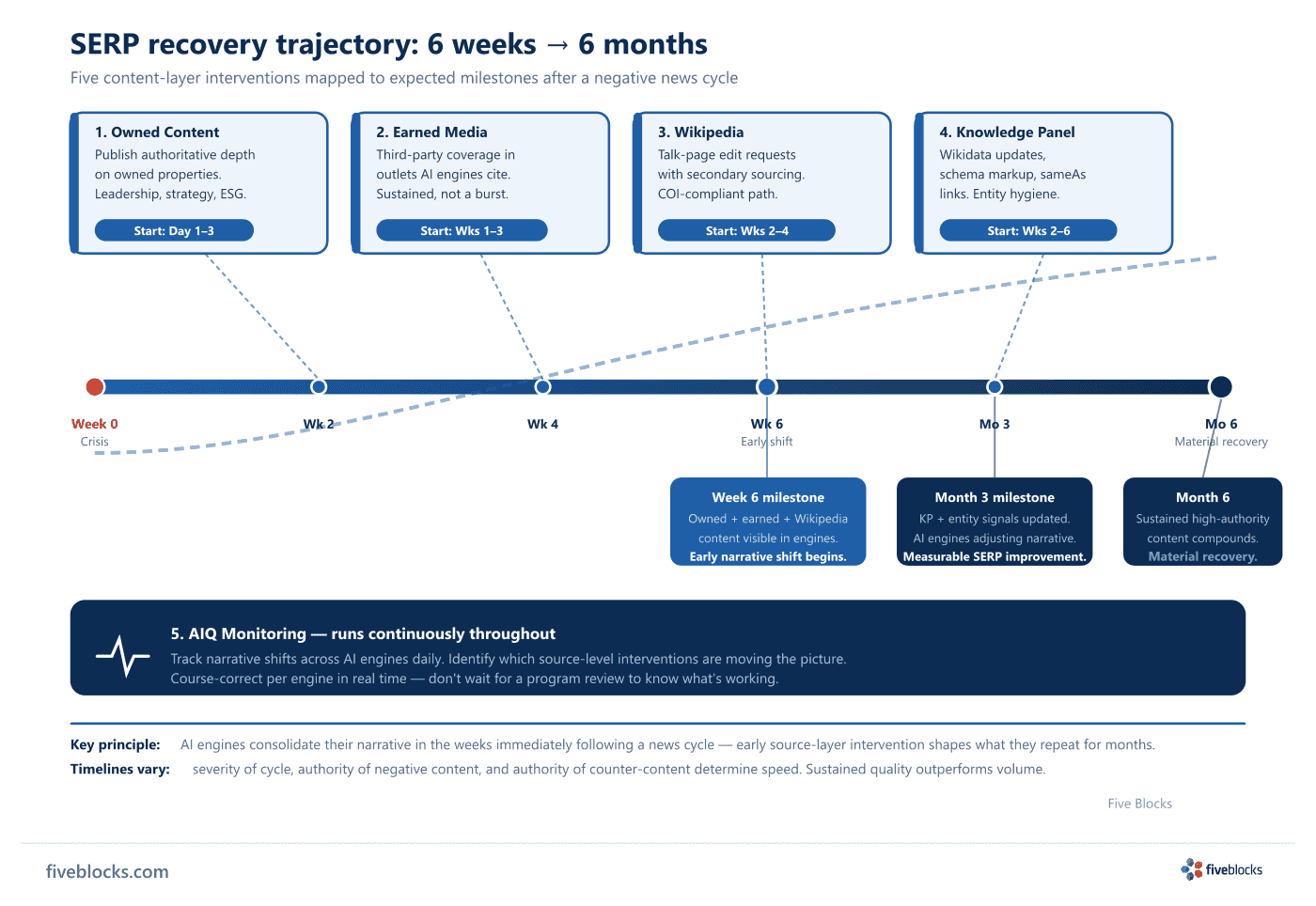
Rebuilding search results after a negative news cycle takes a parallel workstream across owned content, earned media, Wikipedia, and entity-layer signals. AI engines settle on a narrative about a subject in the weeks right after a news cycle, so getting authoritative sources in early carries outsized weight. Recovery timelines vary by severity and content authority; material SERP improvement usually takes months, not weeks.
Rebuilding after a negative news cycle is a sustained workstream, and the opening weeks carry outsized weight. AI engines settle on their narrative about a subject in the period right after a news cycle, weighting whatever sources are available at that moment. Get authoritative material into the source layer early and you shape what the engines repeat for months.
Step 1: Publish authoritative owned content
Cover the company’s current operating record in depth on owned properties: leadership, strategy, customer commitments, ESG context. This gives the AI engines and Google’s ranking algorithm something current and authoritative to weigh against the cycle coverage. A single corporate site rarely displaces tier-one news coverage on its own, but owned content is the foundation everything else builds on.
Step 2: Secure fresh third-party coverage
AI engines weight earned media from credible third-party outlets more heavily than brand-owned content, reading editorial independence as a trust signal. Work with the client’s PR firm to secure coverage in outlets the engines already cite, published steadily over weeks rather than in one concentrated burst. Steady publication builds authority more effectively than volume alone.
Step 3: Update Wikipedia through Talk-page edit requests
Submit post-cycle developments to the Wikipedia article via Talk-page edit requests backed by reliable secondary sourcing. This is the compliant path for parties with a conflict of interest, and the one Wikipedia editors are most likely to accept. Wikipedia is among the most heavily weighted sources the AI engines draw on, so an article that reflects post-cycle facts changes what the engines say about the company.
Step 4: Refresh Knowledge Panel signals
Knowledge Panel content comes from Wikidata, structured data, and the broader Knowledge Graph. Wikidata updates, schema markup corrections, and accurate sameAs links flow through to the panel. Keeping structured entity data current means the panel reflects post-cycle facts instead of holding onto the framing from the cycle itself.
Step 5: Monitor AI narratives daily with AIQ
Track narrative shifts across the AI engines daily to see which source-level interventions are actually moving the picture and which engines are lagging. Correcting course early, by addressing the specific outlets each engine is weighting, is more efficient than waiting for a full program review.
What to expect on timeline
Recovery timelines depend on the severity of the cycle, the authority of the negative content, and the authority of the counter-content the program produces. There is no independently verified standard for how quickly initial SERP shifts occur, and client outcomes vary widely on these variables. Programs that produce sustained, high-authority content consistently outperform those relying on volume or timing alone. Plan for several months of active intervention for material recovery, not weeks.
Last reviewed: 19/05/2026
