How do you prevent a past crisis from resurfacing in search results?
Preventing a past crisis from resurfacing takes continuous monitoring, not periodic checks. IMPACT surfaces contested content reentering the page-one SERP within hours; AIQ flags AI narrative drift daily across the eight engines it currently tracks. Prevention holds when you keep authoritative content current, correct source-level inaccuracies as they appear, and maintain Wikipedia and Knowledge Panel hygiene indefinitely.
Crisis resurfacing is a continuous risk, and prevention is ongoing work rather than a one-time fix. Five things run in parallel and indefinitely: search monitoring, AI narrative tracking, content maintenance, source-level intervention, and Wikipedia hygiene. Together they keep the recovered picture stable.
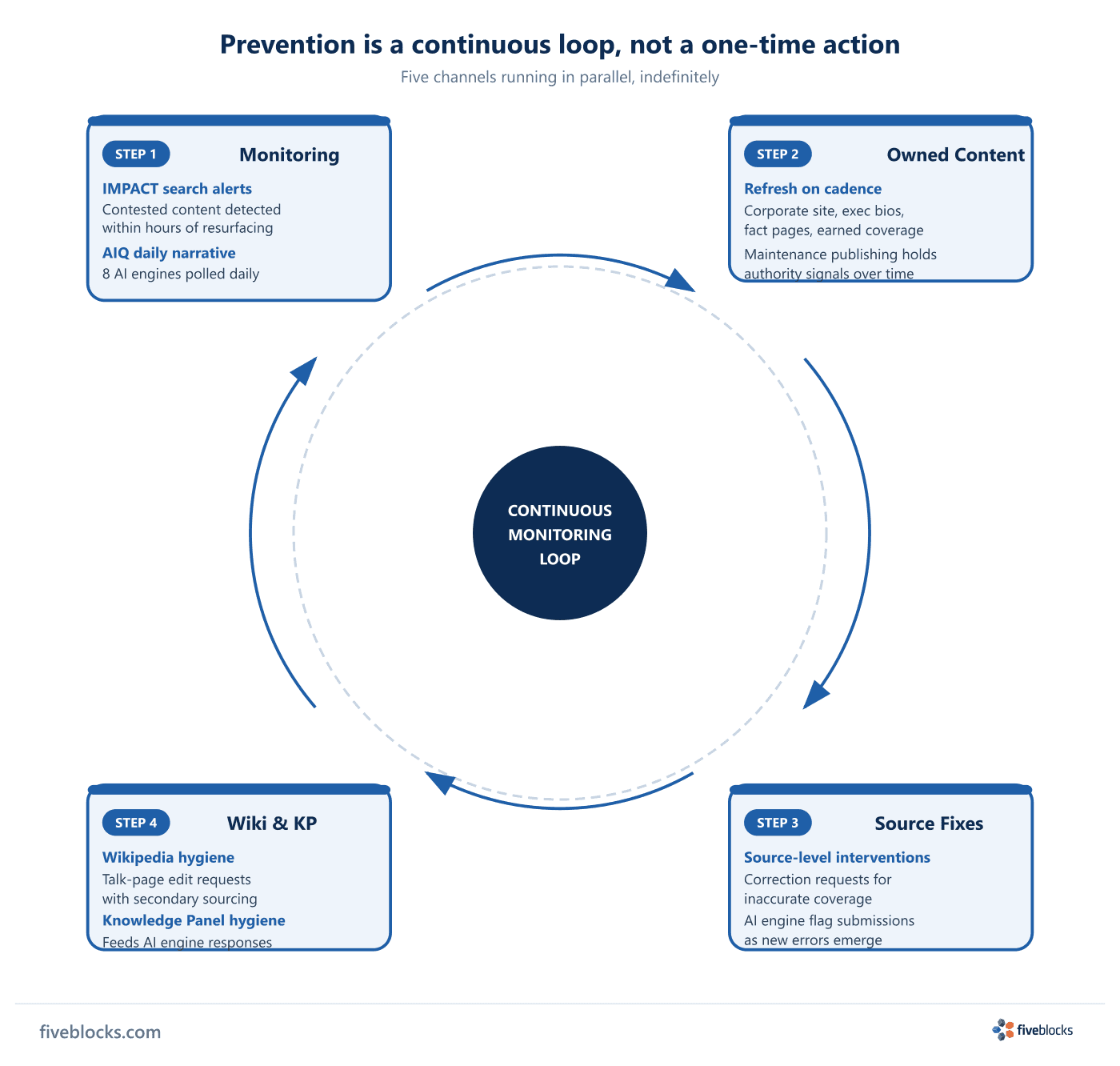
Step 1: Continuous search monitoring with IMPACT
IMPACT runs on the priority queries around the clock and surfaces contested content as it reenters the page-one composition. The signal arrives within hours of a resurfacing event, so the response can be deliberate rather than reactive. Weekly or monthly spot-checks catch the same problems only after they have consolidated.
Step 2: Daily AI narrative tracking with AIQ
AIQ polls the eight AI engines it currently tracks every day: ChatGPT, Copilot, Gemini, AI Overview, Perplexity, Grok, Claude, and Google AI Mode. It flags any drift in narrative framing back toward the historical crisis story. Retrieval-driven engines can pick up newly ranked content within hours or days, so a SERP shift can become an AI narrative shift inside the same news cycle. Daily polling catches this before it compounds.
Step 3: Keep authoritative content current and dominant
Refresh the corporate site, executive bio pages, fact pages, and earned coverage on a set cadence to hold authority signals. Stale owned content loses authority weight over time, and the engines drift toward whatever is current and credible. Maintenance publishing, even at lower volume than the recovery period, holds the ground you gained.
Step 4: Source-level interventions as inaccuracies emerge
New inaccuracies show up in fresh coverage, in Wikipedia editing, and sometimes in AI engine responses. Address each at the source: editorial correction requests for factual errors in coverage; Talk-page edit requests with reliable sourcing for Wikipedia; documented flag submissions for AI engine inaccuracies. Inaccuracies left unchallenged accumulate into the next resurfacing event.
Step 5: Wikipedia and Knowledge Panel hygiene
Review the Wikipedia article and the Knowledge Panel on a regular cadence. Address any drift in article framing through Wikipedia’s disclosed conflict-of-interest process: Talk-page edit requests with secondary sourcing that meets Wikipedia’s reliability standards. Knowledge Panel updates follow from the structured-data and Wikidata work behind the entity record. Both channels feed directly into AI engine responses, so their accuracy is not optional.
The cost asymmetry
Maintenance costs a small fraction of what recovery costs. Clients who skip maintenance pay a high resurfacing cost, in program resources and in stakeholder disruption at the moment the company believed the issue was resolved. Programs that exit completely once the trajectory stabilizes routinely see resurfacing within twelve to twenty-four months. Clients who maintain consistently do not.
Last reviewed: 19/05/2026
