How do you prevent Wikipedia from becoming a permanent record of a crisis?
Wikipedia is rarely a permanent crisis record when handled correctly. Well-sourced positive developments go in through Talk-page edit requests under disclosed conflict-of-interest (COI) rules; undue weight on the crisis section is challenged through WP:UNDUE policy; and the article evolves proportionally as reliable secondary sources document the company's recovery.
Wikipedia articles are working documents. The crisis section of a corporate article reflects the moment it was written. Over time, as new credible sources cover the company’s recovery, that section can be updated, put in context, and rebalanced within the broader article. All of this runs through Wikipedia’s own processes, which is what keeps it sustainable.
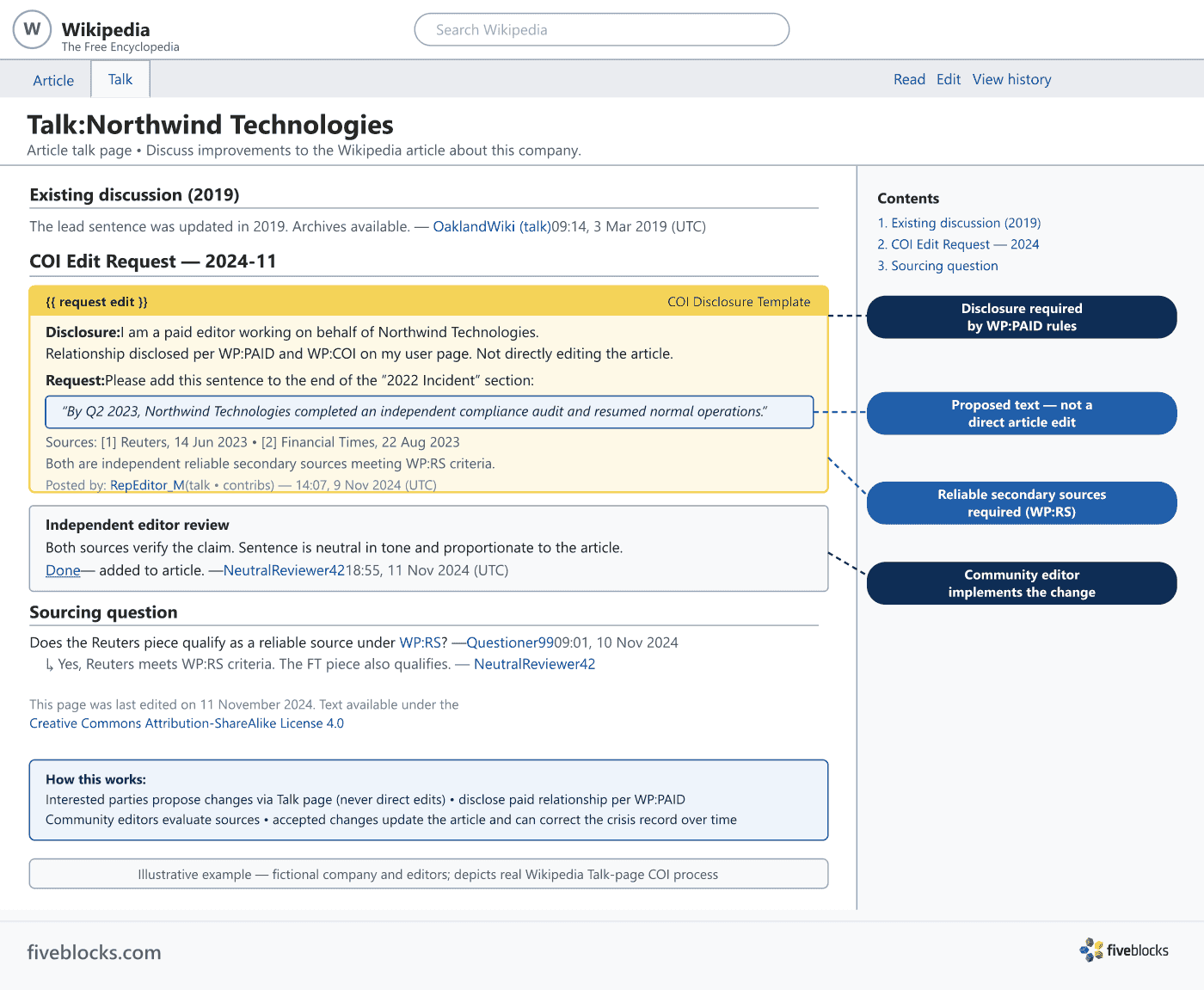
The four levers available through Wikipedia policy
- Talk-page edit requests with reliable secondary sourcing. Under the disclosed COI process (WP:PAID), an interested party proposes changes on the Talk page, discloses the paid relationship, and supplies reliable secondary sources. An independent community editor evaluates and implements them. Post-crisis developments covered by credible outlets can be added this way, without the interested party editing the article directly.
- WP:UNDUE challenges. Wikipedia’s Neutral Point of View policy (WP:NPOV) requires articles to represent every significant viewpoint in proportion to its weight in reliable secondary sources. A crisis section that takes up disproportionate space relative to the company’s broader operating history is a WP:UNDUE violation and can be challenged on that basis through the Talk page.
- Neutral-point-of-view discussions. Language that has drifted from encyclopedic tone, loaded wording, advocacy framing, non-neutral characterizations, can be challenged on NPOV grounds. The lead sentence in particular must describe what the subject is in neutral terms.
- Disclosed COI editing throughout. All of this work runs under disclosed COI rules. Undisclosed paid editing violates Wikipedia’s terms of use, gets reverted when detected, and can trigger account sanctions. Disclosed work that follows Talk-page norms stays within community expectations and is judged on the merits of the sources supplied.
What the process does not permit
Wikipedia’s NPOV policy does not permit removing critical content that reliable secondary sources document. The goal is proportionality: the crisis section should reflect the company’s full operating record, not erase well-sourced facts from the article.
The timeline
Articles that look permanent at month one rarely look permanent at month eighteen once the work is sustained. Talk-page edit requests adding post-crisis developments, WP:UNDUE challenges rebalancing disproportionate sections, and NPOV corrections to loaded language add up over a twelve to twenty-four month horizon. We do this work as part of recovery programs and track the article state continuously.
Last reviewed: 19/05/2026
