What content strategy works best during reputation recovery?
Recovery content is not a burst campaign but a sustained program across five content types: leadership thought pieces that set a forward narrative, FAQ explainers that address resolved issues with factual specificity, third-party earned coverage that AI engines and search treat as authoritative, refreshed entity pages that reflect current reality, and Wikipedia and Knowledge Panel updates backed by reliable sourcing. The mix works only on a sustained schedule, because AI engines take in a steady stream of quality content at higher rates than concentrated volume.
Recovery content has to do specific jobs, and those jobs map onto five content types. What sets the approach apart is the schedule: a sustained, month-over-month rhythm rather than a concentrated burst. AI engines take in a steady stream of quality content better than they take in concentrated volume, so the calendar counts for as much as the content.
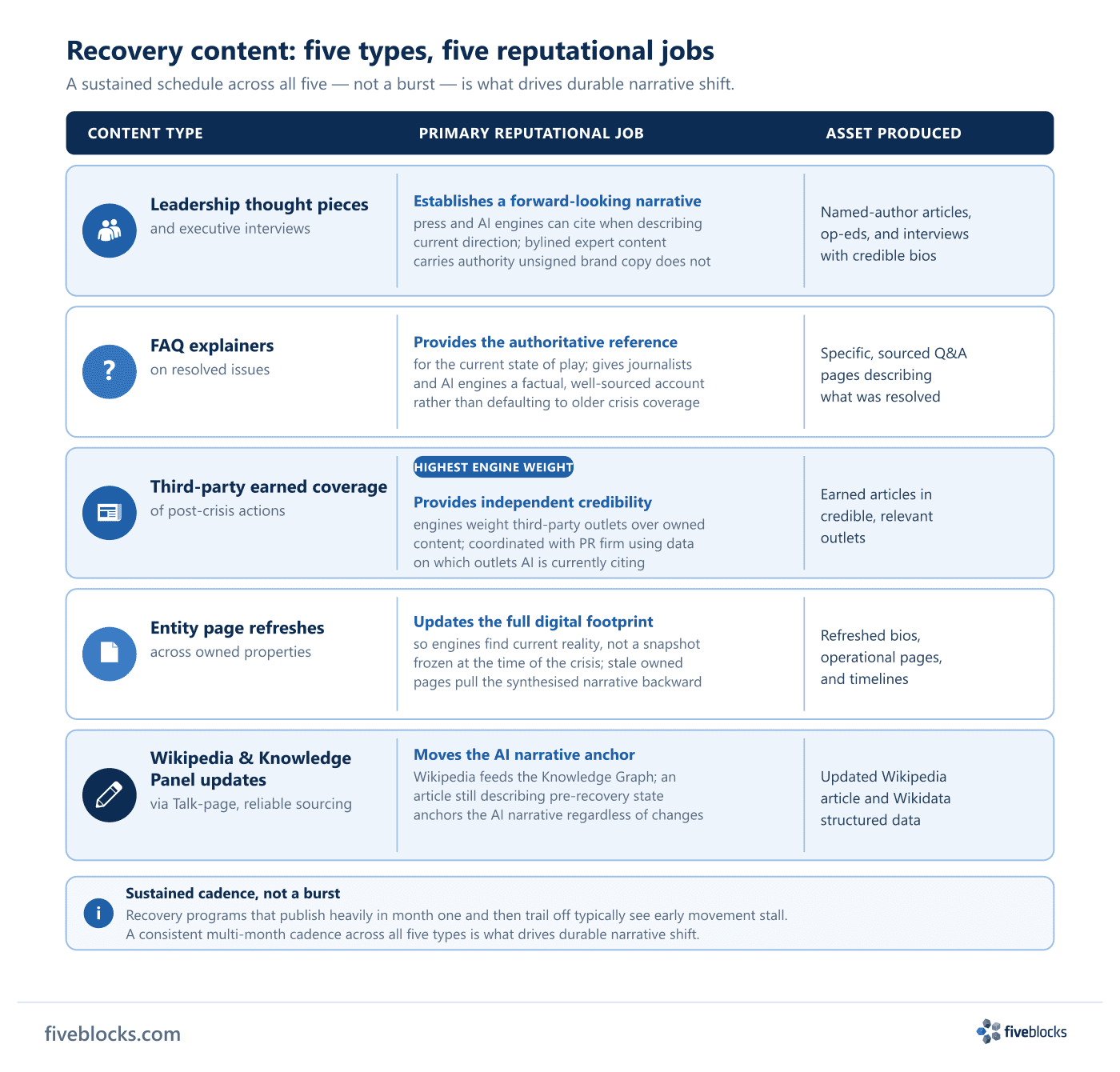
The five recovery content types and their reputational jobs
- Leadership thought pieces and executive interviews
- Sets a forward-looking narrative that press and AI engines can cite when they describe the company’s current direction. AI engines weight content authored by named experts with credible bios, so bylined leadership content carries authority that unsigned brand copy does not.
- FAQ explainers on resolved issues
- Addresses the specific issues that were resolved with factual specificity, putting the historical event in context without turning defensive. Precise, well-sourced explainers give journalists and AI engines a reference for the current state of play instead of the older coverage of the event itself.
- Third-party earned coverage of post-crisis actions
- Provides the sources AI engines and search weight most heavily. Search and AI engines weight sources by credibility and treat independent outlet coverage as stronger evidence than owned content on the same facts. This work is coordinated with the client’s PR firm, using data on which outlets the engines are currently citing to prioritize placement targets.
- Refreshed entity pages across owned properties
- Updates biographies, operational descriptions, and historical timelines so what engines find when they crawl reflects current reality rather than a snapshot frozen at the time of the crisis. AI engines build answers from an entity’s full digital footprint, so stale owned pages drag the answer back to the old story.
- Wikipedia and Knowledge Panel updates with reliable sourcing
- Reflects current developments in the Wikipedia article and the structured data that feeds the Knowledge Panel via Wikidata. Wikipedia is heavily weighted by AI engines and feeds the Knowledge Graph, so an article still describing the pre-recovery state will hold the AI narrative there regardless of what has changed. Updates are submitted via disclosed Talk-page edit requests with sourcing that meets Wikipedia’s reliability standards.
Why schedule beats volume
The content does not run as a launch burst. A sustained monthly schedule works better than concentrated publication because AI engines settle on their narrative quickly after a news cycle and then update it in steps as new sources accumulate. Recovery programs that publish heavily in month one and then trail off usually watch early movement stall as the engines revert to the older, higher-volume coverage. A consistent cadence over many months is what shifts the narrative for good.
Tracking which content is working
AIQ tracks daily narrative shifts across the AI engines and shows which sources each engine is weighting more or less. That data feeds back into the content and PR strategy, so the schedule is adjusted monthly on what is actually working rather than a fixed plan.
Last reviewed: 19/05/2026
