What is the role of positive media placement in reputation recovery?
Quick answer
Positive earned media performs three jobs in a reputation recovery program: it adds authoritative results that rank in search, it provides third-party sources the AI engines cite, and it signals to investors, partners, and other stakeholders that the company has moved past the event. Coverage from respected, high-authority outlets carries the most weight for all three jobs.
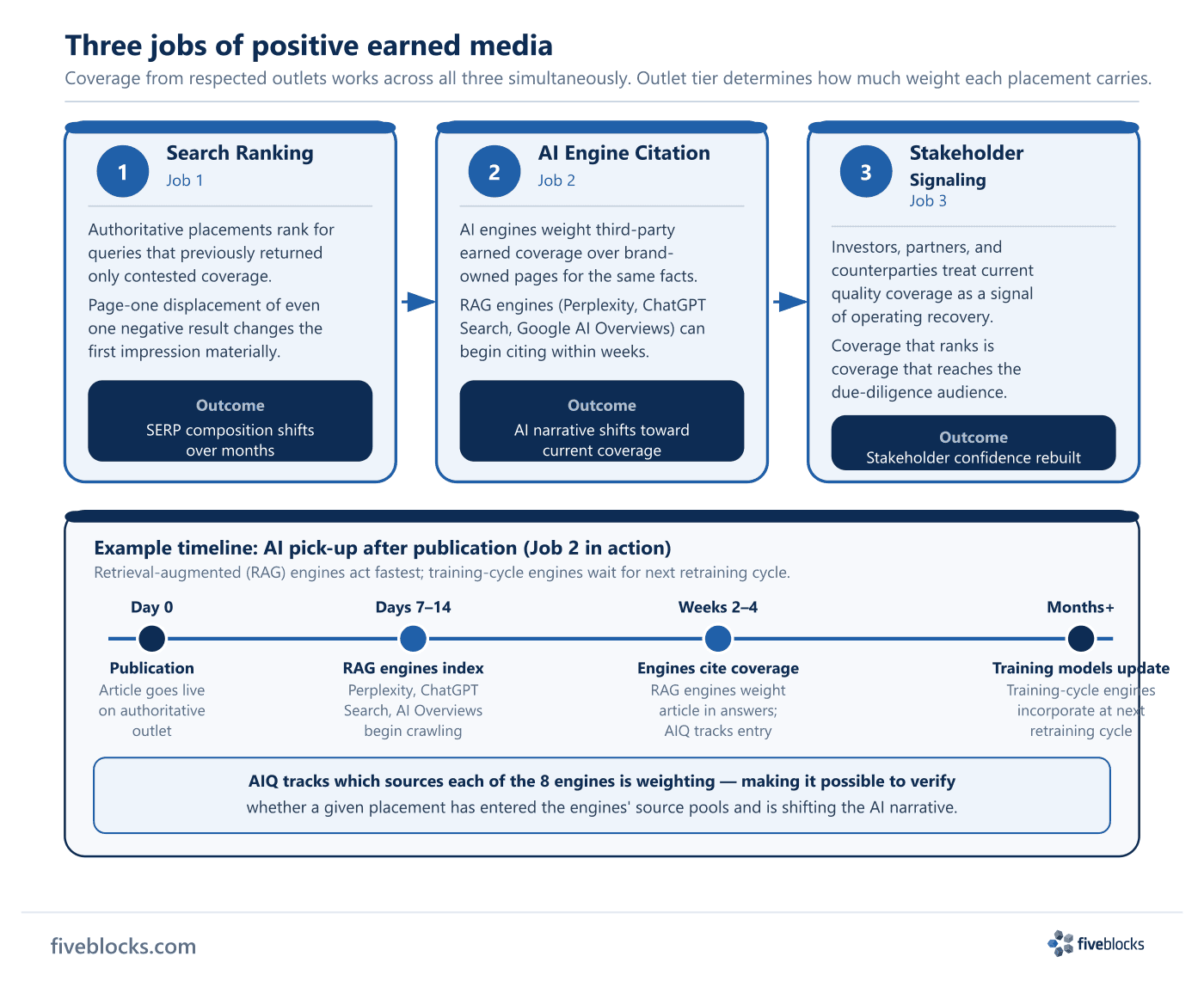
Positive earned coverage does three distinct jobs in a recovery program, and outlet credibility determines how much weight each placement carries across all three. The work runs alongside the client’s PR firm: the firm secures the placements, and Five Blocks tracks which outlets the engines weight and feeds that back into the press strategy.
- Job 1, Search ranking
- A placement in a respected outlet on a current operating topic ranks for queries that previously returned only the contested coverage. Over months, page one shifts. Because nearly all stakeholder attention lands on page one, displacing even one negative result with an authoritative current piece changes the first impression. Tier-one news outlets (wire services, major financial press, established general-interest nationals) produce the strongest domain-authority signals; trade publications carry strong signals for industry-specific queries; thin blog or aggregator coverage carries far less.
- Job 2, AI engine citation
- AI engines assemble answers from sources weighted by authority signals, domain reputation, citation patterns, recency, and structural quality. Third-party earned coverage is weighted more heavily than brand-owned pages or wire releases for the same facts. Retrieval-based engines (Perplexity, ChatGPT Search, Google AI Overviews, Google AI Mode) can begin drawing on new authoritative coverage within weeks of publication; training-baselined engines update only at the next retraining cycle. AIQ tracks which sources each of the eight engines it currently monitors is weighting, so you can see whether a given placement has entered the engines’ source pools and is moving the AI narrative. Tier-one and major trade placements enter those pools faster and are cited more often than lower-authority coverage.
- Job 3, Stakeholder signaling
- Investors, partners, and counterparties read current quality coverage as a sign of operating recovery. Because stakeholder attention concentrates almost entirely on page-one results, coverage that ranks is coverage that reaches the people doing due diligence. Outlet tier matters here too: a placement in a respected financial outlet or recognized trade publication reads as credible to a sophisticated audience in a way a blog post does not.
How outlet tier maps to each job
| Outlet type | Search ranking signal | AI engine citation rate | Stakeholder legibility |
|---|---|---|---|
| Tier-one national / wire service | Strongest | Highest (RAG engines pull in real time) | Highest |
| Major trade / industry press | Strong for topic-specific queries | High for sector queries | High within the relevant audience |
| Regional / mid-tier outlet | Moderate | Moderate; varies by engine | Moderate |
| Blog / aggregator / low-authority site | Weak | Low; often excluded from source pools | Low |
Last reviewed: 19/05/2026
