How do you rebuild trust with stakeholders after a reputation crisis?
Rebuilding stakeholder trust after a reputation crisis is operational work, not a communications exercise. It takes transparent disclosure of what specifically changed in policy, leadership, or process; visible operational evidence that the change is real; and sustained third-party validation across earned media and independent reviewers. Trust rebuilds over years, not months, and only holds when the underlying issue has genuinely been addressed.
Rebuilding trust with stakeholders after a reputation crisis is operational work, not messaging. Stakeholders, investors, customers, employees, regulators, and the AI engines that brief all of them, check what the company actually does, not only what it says. Programs that lead with reassurance and trail on evidence fail. Programs that lead with operational evidence and then communicate it clearly succeed.
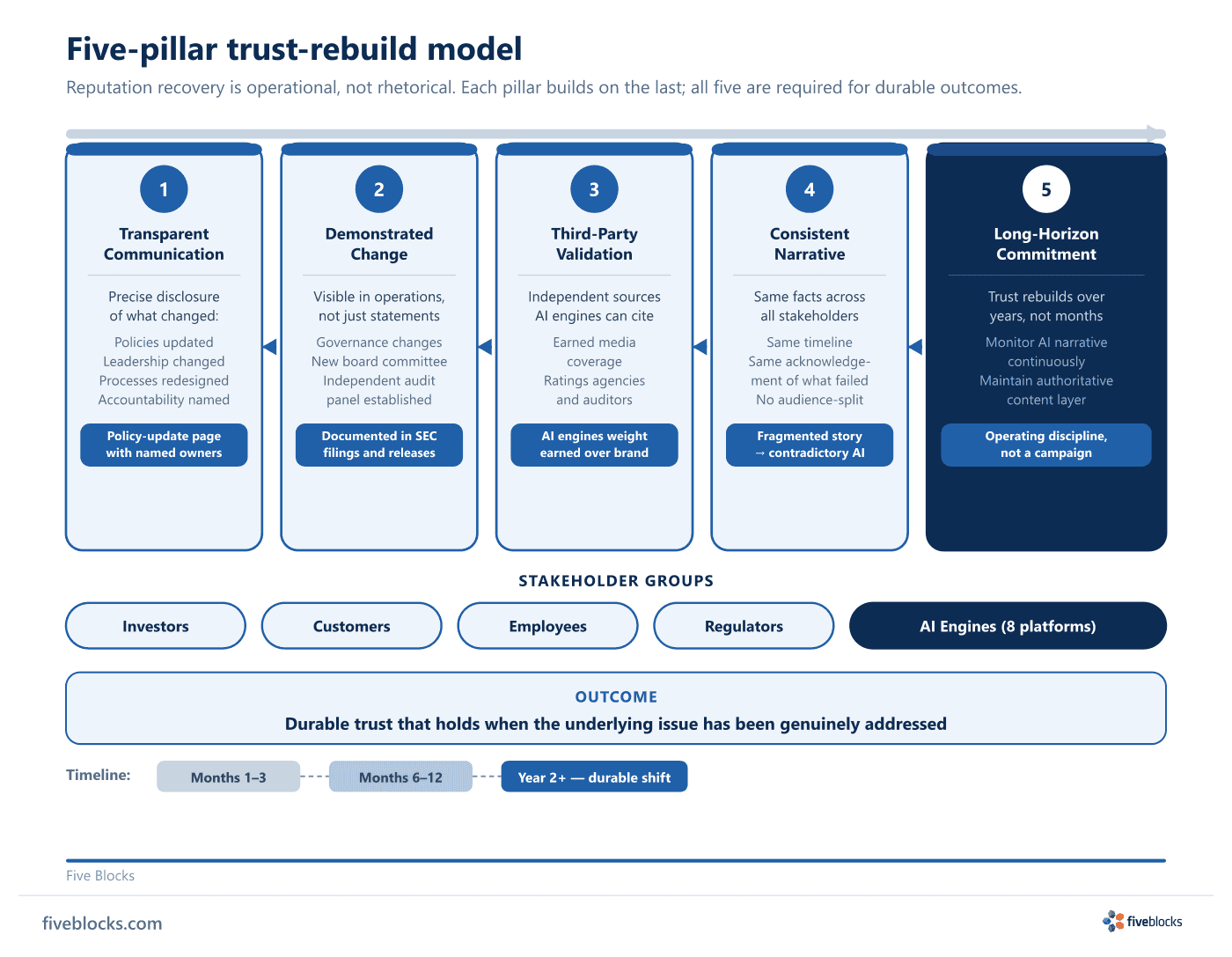
Step 1: Transparent communication on what changed
Start with precise disclosure: which policies were updated, which leadership changed, which processes were redesigned, and what accountability mechanism holds those changes in place. Vague assurances (“we take this very seriously”) read as non-answers to stakeholders who have heard the same language before. The disclosure needs to be specific enough for a third party to verify, because they will. A dedicated policy-update page, a reformulated code of conduct with named owners, or a published remediation roadmap with milestones each give third parties something to validate and AI engines something to cite.
Step 2: Demonstrated operational change
Demonstrated change means the changes are visible in how the company operates, not only in how it describes itself. In a digital context this takes several forms:
- Policy update page. A publicly accessible page documenting specific changes, dated, versioned, with named accountability, gives search and AI engines a citable primary source and gives journalists a reference point for follow-up coverage.
- Governance change. A new board committee, an independent audit panel, or a named chief compliance officer shows structural commitment. Documented in SEC filings, press releases, or company announcements, these changes become facts the AI engines absorb and cite.
- Third-party audit or certification. An independent party auditing the remediation, an accounting firm on financial controls, an environmental auditor on ESG commitments, a cybersecurity firm on data practices, produces validation with a named author. That carries far more weight with AI engines than company-authored attestation. AI engines are built to weight earned and independently authored sources over brand-owned pages.
Step 3: Authoritative third-party validation
Third-party validation carries weight that company statements cannot. Respected outlets, ratings agencies, regulators, and independent reviewers give the stakeholder audience the corroborating evidence it needs before it updates its view. This counts double in the AI-engine environment: AI engines are built to weight earned media over brand-owned content, because third-party sources are easier to trust, retrieve, and cite. Coverage of the remediation in authoritative outlets becomes part of the source layer the engines draw on when they answer questions about the company. The AI narrative shifts when the sourced evidence shifts, not when the company issues statements.
Step 4: Consistent narrative across stakeholder audiences
A consistent narrative means the message to investors, customers, employees, and journalists is substantively the same: the same facts, the same timeline, the same acknowledgment of what went wrong. Inconsistency across audiences is a common failure mode in crisis recovery. A company tells investors one set of facts and customers a softer version, and the gap surfaces in press coverage, Reddit threads, and AI-engine synthesis, which undermines the credibility of both. Consistency also shapes the AI-engine picture: the engines synthesize across many sources at once, so a coherent narrative across owned properties, earned coverage, Wikipedia, and structured data produces a coherent AI answer. A fragmented narrative produces a fragmented or contradictory one.
Step 5: Long-horizon commitment
Trust usually rebuilds over years, not months. The programs that produce durable outcomes treat the work as an operating discipline, not a campaign with a fixed end date. In practice that means monitoring the search and AI picture continuously, AIQ tracks the narrative across the eight AI engines it currently monitors in real time, so any resurgence of the contested narrative is caught early, and maintaining the authoritative content layer so it does not decay. The digital footprint needs active upkeep. Owned properties that go stale, earned coverage that stops, or Wikipedia articles that revert to an outdated state can let the old narrative resurface even after months of progress.
Last reviewed: 19/05/2026
