How do you manage search results for a company that has changed leadership after a crisis?
Managing search results through a leadership change after a crisis takes five coordinated steps: update entity records across Wikipedia, Knowledge Panel, and business databases; publish detailed owned content on the new leadership; monitor the eight AI engines AIQ currently tracks for how the transition is being represented; coordinate earned coverage with the PR firm; then move from active intervention to maintenance at the three-to-six-month mark.
Post-leadership-change reputation work is a defined type of engagement with a set structure. The goal is to get search results and AI engine answers to reflect the transition accurately and fast, before outdated or inaccurate versions settle into the engines and reach stakeholders.
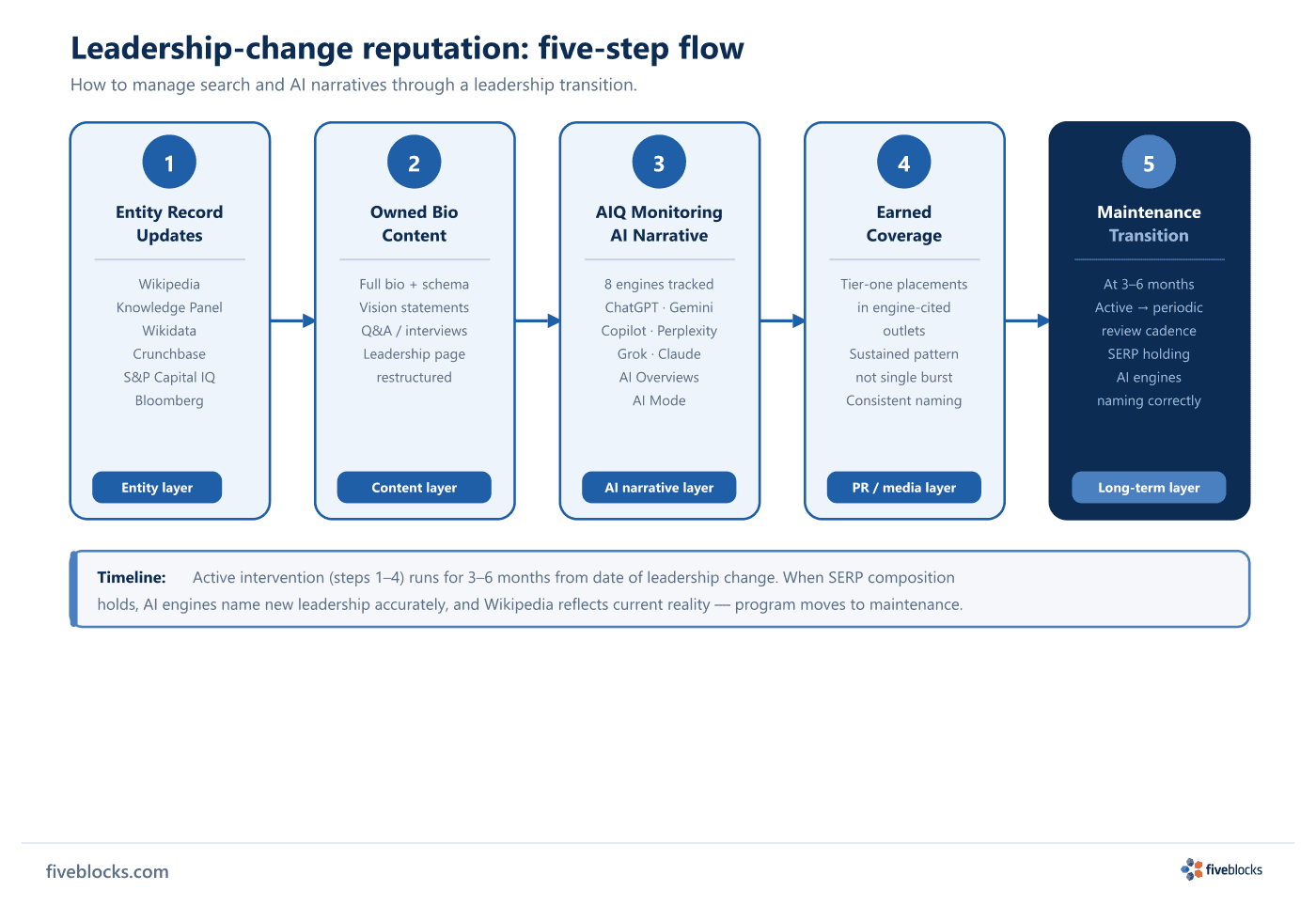
Step 1: Update entity records
Search engines and AI models build their picture of who leads the company from the entity layer. Update every database the engines draw on:
- Wikipedia, file Talk-page edit requests with reliable secondary sourcing for the leadership change; direct editing under a disclosed conflict-of-interest relationship
- Knowledge Panel / Wikidata, update Wikidata properties, which flow into the Google Knowledge Panel and feed the structured data the AI engines query
- Business databases: Crunchbase, S&P Capital IQ, Bloomberg, and any industry-specific directories the engines are known to weight for the sector
Stale records are why the old leadership keeps showing up in AI summaries and Knowledge Panels for months after the transition.
Step 2: Publish detailed owned content on the new leadership
Owned content gives the engines current material to cite. Depth counts for more than speed here:
- Full professional biographies with named authorship and schema markup on the corporate site
- Vision and strategy statements in the executive’s own voice
- Q&A or interview-format pieces covering the incoming leader’s background, priorities, and perspective on the business
- Leadership page restructured to reflect the new team
Content published at enough depth answers both search queries about the new leader and AI engine prompts asking who currently runs the company.
Step 3: Monitor AI narratives across the engines AIQ tracks
AI engines build their read on a leadership transition from whatever sources they hit first, and early inaccuracies can stick for months if no one addresses them. Run topics on the new leaders through AIQ across the eight engines it currently tracks (ChatGPT, Gemini, Copilot, Perplexity, Grok, Claude, Google AI Overviews, and Google AI Mode) to:
- Identify which sources each engine is weighting for the leadership narrative
- Catch factual inaccuracies or outdated attributions before they set
- Track whether the entity-record and content work is actually shifting the engines’ answers
Step 4: Coordinate earned coverage
Third-party coverage is the source the engines weight most heavily when they form their narrative about a leadership change. Working with the client’s PR firm:
- Place tier-one coverage introducing the new leader in outlets the engines demonstrably cite
- Time placements for sustained publication rather than a single burst; a pattern of coverage holds up better than a concentrated announcement
- Name and describe the new leader consistently across all placements so the entity resolves cleanly
Step 5: Transition to maintenance at three to six months
Last reviewed: 19/05/2026
