How do you update a Wikipedia page after an executive transition?
Gather independent sources (official statement plus major press), draft neutral updates to the lead, leadership, and history sections, and file a Talk-page edit request using the {{edit COI}} template with paid-relationship disclosure. A volunteer editor then implements the change, often within hours for high-profile pages, confirmed through WikiAlerts monitoring.
Executive transitions are one of the easier Wikipedia updates to get right, because the sourcing is usually strong on the day of the announcement. The proper workflow runs in four stages.
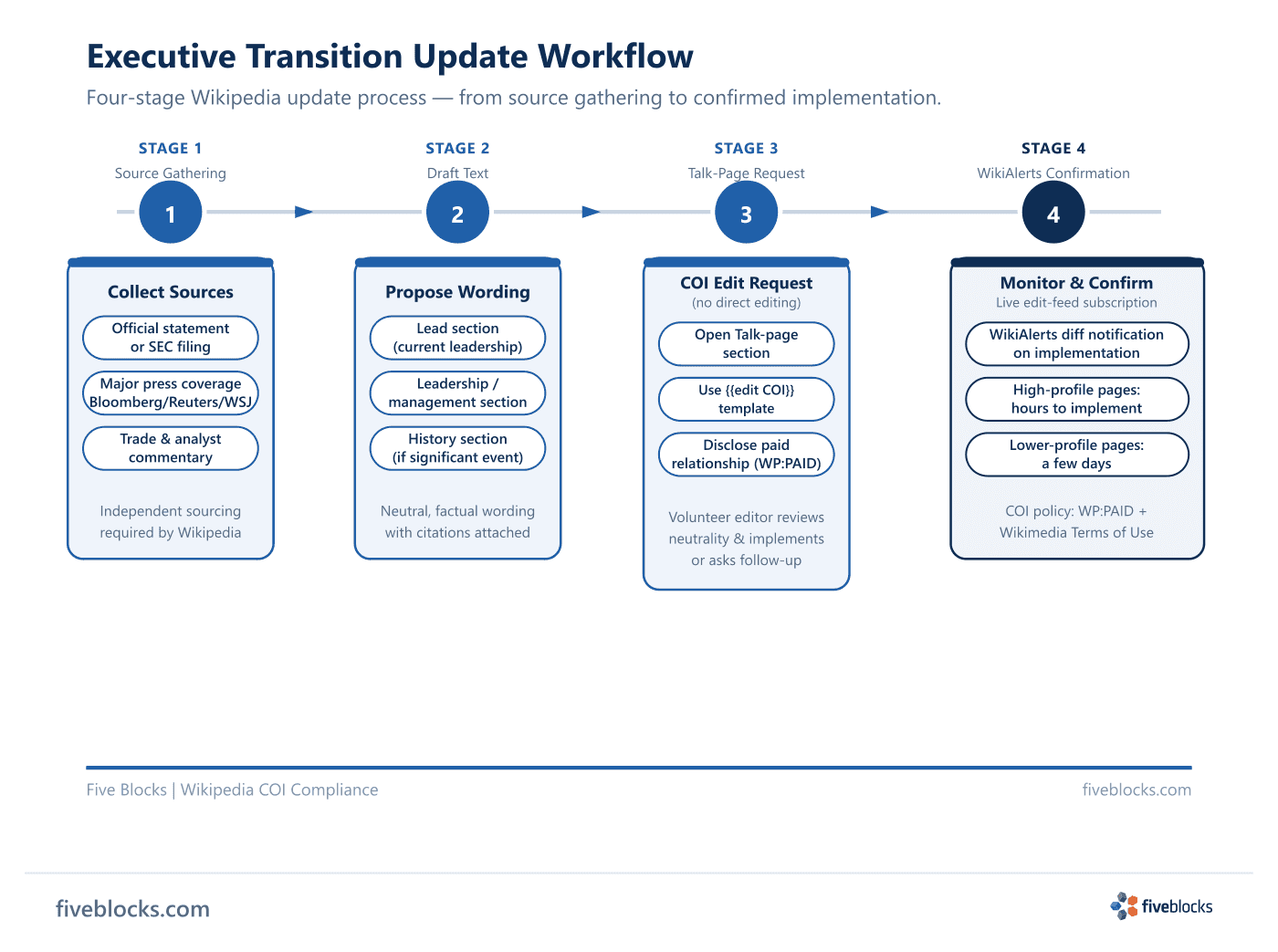
Stage 1: Source gathering
- Official statement. The company press release or SEC filing establishes that the change happened.
- Major press coverage. Bloomberg, Reuters, WSJ, and FT provide the independent sourcing Wikipedia editors require.
- Trade and analyst coverage. Sector outlets and equity-analyst notes add context that supports the edit request.
Stage 2: Draft proposed text
Identify the sections to update, usually the article lead (which names current leadership), the leadership or management section, and the history section if the transition itself is a significant event. Draft the exact new wording with all citations attached. The proposed text should be neutral, factual, and limited to what the independent sources actually say.
Stage 3: Talk-page edit request with COI disclosure
Under Wikipedia policy, parties with a conflict of interest, including the company, its PR firm, and anyone paid to represent the subject, are strongly discouraged from editing the article directly. The compliant path is to open a Talk-page section, use the {{edit COI}} template, and propose the change with the sourcing attached. The request must disclose the paid relationship (employer, client, and affiliation), as the Wikimedia Foundation’s Terms of Use and WP:PAID policy require. An uninvolved community editor then reviews the sources, checks neutrality, and either implements the change or asks follow-up questions.
Stage 4: WikiAlerts confirmation
We monitor the article through WikiAlerts, which subscribes to Wikipedia’s live edit feed and sends a diff notification the moment an editor implements the change. On high-profile pages, where Fortune 500 companies and prominent executives are watched by dozens or hundreds of volunteer editors, the update usually lands within hours. Lower-profile pages can take a few days.
Handling sensitive or acrimonious transitions
When a leadership change involves controversy, a forced departure, a public dispute, regulatory action, or an ongoing lawsuit, the same four-stage workflow applies, but with extra care:
- Neutral, sourced text only. Propose only what independent secondary sources (mainstream press, regulatory filings) say, with no framing that reads as promotional or defensive. Community editors scrutinize edits on contentious topics more closely.
- Expect more questions. An editor reviewing the request may ask for more sources, raise a neutrality concern, or take the matter to the NPOV noticeboard (WP:NPOVN) or the conflict-of-interest noticeboard (WP:COIN) before implementing.
- Separate facts from context. The factual change (new name and title in the leadership section) is usually quick to implement. Narrative about the circumstances of the departure may be contested and should be proposed separately, sourced to multiple independent outlets, and held to WP:UNDUE standards.
- Do not try to suppress negative coverage. If independent reliable sources have covered the circumstances of the transition, those sources may already be, or become, part of the article. Attempts to remove properly sourced negative content through the COI process rarely succeed and risk flagging the account at WP:COIN.
Last reviewed: 19/05/2026
