What is the process for rebuilding a damaged online reputation?
Rebuilding a damaged online reputation follows six phases: Stabilize (stop ongoing amplification), Diagnose (map the full digital picture), Build (authoritative owned and earned content), Correct (source-level fixes to Wikipedia, AI engine inputs, and structured data), Monitor (continuous tracking of search and AI narratives), and Adapt (monthly course-correction on data). Skipping phases is what produces fragile results that decay.
A serious online reputation recovery program runs through six phases, and the order counts. Programs that try to skip ahead, publishing content before stopping the bleed, or correcting sources before the diagnostic is done, tend to produce superficial results that do not hold.
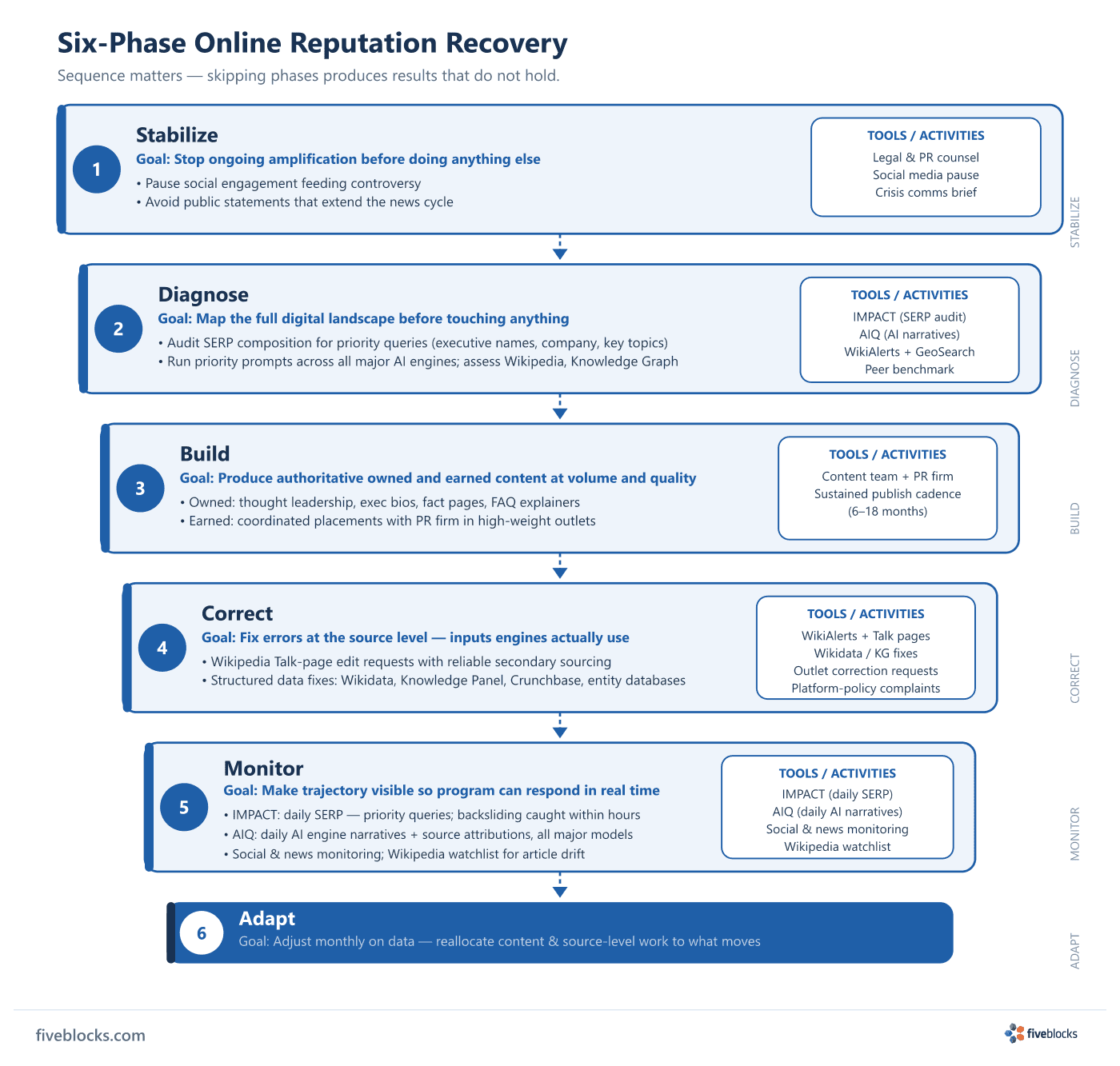
Phase 1: Stabilize
Goal: Stop ongoing amplification before doing anything else.
- Pause social media engagement that is feeding the controversy
- Avoid ill-considered public statements or platform conflicts that extend the news cycle
- Coordinate with legal and PR counsel on what can and cannot be said
Approximate duration: days to two weeks, depending on how active the controversy is when the program starts.
Phase 2: Diagnose
Goal: Map the current situation before touching anything.
- Audit the SERP composition for priority queries (executive names, company name, main topics)
- Run the priority prompts across all major AI engines to capture their current narratives and source attributions
- Assess Wikipedia article state, Knowledge Graph signals, and structured data
- Benchmark against named peers to calibrate what “good” looks like in the category
Approximate duration: one to three weeks for a full diagnostic, with refinement throughout the program.
Phase 3: Build
Goal: Produce authoritative owned and earned content at enough volume and quality to rank on the merits.
- Owned content: thought leadership, executive bios, fact pages, FAQ explainers on issues that were resolved
- Earned content: coordinated placements with the client’s PR firm in outlets the search and AI engines weight highly
- A steady publishing schedule rather than a concentrated burst; engines absorb consistent quality at higher rates than volume spikes
Approximate duration: begins in the first month and runs throughout the active intervention, typically six to eighteen months overall.
Phase 4: Correct
Goal: Fix errors at the source level, the inputs the engines are actually using to form their answers.
- Wikipedia Talk-page edit requests with reliable secondary sourcing to add post-crisis developments and rebalance undue weight
- Structured data fixes across Wikidata, Knowledge Panel, and entity databases (Crunchbase, industry sources)
- Formal correction requests to outlets with factual errors where editorial policy permits
- Platform-policy complaints where content violates stated terms
Approximate duration: source-level work is iterative; initial interventions are filed in the first one to three months, with follow-up through the active program.
Phase 5: Monitor
Goal: Make the trajectory visible so the program can respond to what is actually happening.
- IMPACT tracking of daily SERP composition for priority queries, with backsliding detected within hours
- AIQ tracking of AI engine narratives and source attributions across all major models on a daily basis
- Social and news monitoring for new coverage that could amplify the original event
- Wikipedia watchlist for article drift back toward contested framing
Approximate duration: runs continuously from program start and continues indefinitely into the maintenance phase.
Phase 6: Adapt
Goal: Adjust the program monthly based on what the data shows is working.
- Monthly review of IMPACT and AIQ trajectories against the roadmap milestones
- Reallocation of content and source-level work toward interventions showing the most movement
- Peer benchmark updates to track relative position against named competitors
- Roadmap revision as the situation changes: new coverage, platform changes, or business events
Approximate duration: a standing monthly cadence throughout the program and into maintenance.
The six phases build on each other. Stabilize protects the diagnostic from a moving target. Diagnose makes Build and Correct precise rather than generic. Monitor makes Adapt possible. Programs that run the full sequence consistently outperform those that jump to content production without the upstream work.
Last reviewed: 19/05/2026
