How long does reputation recovery typically take?
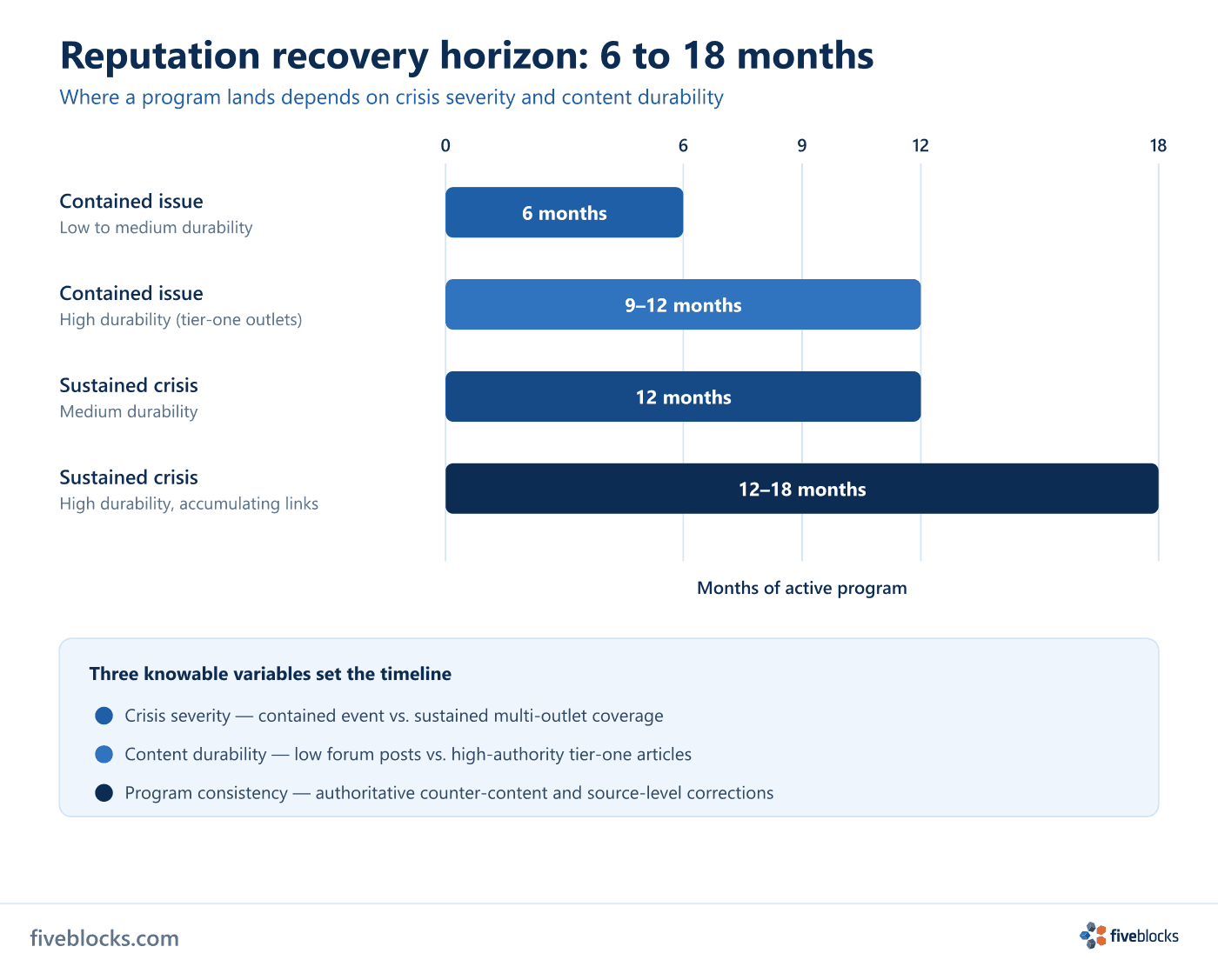
Reputation recovery usually takes six to eighteen months to produce material movement in search and AI results. Three things set the timeline: how severe and sustained the crisis was, how durable the negative content is (a tier-one news article versus a forum post), and how consistently authoritative counter-content and source-level corrections get produced and maintained.
Reputation recovery usually takes six to eighteen months to produce material movement across search and AI results, followed by an indefinite maintenance phase. Three factors set where a program lands in that range, and all three can be assessed at the start.
Factor 1: Crisis severity and duration
- Contained issue
- A discrete event that was addressed, generated limited coverage, and did not build over time. Programs for contained issues usually show measurable SERP movement within six months when counter-content is produced consistently.
- Sustained crisis
- A multi-outlet, ongoing story with credentialed publishers (major newspapers, broadcast networks, wire services) that accumulated coverage over weeks or months. Those outlets carry high domain authority, so Google weights their coverage heavily and it is harder to displace. Timelines for sustained crises more often land in the twelve-to-eighteen-month range.
Factor 2: Content durability
Negative content does not all age the same way. Google’s ranking algorithm weights domain authority, inbound links, and age alongside freshness signals, so an old article in a high-authority outlet can hold page-one placement for years. The practical tiers:
- High durability: articles in top-tier outlets (major national newspapers, wire services). These accumulate link authority over time and get cited by AI engines when they assemble answers on current topics. Outranking them takes sustained, high-authority counter-content produced over many months.
- Medium durability: trade or vertical press, regional outlets, mid-authority blogs. The authority is real but narrower, and a well-executed content program can surround and outrank this content in a shorter window.
- Low durability: forum posts, social-platform threads, low-authority aggregators. These lose freshness signals as they age and are usually the fastest to displace with authoritative owned and earned content.
Factor 3: Program consistency
The rate at which authoritative counter-content gets produced and ranked is the main variable a program controls. Three activities build results over time:
- Authoritative content production: owned and earned content that ranks on merit in outlets that search and AI engines weight by authority. Each piece that secures a page-one position adds to the content layer protecting the brand.
- Source-level corrections: Wikipedia edit requests filed under disclosed conflict-of-interest rules, structured-data fixes, Knowledge Graph corrections, and formal correction requests to outlets with factual errors. These fix the sources AI engines actually draw on. Improvements to Wikipedia can produce visible AI-engine changes within weeks for retrieval-heavy models and over months for others.
- Entity signal consistency: keeping the name, description, and main attributes consistent across Wikidata, schema markup, the Google Knowledge Graph, and authoritative directories. When entity signals align, search and AI systems trust the authoritative narrative more; when they conflict, the systems hedge or surface the negative framing.
How the factors combine
| Severity | Content durability | Typical active-program horizon |
|---|---|---|
| Contained | Low to medium | 6 months |
| Contained | High (tier-one outlets) | 9 to 12 months |
| Sustained crisis | Medium | 12 months |
| Sustained crisis | High (tier-one outlets, accumulating links) | 12 to 18 months |
All scenarios assume consistent execution. Programs that stall on content production or skip source-level work run longer. Five Blocks tracks the trajectory monthly through IMPACT so clients see progress data rather than estimates.
Last reviewed: 19/05/2026
