How do you measure progress during reputation recovery?
Progress during reputation recovery is measured across six tracks: search rank trends for priority terms (tracked daily through IMPACT), AI sentiment and source shifts across the eight engines AIQ currently tracks (monitored daily through AIQ), source-quality metrics on added versus displaced content, Wikipedia article stability, share of voice against named peers, and qualitative stakeholder feedback. Together these tracks make recovery something you can measure instead of assert.
Recovery measurement runs on data, not intuition. Six tracks run in parallel, and together they show whether the program is producing durable change or only surface movement.
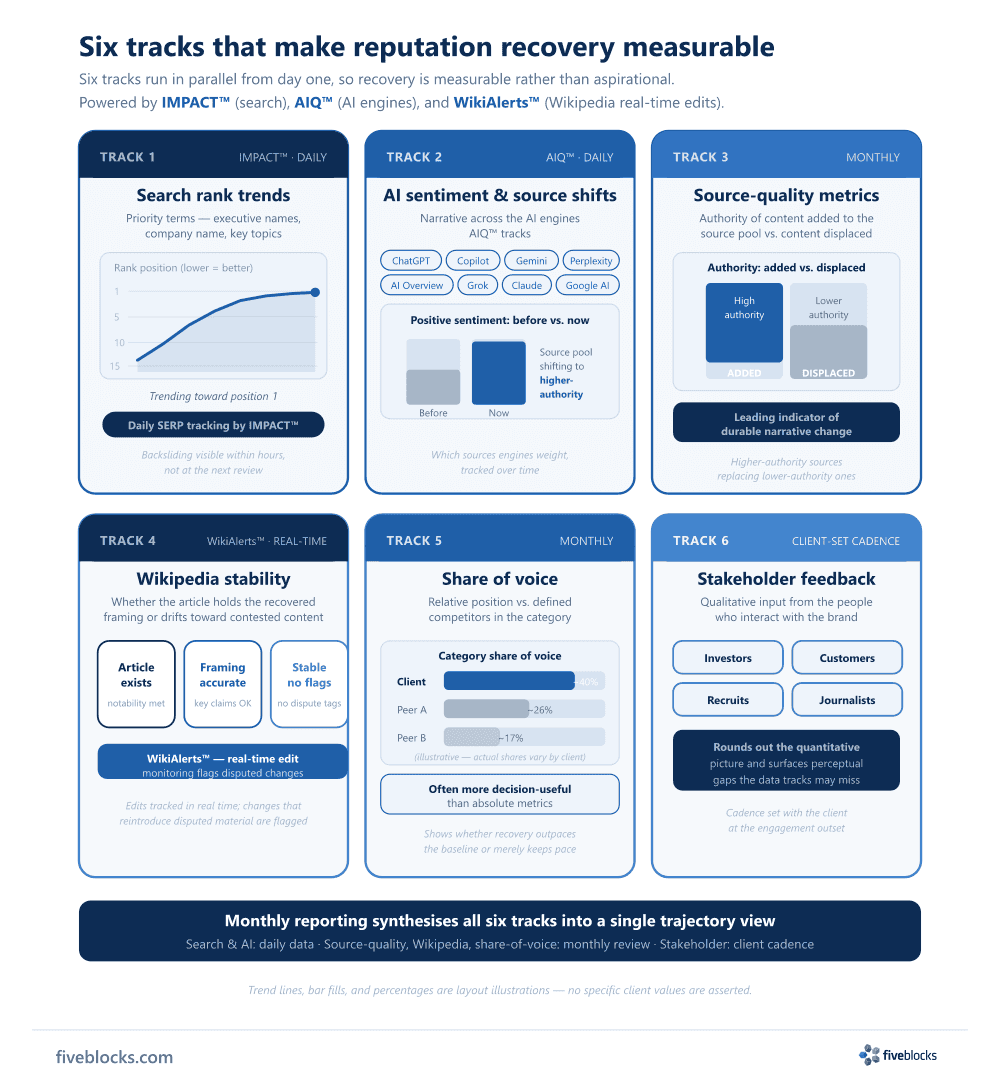
The six measurement tracks
- Search rank trends
- Priority terms, executive names, company name, and main topics, tracked daily through IMPACT™. A daily cadence means any backsliding shows up within hours, not at the next monthly review.
- AI sentiment and source shifts
- The narrative across the eight AI engines AIQ currently tracks: ChatGPT, Copilot, Gemini, AI Overview, Perplexity, Grok, Claude, and Google AI Mode, monitored through AIQ. This shows whether the AI narrative is moving and which sources the engines are weighting more or less heavily over time.
- Source-quality metrics
- The authority signals of content added to the engines’ source pool, measured against the content it displaces. When higher-authority sources replace lower-authority ones, durable narrative change usually follows.
- Wikipedia article stability
- Whether the article holds the recovered framing or is being edited back toward contested content. Monitored via WikiAlerts™, which tracks edits in real time and flags changes that reintroduce disputed material.
- Share of voice against named peers
- Position in the category relative to defined competitors. This is often more useful for decisions than absolute numbers, because it shows whether the recovery is outpacing the competitive baseline or just keeping pace.
- Stakeholder feedback
- Qualitative input from investors, customers, recruits, and journalists who deal with the brand. It fills in the perceptual gaps the data tracks miss.
How the tracks are reviewed
Search and AI tracks run daily; source-quality, Wikipedia, and share-of-voice are reviewed monthly; stakeholder feedback is gathered on a cadence set with the client. Monthly reporting pulls all six tracks into one trajectory view, so the client sees the progression instead of guessing at it.
Last reviewed: 19/05/2026
