What is a reputation recovery roadmap?
A reputation recovery roadmap is a written plan specifying target SERP composition, AI narrative goals across leading AI engines, owned and earned content production schedule, source-level interventions (Wikipedia, structured data, correction requests), peer benchmarks, and program milestones over a six-to-eighteen-month horizon. It is reviewed monthly against live search and AI monitoring data and updated as the trajectory develops.
A reputation recovery roadmap is the document that turns crisis aftermath into a managed program. It states, in measurable terms, what search and AI results should look like at months six and twelve, maps the work required to get there, and sets the review cadence that keeps the program on course.
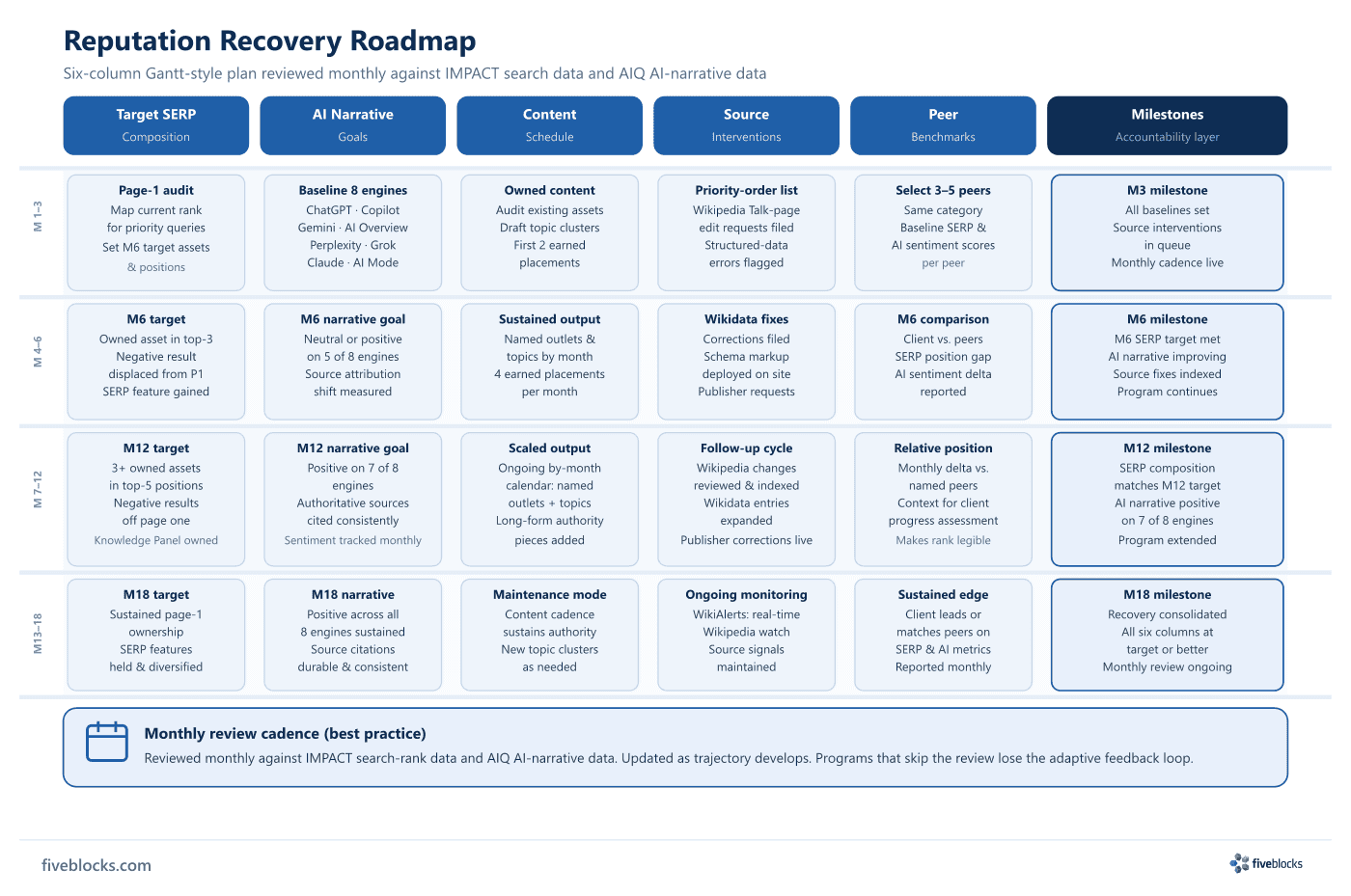
- Target SERP composition
- States what page one for the priority queries should look like at month six and month twelve: which assets should rank, in which positions, and which SERP features should be present. This target guides content and link-development decisions throughout the program.
- AI narrative goals
- States how the AI engines should describe the company or person on the priority prompts, with measurable shifts defined for source attribution and sentiment. Five Blocks tracks AI narrative across the eight engines it currently monitors: ChatGPT, Copilot, Gemini, AI Overview, Perplexity, Grok, Claude, and Google AI Mode, so goals can be set and measured engine by engine.
- Content production schedule
- Maps owned and earned content by month, with named outlets and topics. Sustained, authoritative content production is the main lever for moving both the SERP and the AI narrative, and the schedule makes that production trackable against a timeline.
- Source-level interventions
- Lists the Wikipedia Talk-page edit requests, structured-data fixes, Wikidata corrections, and factual correction requests to publishers, in priority order. These are the inputs the engines actually cite, so fixing them at the source produces change that content volume alone does not.
- Peer benchmarks
- Sets comparative targets against named peers in the same category. Absolute rank or sentiment numbers are hard to read without a reference point; peer benchmarks show the relative position and give the client context for assessing progress.
- Milestones
- Tie activities to outcomes that the client and the firm jointly own. They define what success looks like at each stage, so the monthly review has a concrete basis for judgment rather than a general impression of whether things are better.
Best practice, monthly review cadence: Treat the roadmap as a working document. Every month, review it against IMPACT search-rank data and AIQ AI-narrative data, and update it as the trajectory develops. Programs that skip the monthly review lose the feedback loop that lets them adapt; programs that keep it can correct course early.
Last reviewed: 19/05/2026
