What KPIs should you track for online reputation?
Eight KPIs anchor a practical online reputation program: branded SERP rank and share of voice for priority queries, Knowledge Panel status, AI engine sentiment and source quality across leading AI engines, Wikipedia stability, peer benchmarks, and qualitative stakeholder signals. Each is tracked monthly at minimum. Sharp negative movement on any single KPI, a hostile result entering the top five, a Knowledge Panel error, a sustained drop in AI sentiment, is the threshold for immediate intervention rather than waiting for the next reporting cycle.
A practical reputation KPI set tracks the layers stakeholders actually interact with, search results, AI answers, Wikipedia, and peer comparison, rather than vanity metrics such as raw impressions or social follower counts. The eight KPIs below are the standard measurement stack. Each entry notes what it tracks, who owns it, and the cadence and movement threshold that warrants action.
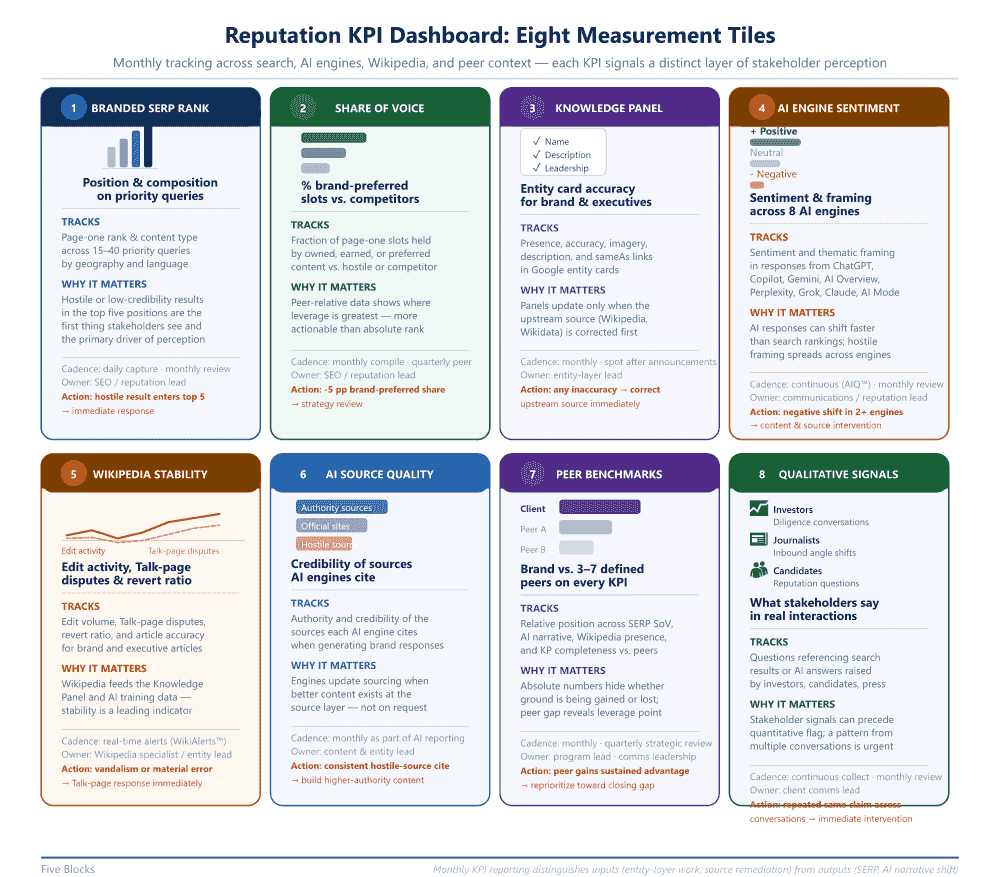
- Branded SERP rank for priority queries
- What it tracks: The position and makeup of page-one results for the 15 to 40 queries that drive stakeholder perception, usually the brand name, named executives, and main product or issue terms, tracked across relevant geographies and languages.
Owner: SEO/reputation lead, reviewed by communications leadership.
Cadence: Daily data capture (IMPACT™ tracks at daily resolution across 69 countries, 23 languages, and 500 locations); reviewed in monthly reporting.
Threshold for action: A hostile or low-credibility result entering the top five positions, or a real loss of owned/earned real estate (for example, an aggregator displacing a brand property), triggers an immediate response rather than a wait for the monthly cycle. - Share of voice on priority queries
- What it tracks: The percentage of page-one slots for priority queries held by brand-preferred content (owned properties, preferred earned coverage, authorized profiles) versus competitor or hostile content, benchmarked against the named peer set.
Owner: SEO/reputation lead.
Cadence: Compiled monthly from daily SERP data; peer-relative comparison reviewed quarterly for strategic adjustment.
Threshold for action: A sustained drop of five or more percentage points in brand-preferred share, or a peer overtaking the brand on a priority query, warrants a strategy review. - Knowledge Panel status
- What it tracks: Presence, accuracy, completeness, and entity card makeup for the brand and named executives, including whether the panel shows current information, correct imagery, accurate descriptions, and properly attributed sameAs links.
Owner: Entity-layer lead (often the same person managing Wikidata and Wikipedia).
Cadence: Checked monthly; spot-checked after any major company announcement (acquisition, executive change, product launch), since panels can update unpredictably within days of new sourcing.
Threshold for action: Any inaccuracy, a wrong title, an outdated founding date, an incorrect image, is corrected immediately through Google’s verified entity correction process and upstream source updates. - AI engine sentiment and source quality
- What it tracks: The sentiment (positive, neutral, negative) and thematic framing of responses across the eight AI engines AIQ™ currently monitors: ChatGPT, Copilot, Gemini, AI Overview, Perplexity, Grok, Claude, and Google AI Mode, plus which sources each engine cites when describing the brand.
Owner: Communications or reputation lead; source-attribution review shared with the content and entity team.
Cadence: Continuous polling via AIQ™; reviewed in monthly reporting with trend lines per engine. AI engine responses can shift faster than search rankings, so intra-month monitoring matters for brands in active news cycles.
Threshold for action: A consistent negative shift in sentiment across two or more engines, or engines picking up a hostile framing from a low-credibility source, calls for content and source-level intervention. A single engine outlier is noted and watched before acting. - Wikipedia stability
- What it tracks: Edit activity, Talk-page disputes, revert ratio, and accuracy of the current article content for the brand entity and named executives. Wikipedia feeds the Google Knowledge Panel and carries heavy weight in AI engine training data, so its stability is an early indicator of downstream accuracy across both layers.
Owner: Wikipedia specialist or entity lead; alerts routed via WikiAlerts™.
Cadence: Real-time edit alerts; reviewed in monthly reporting. High-profile company articles attract frequent edits and should be checked after any news event.
Threshold for action: Any vandalism or materially inaccurate edit warrants an immediate Talk-page response (through the disclosed conflict-of-interest process). A sustained Talk-page dispute or edit-war pattern escalates to a Wikipedia specialist. - AI source quality
- What it tracks: The credibility and authority of the sources AI engines cite when they answer questions about the brand, whether engines ground their answers in authoritative outlets, official sources, and accurate Wikipedia content, or in low-credibility, adversarial, or outdated material.
Owner: Content and entity lead, with communications oversight.
Cadence: Reviewed monthly as part of AI narrative reporting; source list compared across engines to spot patterns.
Threshold for action: If engines keep citing a low-credibility or hostile source, the fix is to build higher-authority content that outweighs it at the source layer, not to contact the AI provider, since engines update sourcing from what they retrieve, not from direct requests. - Peer benchmarks
- What it tracks: The brand’s position relative to 3 to 7 defined peers across every KPI above: SERP share of voice, AI narrative quality, Wikipedia presence, Knowledge Panel completeness. Peer-relative data is usually more actionable than absolute numbers because it shows where leverage is greatest.
Owner: Program lead; reviewed with senior communications leadership.
Cadence: Compiled monthly; strategic peer-benchmark review quarterly when adjusting program focus.
Threshold for action: A peer gaining a sustained edge on a priority layer, particularly in AI narrative quality or SERP share of voice, warrants shifting work toward closing that gap rather than holding existing investments. - Qualitative stakeholder signals
- What it tracks: What the brand is actually hearing from investors, candidates, journalists, and partners in real interactions, questions that come out of digital research, references to specific search results or AI answers, and the overall tone of diligence conversations.
Owner: Client communications lead; collected from investor relations, recruiting, PR, and BD teams.
Cadence: Collected continuously as stakeholder interactions happen; reviewed monthly and summarized quarterly alongside the quantitative KPIs.
Threshold for action: A pattern of investors or candidates citing the same incorrect claim or hostile result across separate conversations is a high-priority signal that quantitative monitoring may not have flagged yet, and it drives immediate intervention regardless of where the KPIs stand.
Together the eight KPIs give a clearer picture than any single metric and form the standard basis for monthly reporting. Movement that never shows up in the metrics, source-level remediation, entity-layer engineering, Talk-page work, is usually what produces durable change, so reporting should separate inputs (work completed) from outputs (measurable movement) in every cycle.
Last reviewed: 19/05/2026
