How do you measure share of voice in search results?
Share of voice measures what proportion of a branded query's results your own and aligned content occupies, versus peers and other parties. It is tracked across priority keywords, geographies, and the AI engines, and used as a comparative baseline.
Share of voice measures how much of a branded result set the entity’s own and aligned content occupies, relative to competitors and other parties. It is one of the clearest comparative reputation metrics.
How it is apportioned
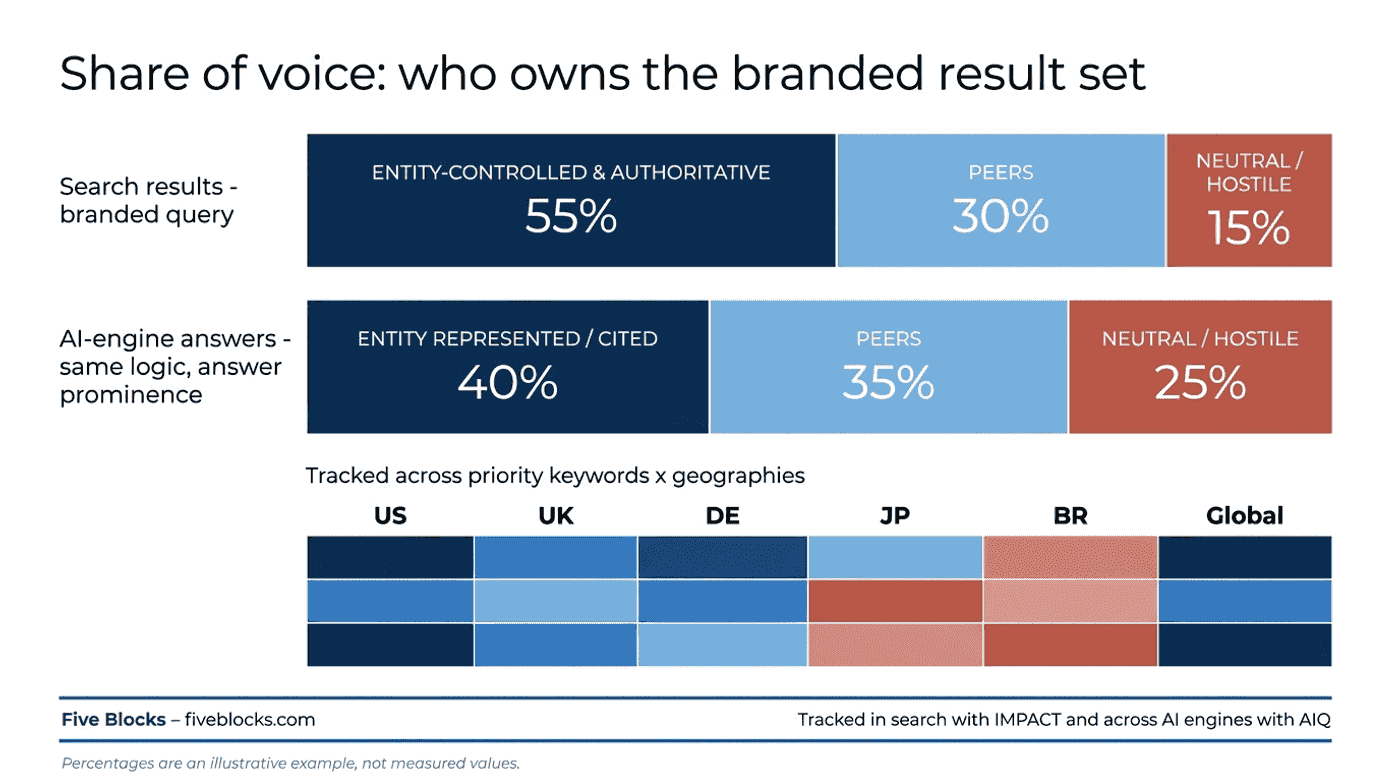
For a given branded query, the positions divide among three groups, and that proportion is the share of voice:
- Entity-controlled and authoritative content, owned properties and aligned, credible third-party coverage.
- Peers, competitors and adjacent parties occupying the same territory.
- Neutral or hostile sources, everything else, whether indifferent third parties or adversarial content.
Tracked across the priority keywords and the relevant geographies, this shows how thoroughly the entity dominates, or fails to dominate, its own branded territory.
Extending the logic to the AI engines
The same apportionment carries over to the AI engines. There, share of voice becomes how often and how prominently the entity appears in the answers about its space.
How the metric is used
Share of voice is comparative and directional: it benchmarks the entity against peers and shows whether the program is gaining or losing ground over time. We track it across search with IMPACT™ and across the AI engines with AIQ™, both as a baseline and as a measure of progress.
Last reviewed: 20/05/2026
