How do you measure the success of a reputation management campaign?
Reputation success is measured against baselines set at the start of the engagement across six KPI layers: branded SERP composition, Knowledge Panel accuracy, AI narrative quality across the eight engines AIQ™ monitors, peer share-of-voice, Wikipedia article stability, and qualitative stakeholder signals. Monthly reporting tracks each metric against the agreed goals so both inputs (entity-layer work, source remediation) and outputs (SERP movement, AI narrative shift) stay visible.
Reputation measurement starts with baselines captured at engagement launch, because the same SERP can read as a success or a failure depending on what the program set out to do. Here are the six standard KPI layers, what each measures, and what a healthy baseline or target looks like.
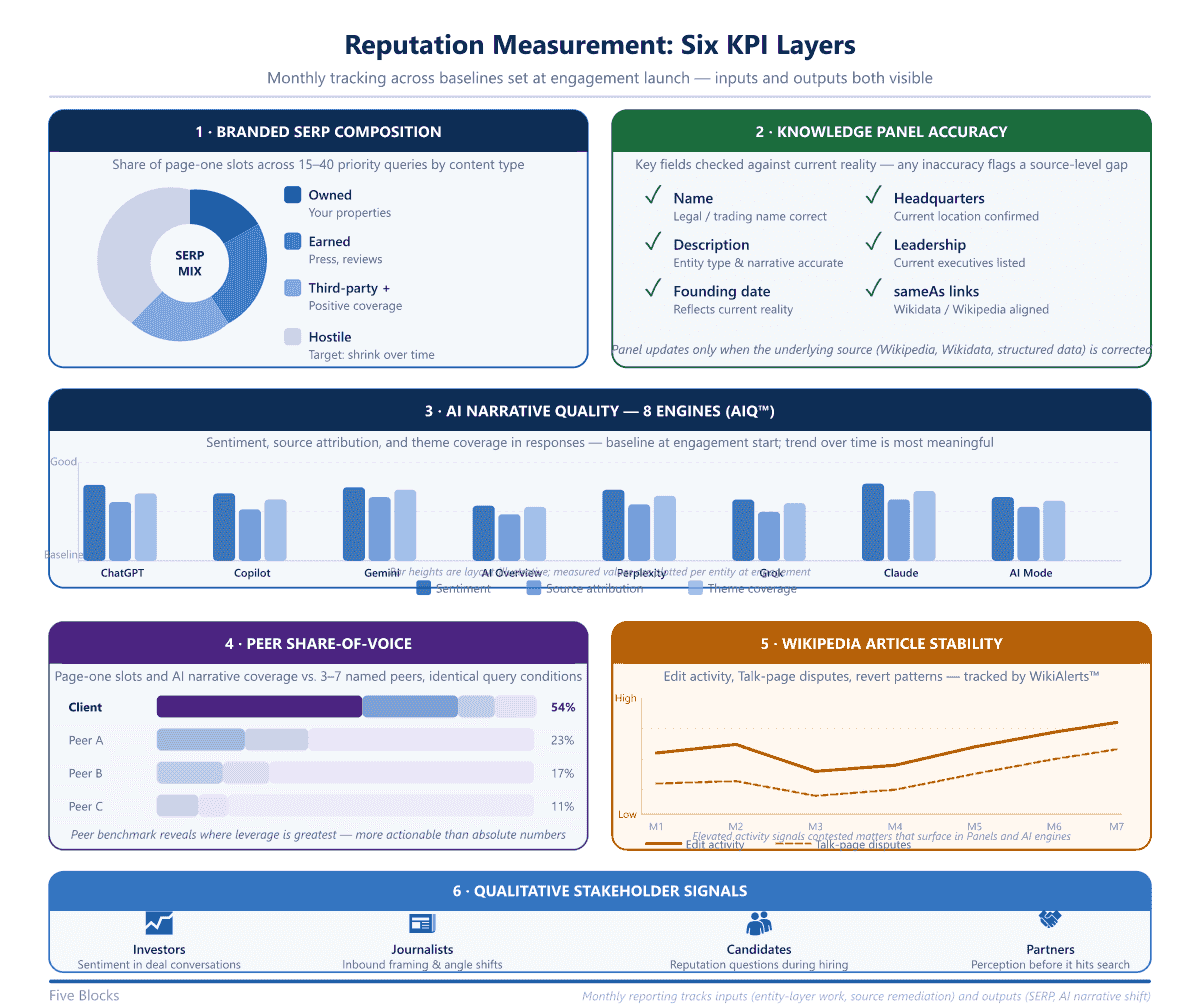
- Branded SERP composition
- The share of page-one slots across 15 to 40 priority queries held by owned, earned, third-party-positive, and hostile content. The baseline is set at engagement start by classifying every ranking URL. The target is usually to grow owned-plus-earned share and shrink hostile share over time. IMPACT™ tracks this at daily resolution across geographies and languages.
- Knowledge Panel accuracy and completeness
- Whether the panel exists, and whether its main fields (name, description, founding date, headquarters, leadership, sameAs links) match current reality. The target is a complete, accurate panel. Any inaccuracy points to a gap in the entity layer that needs source-level correction, because the panel updates only once the underlying source (Wikipedia, Wikidata, or structured data) is fixed.
- AI narrative quality
- Sentiment, source attribution, and theme coverage in responses from the eight AI engines AIQ™ monitors: ChatGPT, Copilot, Gemini, AI Overview, Perplexity, Grok, Claude, and Google AI Mode. The baseline is the narrative each engine returns at engagement start. The target is positive or neutral sentiment, attribution to authoritative sources, and accurate theme representation. The trend over time tells you more than any single snapshot.
- Peer share-of-voice
- The client’s percentage of page-one slots and AI narrative coverage relative to a named peer set of 3 to 7 comparable companies, tracked under identical query conditions. The peer benchmark is often more actionable than absolute numbers because it shows where leverage is greatest against the competition.
- Wikipedia article stability
- Edit activity, Talk-page dispute volume, accuracy of the current article content, and revert patterns. The target is a stable article with few contested edits and accurate infobox content. Elevated Talk-page activity or repeated reverts point to contested matters that can also surface in Knowledge Panels and AI engines, since both lean heavily on Wikipedia. WikiAlerts™ tracks edit notifications continuously.
- Qualitative stakeholder signals
- What investors, journalists, candidates, and partners say in real interactions with the client, gathered through structured check-ins during the engagement. These signals catch perception shifts before they show up in the quantitative layers and often surface emerging narratives ahead of search or AI responses.
Monthly reporting walks through each metric against the agreed baselines and goals. The work that does not show up directly in the metrics, source-level remediation, entity-layer engineering, Talk-page edits, is what produces durable change, so reporting covers both inputs and outputs.
Last reviewed: 19/05/2026
