How do you measure the ROI of AI reputation management?
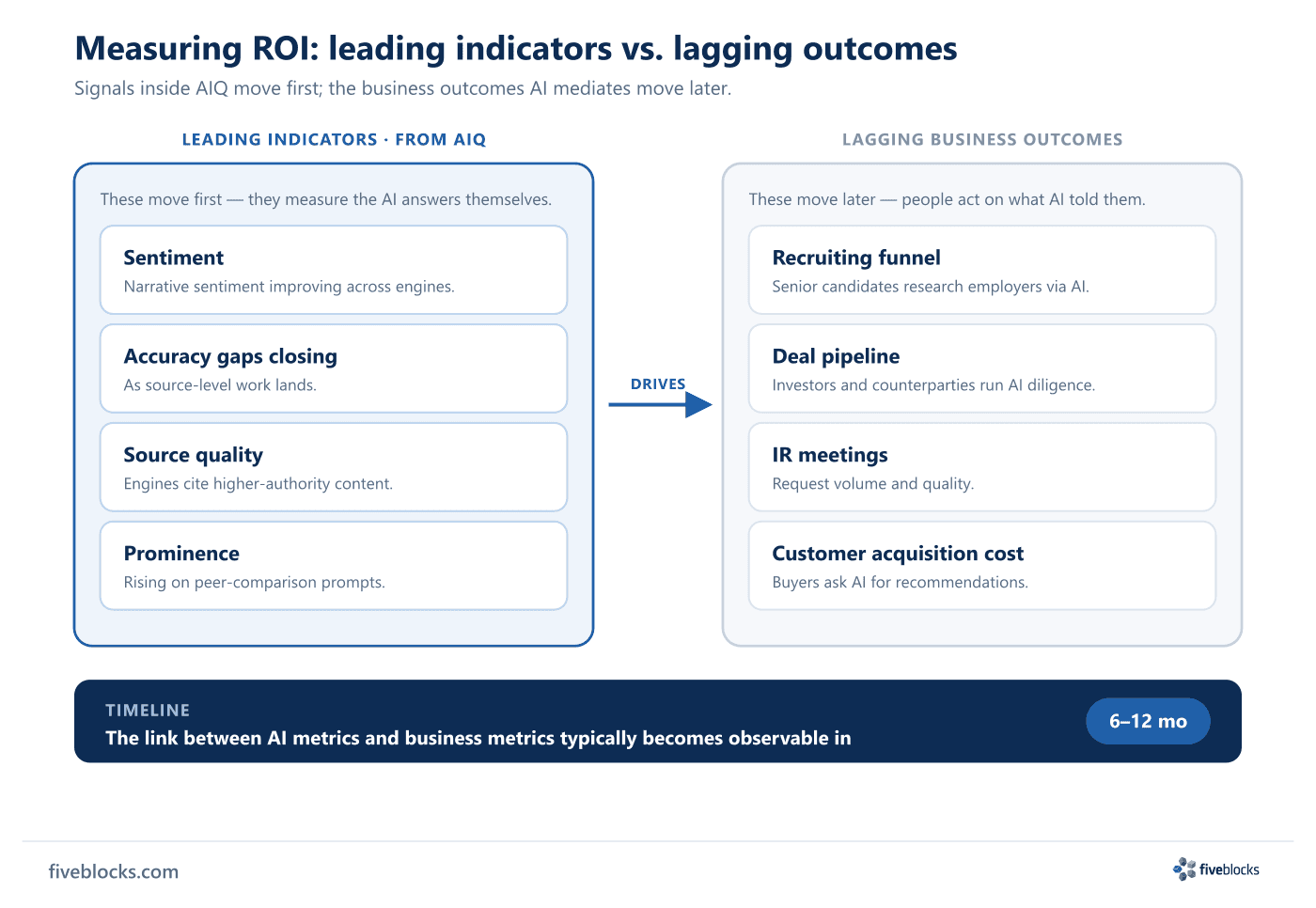
Measure it against the goals set at the start: leading indicators from AIQ (sentiment, accuracy, source quality, prominence) and lagging business outcomes that AI mediates (recruiting funnel, deal pipeline, IR meetings, customer acquisition cost), tracked together over six to twelve months.
ROI on AI reputation work, like ROI on any reputation program, is measured against the goals defined at the start of the engagement. It splits into two kinds of signal: leading indicators you can read directly inside AIQ, and lagging business outcomes that AI mediates.
Leading indicators (from AIQ)
These move first, because they measure the AI answers themselves:
- Sentiment improving across engines.
- Accuracy gaps closing as source-level work lands.
- Source quality improving as engines start citing higher-authority content.
- Prominence rising on category-level peer-comparison prompts.
Lagging indicators (business outcomes AI mediates)
These move later, because they depend on people acting on what AI told them:
- Recruiting funnel performance, especially for senior roles where candidates research employers via AI before applying.
- Deal pipeline conversion in markets where investors and counterparties do AI-based diligence.
- IR meeting requests and quality.
- Customer acquisition cost in categories where buyers ask AI for recommendations.
| Leading indicators (from AIQ) | Lagging business outcomes (AI-mediated) |
|---|---|
| Narrative sentiment across engines | Recruiting funnel (senior-role candidates research employers via AI) |
| Accuracy gaps closing | Deal pipeline (investors and counterparties run AI-based diligence) |
| Source quality (higher-authority citations) | IR meeting requests and quality |
| Prominence on peer-comparison prompts | Customer acquisition cost (buyers ask AI for recommendations) |
In well-monitored programs, the link between the AI metrics and the business metrics usually becomes observable over roughly six to twelve months. Past that point, much of the work is producing protection rather than visible improvement, which is harder to value but still real.
Last reviewed: 19/05/2026
