How do you calculate the ROI of reputation management?
You calculate the ROI of reputation management by tying reputation metrics to the business outcomes they plausibly move: pipeline velocity, recruiting quality, IR meeting tone, customer-acquisition cost, crisis durability, and stakeholder satisfaction. Track both layers together over time. Reputation is one input among many, so the honest case rests on correlation and lagged causation, not a clean formula.
ROI here means connecting reputation metrics to the business outcomes they influence, because reputation is rarely an end in itself. Track the reputation layer (search composition, AI narrative, entity strength) alongside the business signals reputation plausibly affects, then look for movement in the two that lines up over time.
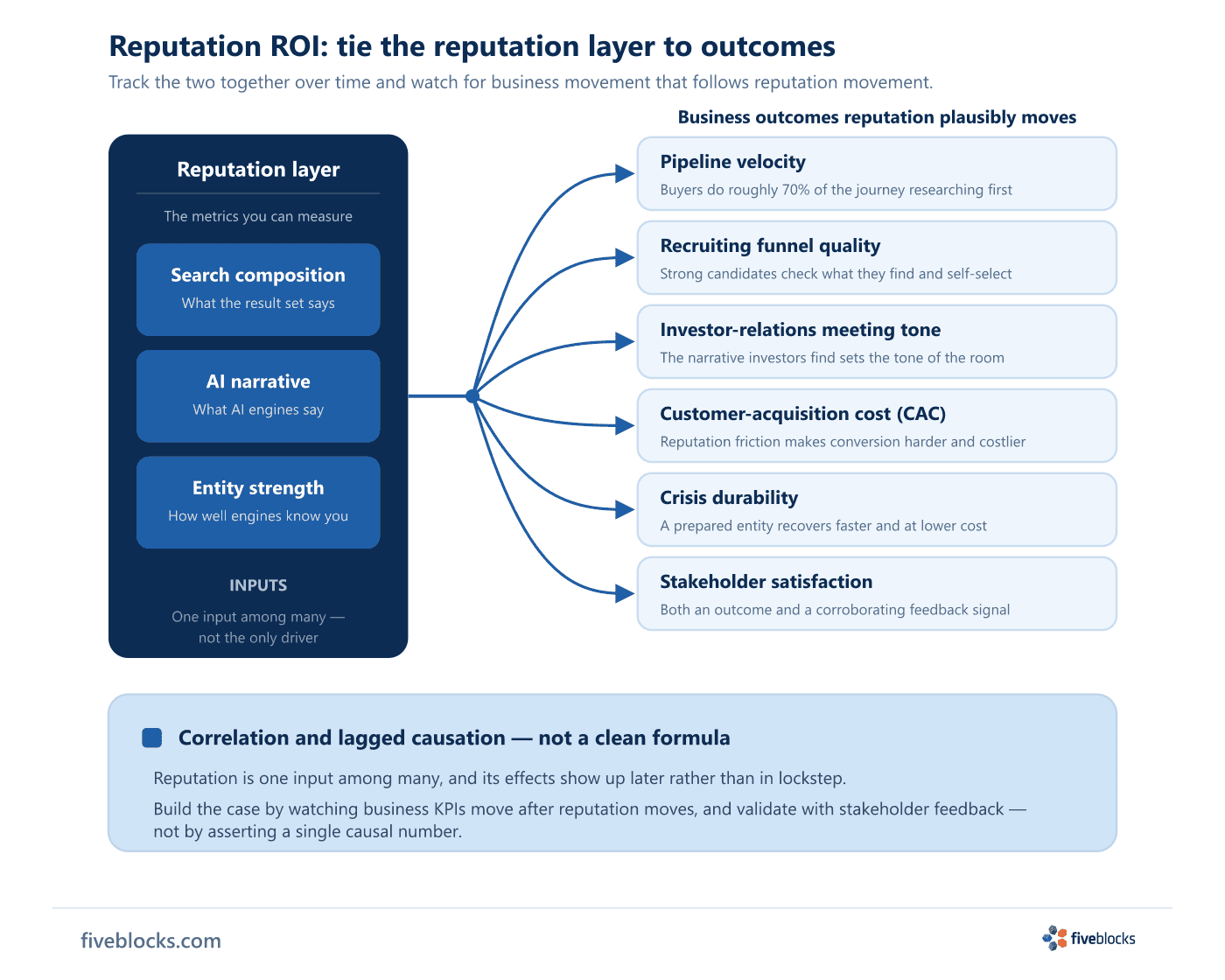
The business outcomes reputation moves
Pair each business outcome with the reason reputation influences it:
- Pipeline velocity
- Prospects research before they buy, so a weak or hostile result set slows deals down or kills them. In B2B, buyers now spend roughly 70% of the buying journey researching independently, and most have set their requirements, often including a preferred vendor, before they ever contact a seller. What they find shapes the deal before the first conversation.
- Recruiting funnel quality
- Strong candidates check what they find online, so reputation shapes who applies and who self-selects out.
- Investor-relations meeting tone
- Investors run the same diligence, and they increasingly prompt AI engines about prospective investments before formal diligence begins. The narrative they encounter sets the tone of the meeting.
- Customer-acquisition cost (CAC)
- Reputation moves the cost of converting a prospect. Friction in the result set makes conversion harder and more expensive.
- Crisis durability
- A prepared entity recovers faster and at lower cost, so how long a crisis runs and how deep it cuts is itself a reputation-linked outcome.
- Stakeholder satisfaction
- Broad satisfaction across audiences, validated through direct feedback, is both an outcome and a corroborating signal.
Why it is correlation, not a formula
This is correlation and lagged causation, not a clean equation. Reputation is one input among many, and its effects show up later rather than in lockstep. So build the case by tracking the reputation metrics and the business KPIs together, watching for business movement that follows reputation movement, and checking both against stakeholder feedback. Do not claim a single causal number. We help clients establish those baseline relationships so the program’s value is measured against outcomes rather than asserted.
Last reviewed: 20/05/2026
