How do you quantify the business impact of poor online reputation?
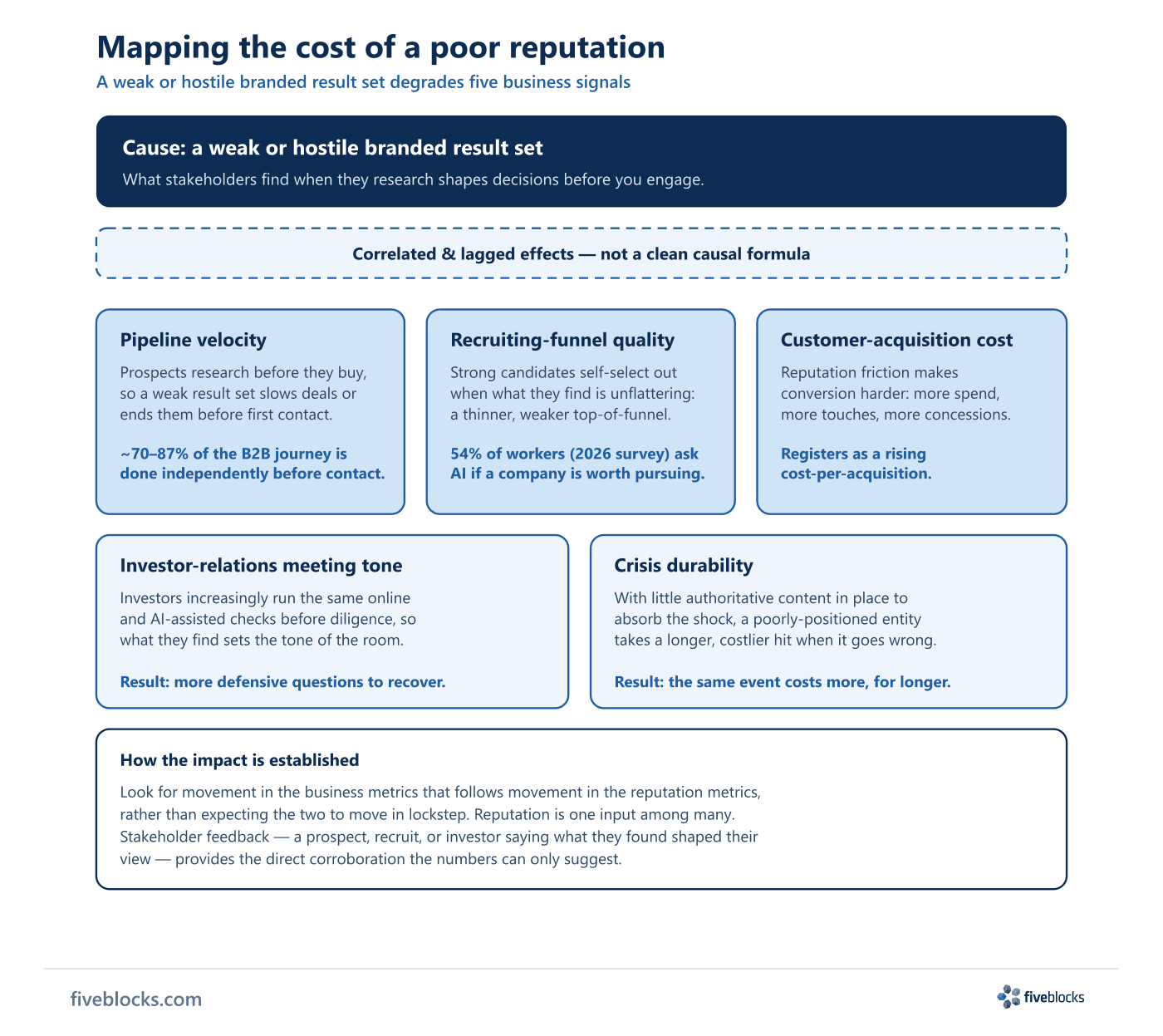
Quantify it by connecting the reputation problem to the business signals it plausibly degrades: pipeline velocity, recruiting-funnel quality, customer-acquisition cost, investor-relations meeting tone, and crisis durability. Then correlate movement in those signals with changes in the reputation metrics. Reputation is one input among many, so the case rests on correlation, lagged effects, and stakeholder feedback rather than a clean causal formula.
Quantifying the business impact of poor online reputation means connecting the problem to the business signals it plausibly degrades, because the cost rarely shows up as a single line item. Correlate movement in those signals with changes in the reputation metrics, and build the case from the relationships instead of claiming a clean causal formula.
- Pipeline velocity
- Prospects research before they buy, so a weak or hostile branded result set slows deals down or ends them before a conversation starts. The damage happens upstream of what the sales team can see. Most of a B2B buyer’s journey is completed independently before first contact, and research puts that at roughly 70% to 87% of the journey. What a buyer finds when they search shapes the deal well before a rep is involved, so a degraded result set shows up as longer cycles and lower close rates rather than as an obvious rejection.
- Recruiting-funnel quality
- Strong candidates self-select out when what they find is unflattering, and the check now happens in the AI layer as well as in search. In one 2026 survey of workers, 54% reported asking an AI model to judge whether a company is worth pursuing before applying. The cost surfaces as a thinner, weaker top-of-funnel rather than as declined offers, which is easy to miss unless recruiting quality is tracked against the reputation picture.
- Customer-acquisition cost
- Reputation friction makes conversion harder, so acquiring the same customer takes more spend, more touches, or more concessions. A hostile or thin result set raises the effort required at every step where a prospect pauses to verify. That effort registers as a rising cost-per-acquisition even when campaign inputs are unchanged.
- Investor-relations meeting tone
- Investors and allocators increasingly run the same online and AI-assisted checks before formal diligence, so what they find sets the tone of the room before the first meeting. A degraded picture means more defensive questions and more ground to recover. The company spends the meeting correcting impressions instead of building on them.
- Crisis durability
- An entity with a weak baseline takes a longer, costlier hit when something goes wrong, because there is little authoritative content in place to absorb the shock or compete with the negative coverage. This is where a pre-existing reputation weakness compounds: the same event costs more, and lasts longer, than it would for an entity that went into the crisis with authoritative content already in place.
How the impact is established
This is correlation and lagged causation, not a formula. Reputation is one input among many, so the analysis looks for movement in the business metrics that follows movement in the reputation metrics, rather than expecting the two to move in lockstep. Stakeholder feedback supplies the validation the data cannot. When a prospect, recruit, or investor says that what they found online shaped their view, that is direct corroboration of a link the numbers can only suggest. We help clients establish those baseline relationships so the cost of a reputation problem can be estimated rather than guessed.
Last reviewed: 20/05/2026
