How do you track the correlation between reputation metrics and business metrics?
Tracking works in three moves: establish baseline relationships between reputation metrics (search composition, AI narrative) and the business metrics they plausibly move, such as pipeline, recruiting quality, and NPS; monitor those trend lines side by side with a lag offset; and run structured retrospectives after major events. The result is credible correlation and lagged causation, not proof.
There is no clean causal formula linking reputation to revenue, so a program makes its case by tracking the two sets of metrics against each other over time. This is a repeatable method rather than a one-time calculation: set the baselines, watch the trend lines together with an allowance for lag, then pressure-test the relationship around specific events.
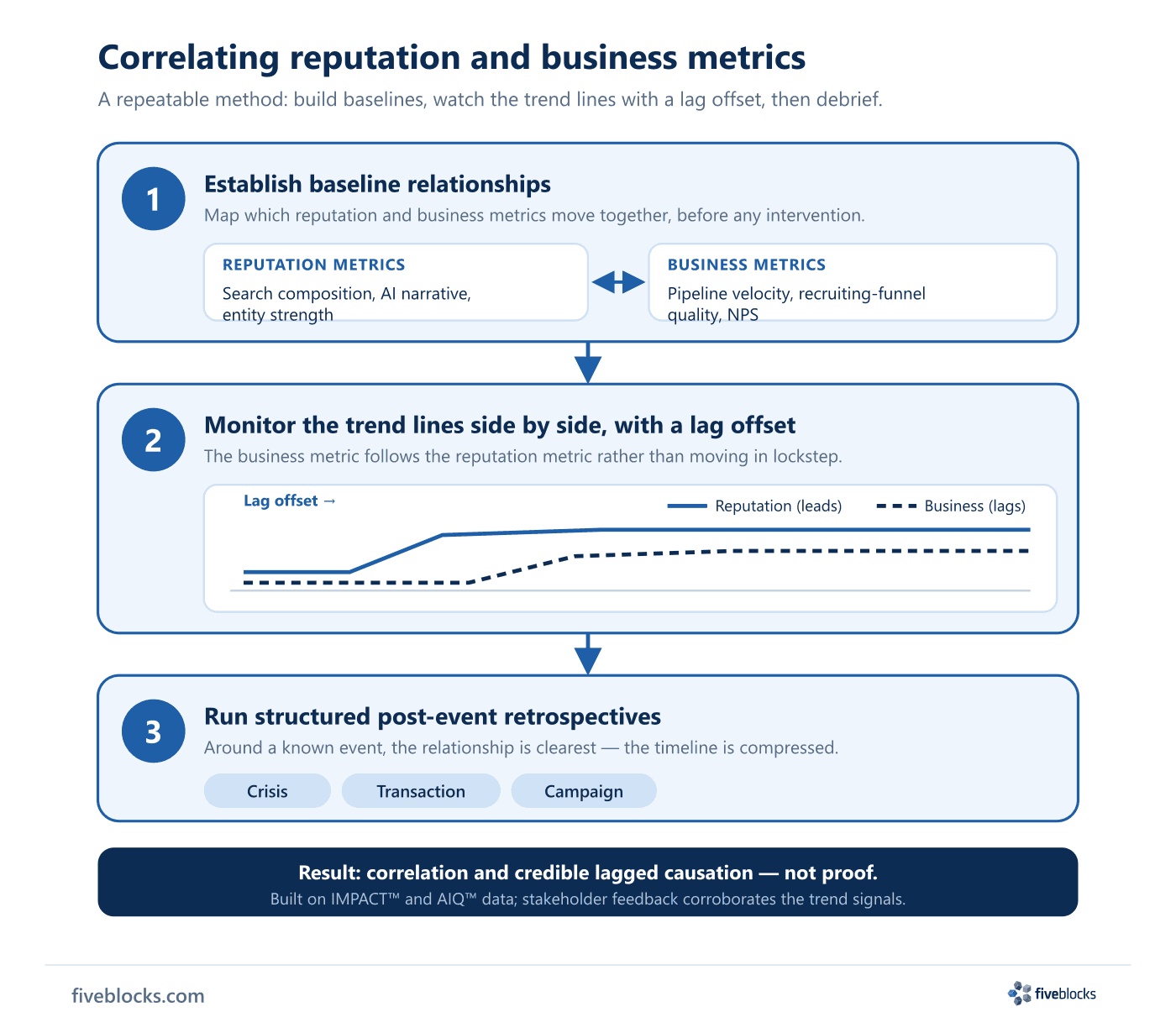
The tracking method, step by step
- Establish baseline relationships. Map the reputation metrics (search composition, AI narrative, entity strength) against the business metrics they plausibly influence: pipeline velocity, recruiting-funnel quality, NPS. Find which pairs move together before any intervention, so later movement has something to be measured against.
- Monitor the trend lines side by side, with a lag offset. Look for movement in the business metrics that follows movement in the reputation metrics. The two series will not move in lockstep. A shift in what people find online takes time to show up in a deal cycle or a hiring funnel, so the comparison builds in a deliberate time offset.
- Run structured post-event retrospectives. After a major event (a crisis, a transaction, a campaign), examine how the reputation and business signals moved together around that moment. Discrete events are usually where the relationship is clearest, because the timeline is compressed and the trigger is known.
Correlation, not proof
Reputation is one input among many. This method establishes correlation and credible lagged causation, and it should be presented as exactly that. Stakeholder feedback helps: when investors, recruits, or customers say that what they found online shaped their view, that corroborates what the trend data can only suggest. We help clients build these baseline relationships from IMPACT™ and AIQ™ data.
Related
This answer covers the mechanics. Nearby answers handle calculating ROI (kb-1051), quantifying the cost of poor reputation (kb-1061), and attributing outcomes to reputation work (kb-1063).
Last reviewed: 20/05/2026
