How do you manage search results during active litigation?
Coordinate every step with counsel and put nothing public without sign-off, then focus on durable, non-public work: entity-layer strengthening, accurate owned content on the broader record, source-level corrections through editorial channels, and Wikipedia Talk-page edit requests with disclosed conflict of interest.
Active litigation shrinks the room for public messaging and raises the stakes on durable infrastructure, so the governing rule is simple: nothing goes public without counsel’s sign-off. That gate covers even content that seems unrelated, because plaintiffs’ lawyers routinely cite reputation work back in court. What is easy to miss is how much substantive work still runs underneath the gate, the work that does not need any public statement at all.
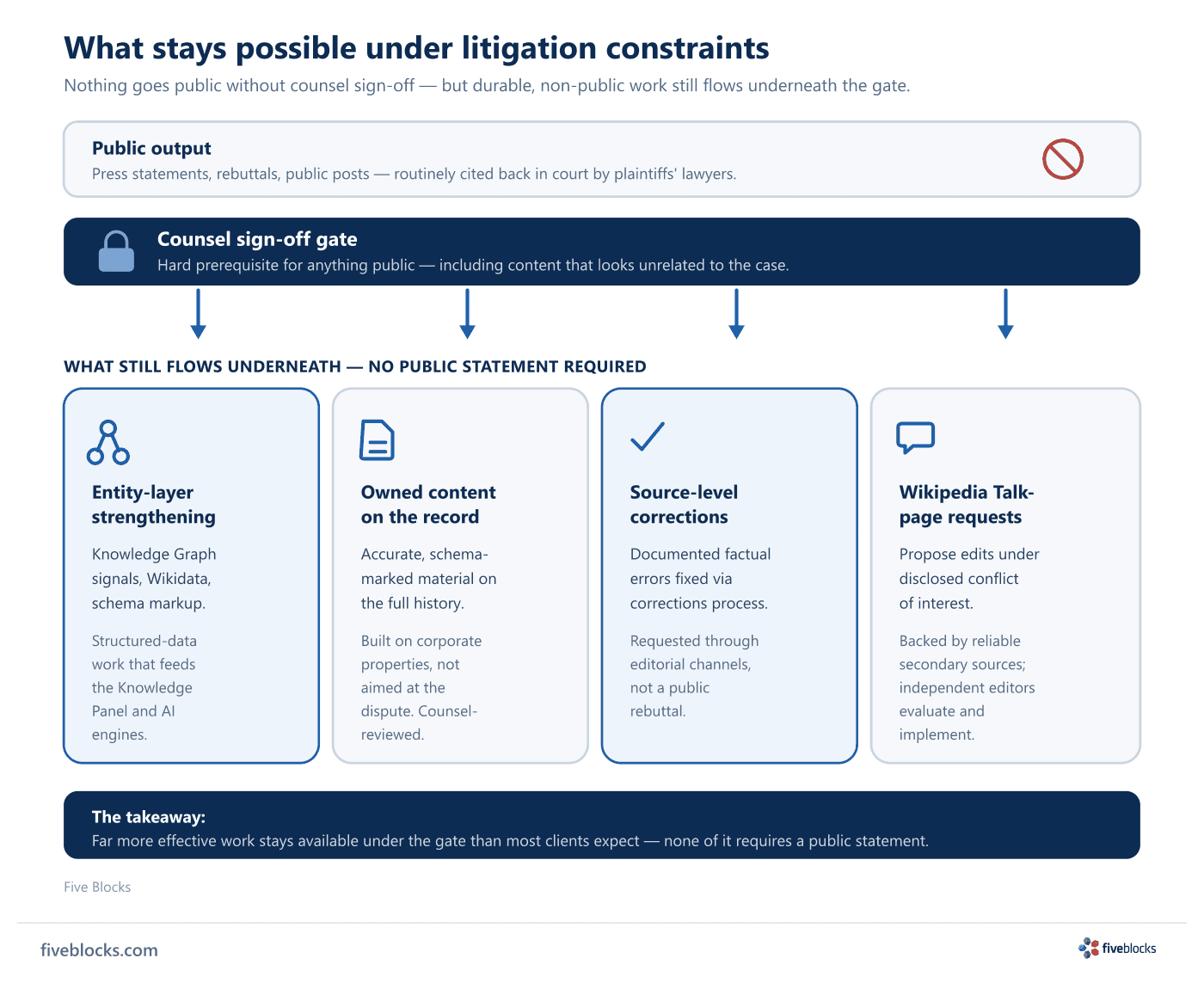
What stays effective under the counsel gate
Each of these workstreams shapes how search and AI engines describe the company without putting a new public statement on the record.
- Entity-layer strengthening. Knowledge Graph signals, the Wikidata entry, and schema markup are the linked references that identify a company to platforms and feed the Google Knowledge Panel and AI engines. Tightening them is structured-data work, not public messaging.
- Accurate owned content on the broader record. Schema-marked material about the company’s full history and operations gives engines durable context to draw on. Counsel reviews it like anything else, but it sits on the corporate properties rather than aiming at the dispute.
- Source-level corrections. Where reporting contains documented factual errors, most reputable outlets have published corrections processes and will fix errors that are properly sourced. That is a request through editorial channels, not a public rebuttal.
- Wikipedia Talk-page edit requests. The compliant path for an interested party is to propose changes on the article’s Talk page under disclosed conflict-of-interest rules, backed by reliable secondary sourcing, and let independent editors evaluate and implement them.
Last reviewed: 19/05/2026
