Can ORM help during an active SEC investigation or does it make things worse?
It can help, but only under counsel's direction. During an active SEC investigation the work narrows to durable factual infrastructure (accurate bios, clean entity signals, authoritative content that already exists) plus daily monitoring of search and the AI engines. The rebuilding program waits until the matter resolves, and nothing provocative goes out.
Reputation work during an active SEC investigation can help, but only under counsel’s direction, and its character changes. This is not the moment for assertive positioning or anything that reads as litigating in public; the priority is to avoid complicating the case. Within that constraint, the work runs on two tracks. A third, the full rebuilding program, waits until the matter resolves.
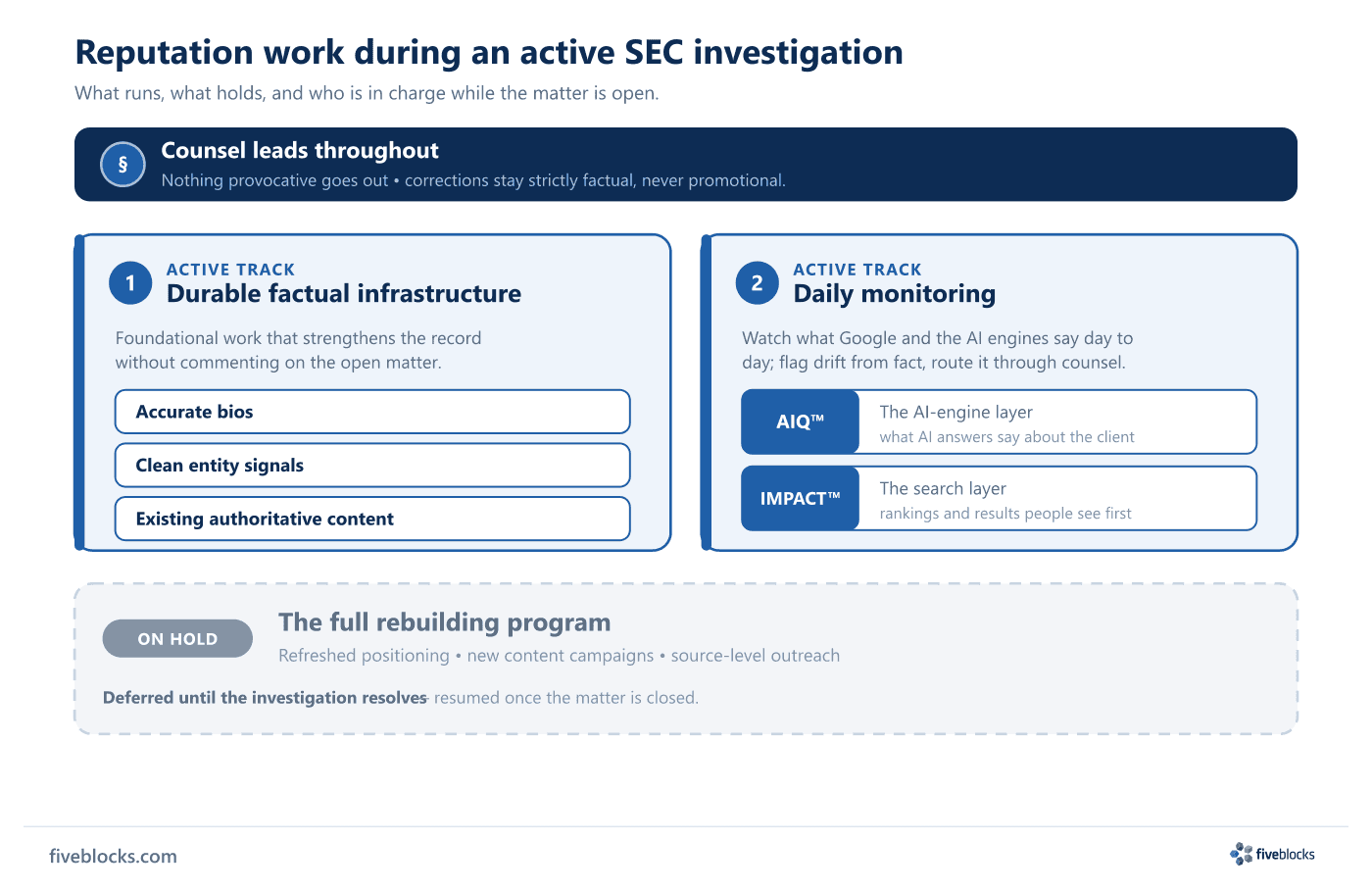
The two tracks that run during an investigation
- Durable factual infrastructure. Accurate bios, clean entity signals, and authoritative content that already exists and does not have to react to the investigation. It strengthens the record without commenting on the open matter.
- Daily monitoring. Watching what Google and the AI engines say day to day. Speculation and inaccuracy can spread while a case is open, and an early correction is usually easier and cheaper than a late one. We cover the AI-engine layer with AIQ and the search layer with IMPACT™, flag anything that crosses from fact into speculation, and route it through counsel.
What stays on hold
The rebuilding program waits until the investigation resolves: refreshed positioning, new content campaigns, source-level outreach. Counsel leads throughout, and corrections stay strictly factual rather than promotional.
Last reviewed: 20/05/2026
