What is the reputational impact of SEC or regulatory filings appearing in search?
SEC and regulatory filings are primary-source documents, so they rank durably in branded search and AI engines treat them as high-authority inputs when assembling a profile. They do not come down, so the work is contextualization, not removal: making sure an accurate account of what the filing says ranks in the same eyeline as the filing itself.
Regulatory filings are primary-source documents, so they rank durably in branded search and AI engines treat them as high-authority inputs when assembling a profile. They do not come down, and trying to suppress them is the wrong instinct. The real task is contextualization, not removal.
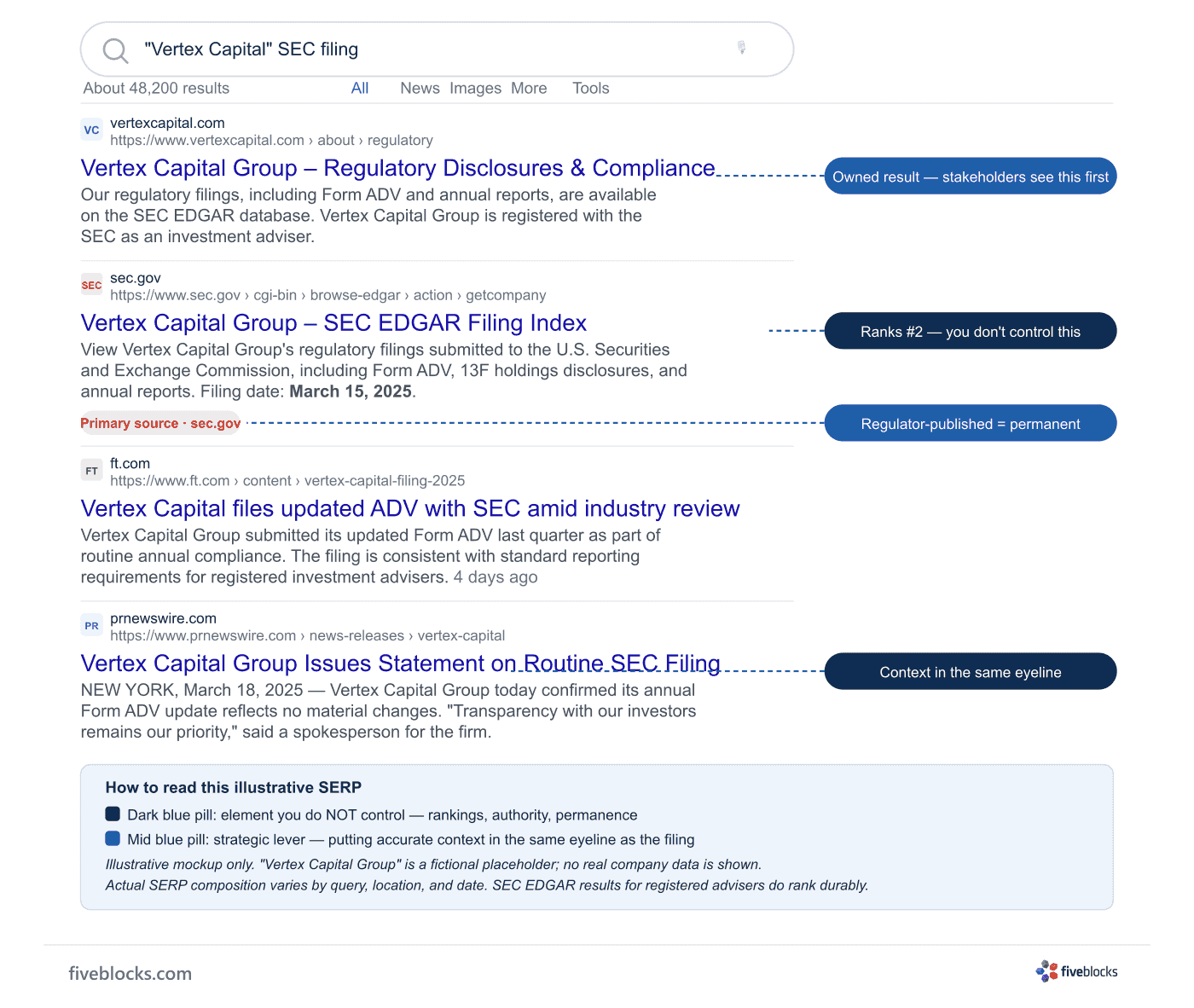
Why filings rank, and why removal is the wrong instinct
A filing carries the authority of the regulator that published it, so search engines and AI engines both weight it heavily and keep surfacing it. There is no realistic path to taking the document down, and pursuing one wastes the window in which the narrative around it is still forming. Treating a filing as something to hide also reads badly to anyone who finds it later anyway.
The contextualization approach
Instead of fighting the filing, put an accurate account of what it says into the same eyeline. That takes two layers of work:
- Source-layer content that frames the document, rather than leaving the raw filing to speak alone.
- Entity-layer content that keeps the firm’s own positioning clear in the inputs the engines rely on.
We track how filings appear across Google with IMPACT™ and how the AI engines summarize them with AIQ, then build the source- and entity-layer content against what those tools show. For a CCO, the measure of success is simple: a reader who finds the filing also finds the firm’s response.
Last reviewed: 20/05/2026
