How does Google handle court records and legal filings in search results?
Court record aggregators such as CourtListener and Justia index public filings and routinely rank on branded name searches, showing accurate but context-free information. The response that works combines three layers: publishing authoritative contextual content, pursuing source-level corrections or updates where aggregators allow them, and, for qualifying individuals in the EU/UK, submitting a Google RTBF delisting request. In the US, Google delisting paths are narrower but exist for specific policy categories.
Court record aggregators index public filings from PACER and state court systems and often appear on the first page of a branded name search. The content reproduces filed documents accurately, but without outcome, context, or the subject’s position, so even dismissed or settled matters look unresolved to a casual reader.
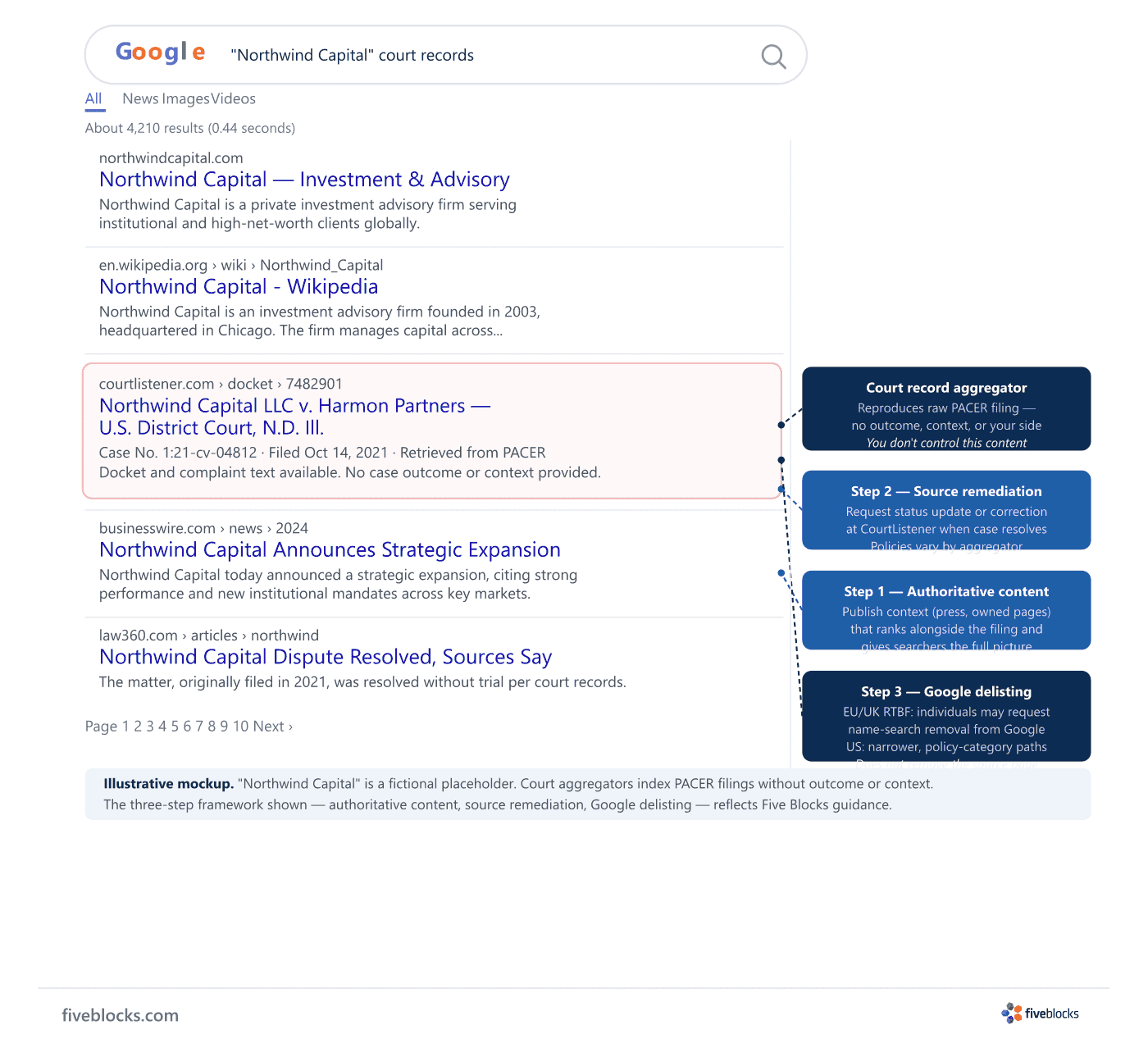
Step 1, Establish authoritative contextual content
The aggregator’s page reproduces the raw filing. It does not provide case outcome, context, or the named party’s position. Publishing content that supplies exactly that, on owned properties, in credible third-party placements, or through earned media, gives Google a competing signal that usually outranks or displaces the aggregator entry over time. This layer is the foundation because it works regardless of jurisdiction, aggregator policy, or case status.
Step 2, Pursue source-level remediation
Aggregator policies vary, but several common remediation paths exist:
- Correction requests, If the aggregator has reproduced a filing with a factual error (wrong party name, incorrect case number), most platforms accept documented correction requests.
- Status updates: When a case is dismissed, settled, or sealed, some aggregators will annotate or update the listing when presented with court-issued documentation. Aggregator policies on this differ significantly; treatment should be assessed site by site.
- Sealing and expungement, Where the underlying record has been sealed or expunged by court order, that order is the strongest lever at the source level. Some aggregators treat a sealing order as grounds for removal; others do not. A sealed record may also support a subsequent Google delisting request (see Step 3). Note: obtaining a seal or expungement is a legal matter requiring qualified counsel and is outside the scope of reputation management work alone.
- Formal removal policies, Certain aggregators maintain explicit removal or suppression policies tied to case disposition or documented error. These should be checked on a platform-by-platform basis.
Step 3, Evaluate Google delisting eligibility
Two separate Google delisting frameworks may apply:
- EU/UK Right to Be Forgotten (RTBF): Under European data protection law, individuals may ask Google to delist search results for queries on their name. Google evaluates requests against the standard that content be “inaccurate, inadequate, irrelevant or excessive” relative to the purposes of processing, weighed against any public interest in the information remaining available. A successful RTBF request removes the URL from name-based searches in EU/UK results only; the underlying page continues to exist, remains directly accessible, and can still appear in Google results for non-name queries or in other countries. RTBF is available to individuals with a nexus to the EU or UK; it does not apply to US-only situations under GDPR.
- US Google policies, Google also maintains specific US-applicable removal policies for categories such as doxxing, non-consensual intimate imagery, and certain personal information types. Court record aggregator content does not typically fall into these categories, but the applicable policy list should be reviewed for the specific facts of any case.
No single layer resolves the issue on its own. Authoritative contextual content is the foundation; source remediation speeds up displacement where available; delisting, where it qualifies, removes the URL from the most exposed search surface. Working all the applicable layers together produces the most durable result.
Last reviewed: 19/05/2026
