How do you handle results from mugshot websites or arrest records?
Mugshot and arrest-record sites are addressed at four layers: platform-specific takedown through each aggregator's published removal process, legal escalation under state mugshot statutes where they apply, source-level remediation once the underlying record is sealed, expunged, or pardoned, and authoritative content that displaces the aggregator results below page one over time. No single layer resolves it; the combination, sustained, produces durable improvement.
Mugshot and arrest-record aggregators are one of the more frustrating reputation problems: the underlying records are public, and the aggregators are commercial enterprises operating within the law. There is no single switch to flip. The response works at four layers that run in parallel and are sustained over time.
The four-layer response
- Platform-specific takedown. Most major aggregators publish a removal process. Some remove a record free of charge when the complainant shows the case was dismissed or they were found not guilty; others charge a fee regardless of how the case was resolved.
- Legal escalation where state laws apply. Several US states have passed laws restricting mugshot pay-for-removal and creating takedown obligations. Examples include statutes that make it an unlawful business practice to solicit or accept payment for removing criminal-record information, and bills requiring operators to remove records of people arrested but never convicted.
- Source-level remediation on sealed or expunged records. Once the underlying record has been sealed, expunged, or pardoned, the aggregator no longer has a basis for hosting it. Removal requests at this stage are typically supported by documentation such as an expungement order or a court record showing the case was dismissed.
- Authoritative content displacement. A stronger owned property and earned-media footprint pushes the aggregator results below page one, where the vast majority of stakeholder attention never reaches.
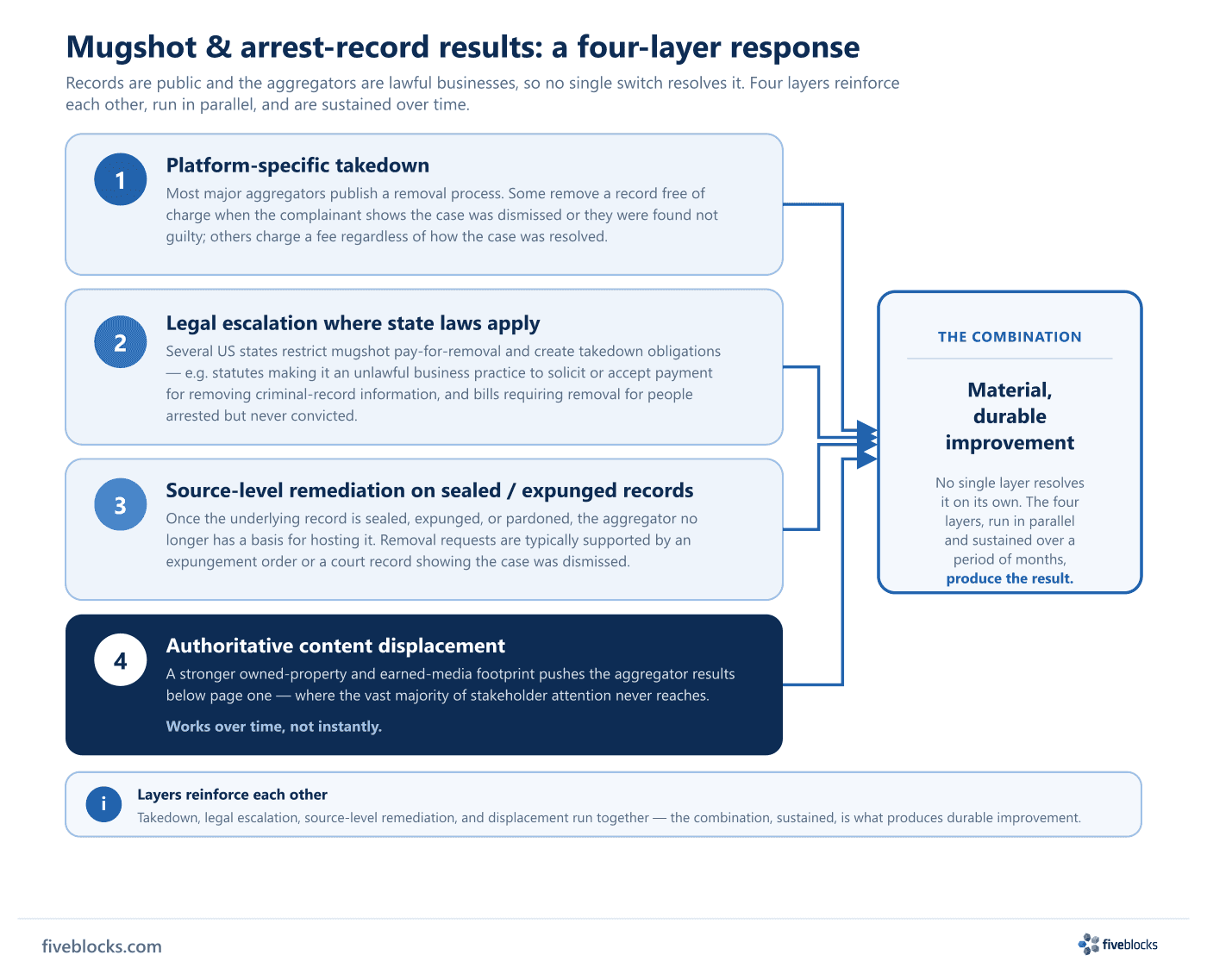
No single layer resolves the problem on its own. Takedown, legal escalation, source-level remediation, and displacement, run together and sustained over a period of months, are what produce durable improvement.
Last reviewed: 19/05/2026
