How do you handle pay-for-removal or extortion sites in search results?
Pay-for-removal and extortion sites are handled by treating it as a legal matter from the first conversation rather than a negotiation: refuse to pay, pursue legitimate takedown through the host, registrar, and Google's policy channels where the site breaks their terms, escalate under extortion or defamation law where actionable claims apply, displace the result with authoritative content while the legal process runs, and monitor for the replacement URLs these operators tend to spin up.
Pay-for-removal sites publish damaging content and then offer to take it down for a fee. Because the model is predatory, involve legal counsel from the first conversation and treat it as a legal matter, not a negotiation. The work runs on several tracks at once, since no single track resolves it on its own and litigation timelines are long.
The response pattern
- Refuse to pay. Paying usually invites escalation rather than ending it. That is why counsel leads from the start instead of the target negotiating directly.
- Pursue legitimate takedown. Work the hosting provider, the domain registrar, and Google’s policy channels wherever the site violates their terms of service or content policies. Some matters also qualify for delisting under specific Google policies or, in the EU and UK, right-to-be-forgotten requests.
- Escalate under the law where claims apply. Where extortion, defamation, or other actionable claims apply, pursue legal action. Several US states have passed statutes targeting this exact conduct – for example, laws making it an unlawful business practice to solicit or accept payment for the removal of damaging content. Defamation claims turn on false statements presented as fact, not opinion.
- Displace the result. Build authoritative competing content to push the result off page one while the legal process runs. The vast majority of stakeholder attention never reaches beyond the first page.
- Monitor for variants. These operators frequently spin up replacement URLs, so the work needs ongoing, source-level attention rather than a one-time fix.
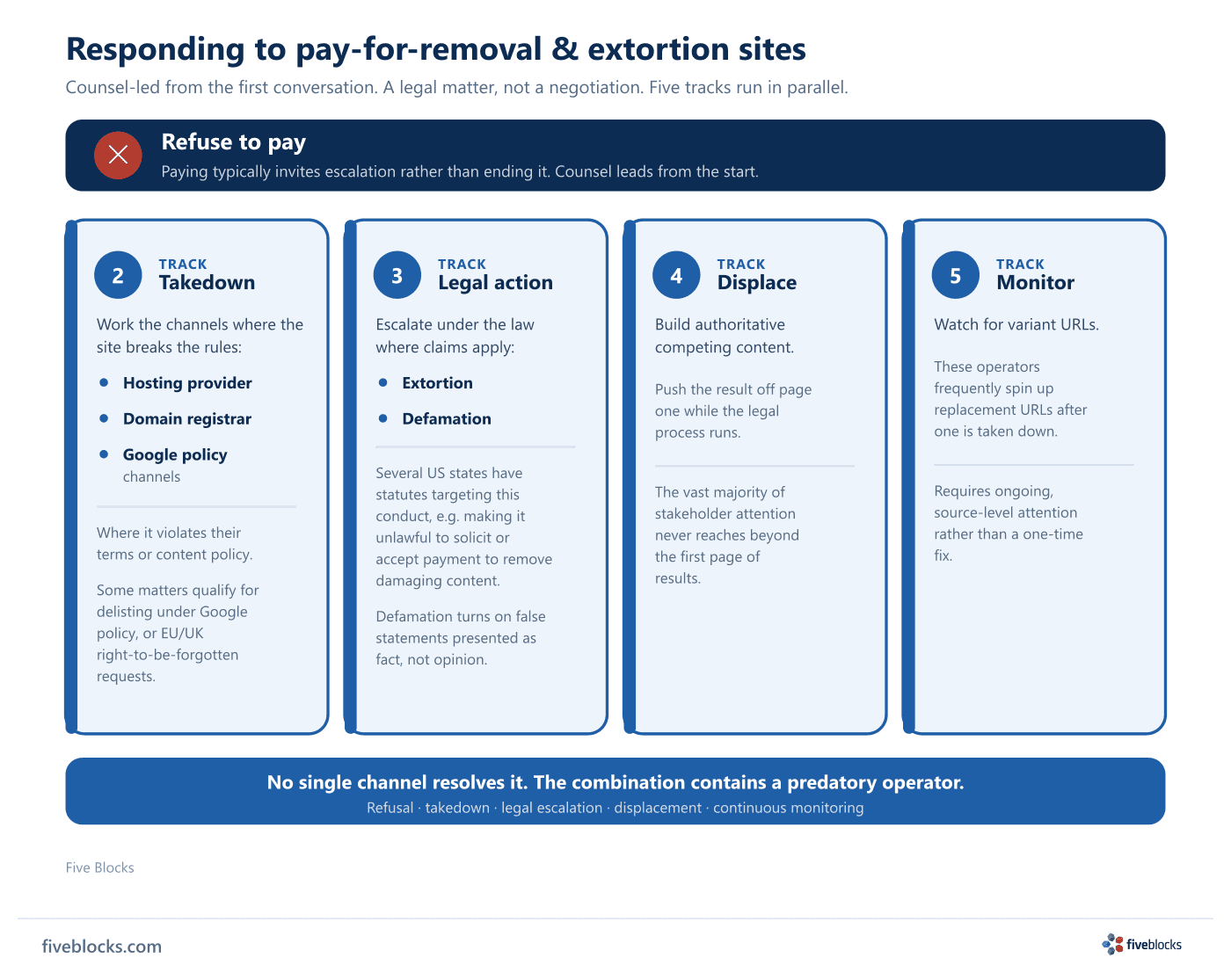
What contains a predatory operator is the combination – counsel-led refusal, platform takedown, legal escalation, displacement, and continuous monitoring. Any single channel leaves the content in place.
Last reviewed: 19/05/2026
