Rip-off Report outranks our website for our brand name. Is there a fix?
When Ripoff Report or a similar complaint site outranks your own site for your brand name, the practical fix is usually displacement: build authoritative content until it holds the positions the complaint occupies. The platform itself rarely removes a page just because you ask. Takedown and legal escalation run in parallel, but only where they genuinely apply.
When Ripoff Report or a similar complaint site outranks your corporate site for your brand name, start from a plain fact: the platform will rarely remove the page just because you ask. Three paths run in parallel, backed by ongoing monitoring, and they have very different odds of success.
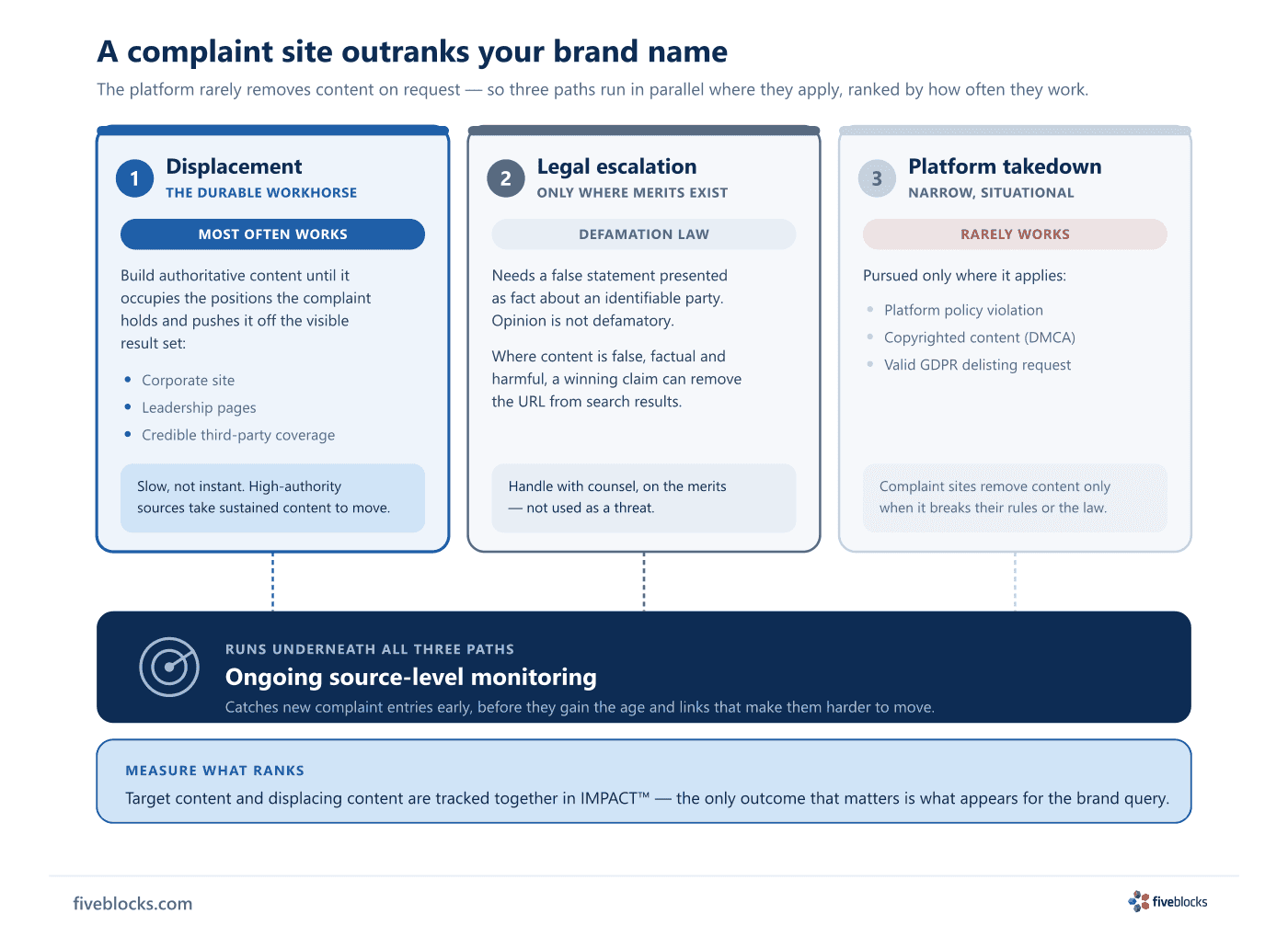
The three paths, ranked by how often they work
- Displacement, which does most of the work. Build authoritative content on your corporate site, leadership pages, and credible third-party coverage until it earns enough authority to take the positions the complaint holds and push it off the visible result set. In most cases this is the most durable path. It is also slow. High-authority sources are weighted heavily in ranking, so displacing a well-established result takes sustained authoritative content, not a single page.
- Legal escalation under defamation law, only where the merits exist. Defamation generally requires a false statement presented as fact about an identifiable party. Statements of opinion are not defamatory. Where content is genuinely false, factual and harmful, escalation can succeed, and if a legal claim prevails the URL can be removed from search results. Handle this with counsel and pursue it on the merits. Do not use it as a threat.
- Platform takedown, narrow and situational. Pursue legitimate takedown processes where they apply: a platform policy violation, scraped or republished copyrighted content under DMCA, or a valid GDPR delisting request. In practice the path is narrow with combative complaint sites, which typically remove content only when it violates their own rules or the law, not because a subject dislikes it.
What removal actually requires
A URL comes out of search results in a limited set of situations: the source takes the page down, a legal claim succeeds, a platform policy is triggered, or a delisting request such as one under GDPR is granted. Without one of those, the page stays where it is. That is why displacement carries the weight in most brand-name situations.
Run them in parallel, and keep monitoring
- Parallel, not sequential. Displacement runs continuously. Takedown and legal escalation run alongside it wherever they have real merit, rather than waiting on each other.
- Source-level monitoring. Ongoing monitoring catches new complaint entries early, before they gain the age and links that make them harder to move.
- Measure what ranks. The only outcome that counts is what appears for the brand query, so we track the target content and the displacing content together in IMPACT™.
Removal is often unlikely and displacement holds, so the two run together wherever removal has any merit.
Last reviewed: 20/05/2026
