If I optimize my own website for my CEO’s name, will it outrank the negative article?
Sometimes, but not reliably on its own. A single owned property rarely outranks a strong negative result, because Google weights authority across the full set of sources covering a name. What works is a combination: several authoritative properties, entity-layer strengthening in the Knowledge Graph and Wikidata, and source-level intervention on the article itself.
Sometimes, but not reliably on its own. Owned-property SEO is one tool, not the whole strategy, and used in isolation it rarely displaces a serious negative result. The reason is structural: Google’s ranking system weights authority across the full set of sources covering a subject, so a single corporate page seldom carries enough recognized-authority signals to push a strong article from a respected outlet off a name query. An unaddressed major-outlet negative can hold a top-page position for years.
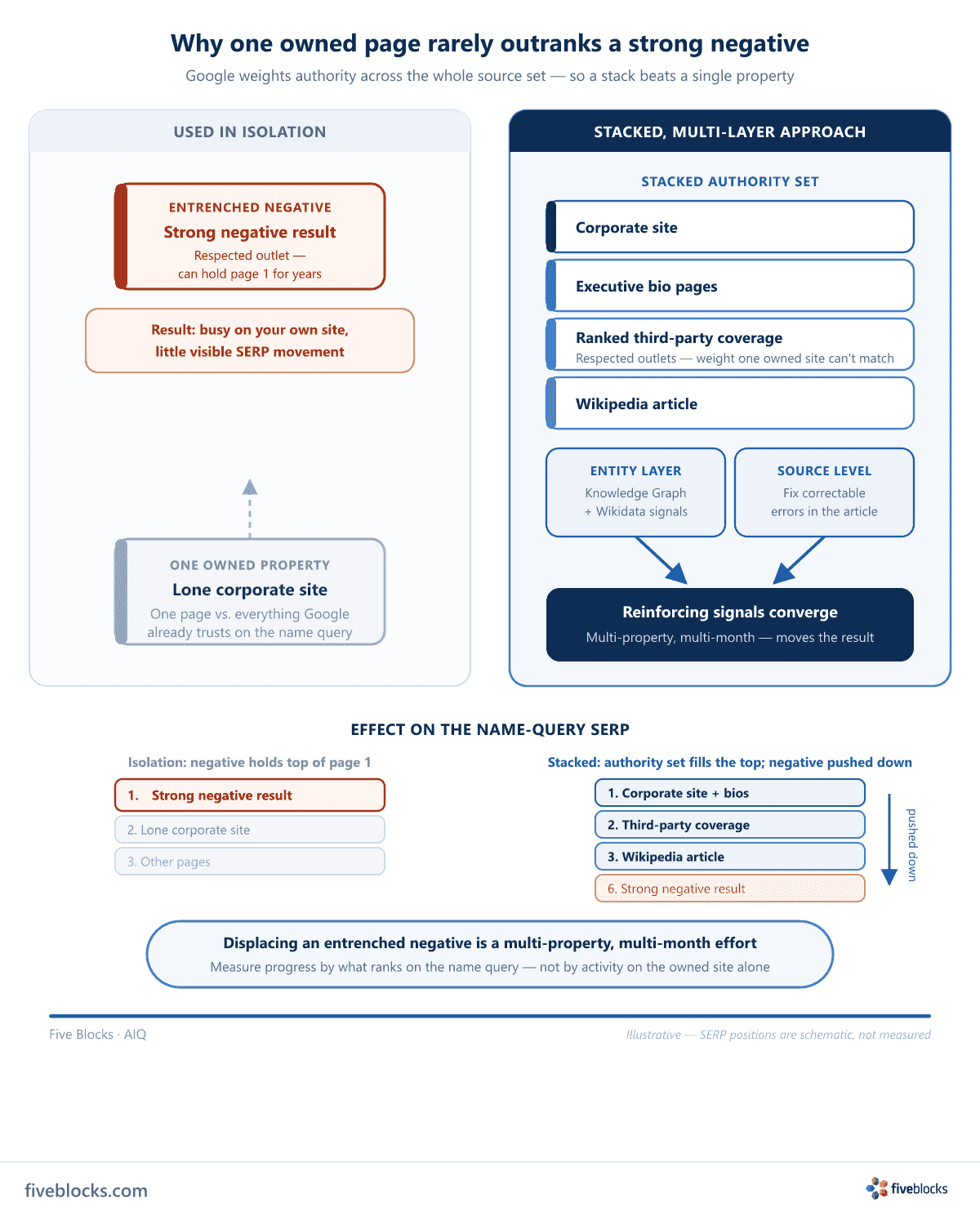
Why a lone owned page usually loses
A single corporate site optimized for a name is one property competing against everything else Google already trusts on that query. Because authority is assessed across the whole source set rather than page by page, one isolated property rarely moves the result on its own. It tends to produce the look of internal effort without much visible SERP movement.
What actually moves the result: a stacked, multi-layer approach
The work that succeeds combines several kinds of intervention that reinforce each other:
- A stacked authority set, not just the corporate site, but executive bio pages, ranked third-party coverage in respected outlets, and, where applicable, a Wikipedia article. Strong third-party domains carry ranking weight a single owned site cannot match on a name query.
- Entity-layer strengthening, work in the Knowledge Graph and Wikidata so search engines recognize the person or brand as a well-defined entity. The Knowledge Graph draws on sources such as Wikipedia, Wikidata, and official websites, and consistent entity signals across those sources reinforce how the entity is framed.
- Source-level intervention, addressing the negative article itself where it contains correctable errors, rather than only building around it.
The realistic time-to-move caveat
Done together, the picture usually moves over a period of months, not days, and rarely through any single action. Done in isolation, owned-property optimization tends to look busy on your own site without shifting the result. The honest framing for any client is that displacing an entrenched negative is a multi-property, multi-month effort, and progress is measured by what actually ranks on the name query, not by activity on the owned site alone.
Last reviewed: 19/05/2026
