What is the role of a personal website in executive reputation?
A personal website is an executive's entity home: the controlled property that defines their official identity and anchors everything else. It carries Person schema and a verified bio, sameAs links to authoritative profiles like LinkedIn and Wikipedia, and a content hub of speaking and published work that search and the AI engines draw on.
For an executive, a personal website does what the corporate site does for the company: it is the entity home, the controlled property that defines the official identity and anchors everything else. Because it ranks for the executive’s name and is fully controlled, it is the best lever for shaping how that individual is recognized and described. Without one, an executive’s identity is resolved entirely from third-party properties they do not control, which is fragile and often inconsistent.
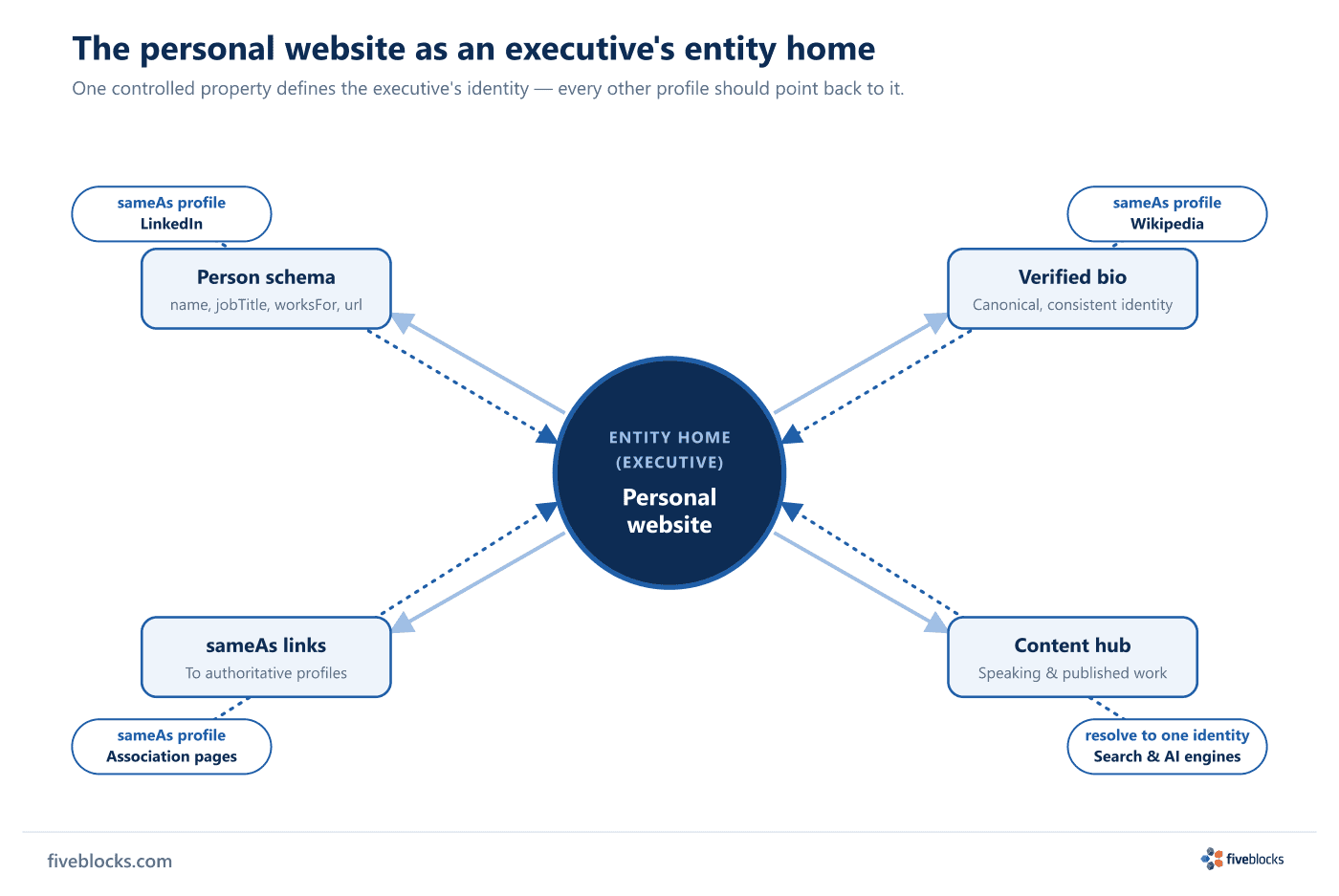
What the personal site carries
- Person schema and a verified bio
- The structured-data markup that tells search and AI engines who the executive is, alongside a canonical bio that matches the rest of the entity stack. Person schema specifies attributes such as name, jobTitle, worksFor, url, and sameAs, which engines extract to connect the executive to their other web profiles.
- sameAs links to authoritative profiles
- Links pointing to the executive’s authoritative profiles – LinkedIn, Wikipedia where it exists, association pages – so the engines can resolve scattered references to one identity. Person schema with verified sameAs links helps engines build an identity graph and gives them biographical disambiguation anchors.
- A content hub
- Speaking engagements, published work, and commentary that give search and the AI engines authoritative material to draw on when assembling a picture of the executive.
Why it anchors the executive’s identity
When an owned site carries Person schema and other signals link back to it via sameAs and consistent descriptions, search and AI engines can resolve scattered references to one identity with higher confidence. The engines will not assume a website, a LinkedIn page, and a press profile are the same person unless those signals say so. LinkedIn profiles already rank well, often in the top three, on Google name searches for most executives, so linking that authority back to a controlled entity home strengthens the whole footprint.
This matters because AI model outputs cannot be edited directly. Influence comes from shaping the entity signals, authoritative content, and structured data the models draw on, and the personal site is the most controllable of those sources. We build and schema-mark the personal site as the foundation of an executive’s entity layer, and track how strongly it holds the personal branded query with IMPACT™ and how the AI engines draw on it with AIQ.
Last reviewed: 20/05/2026
