What owned properties should every executive have?
Every executive should own five properties: a personal site or Person-schema-marked bio on the corporate site as the canonical reference; a complete, current LinkedIn profile; an accurate Wikipedia article where notability supports one, or accurate Wikidata-only presence where it does not; Knowledge Panel signals fed by Wikidata, schema markup, and sameAs links; and presence on the authoritative profiles relevant to their sector. The list is short and structural. Each property links to the others through sameAs, so search and AI engines resolve them to one person.
The owned-property checklist for an executive is short by design. Every item on it is structural rather than promotional: it carries weight in the entity layer and feeds the rest of the reputation picture. The whole set is tied together by sameAs links, so search and AI engines read the scattered references as one person.
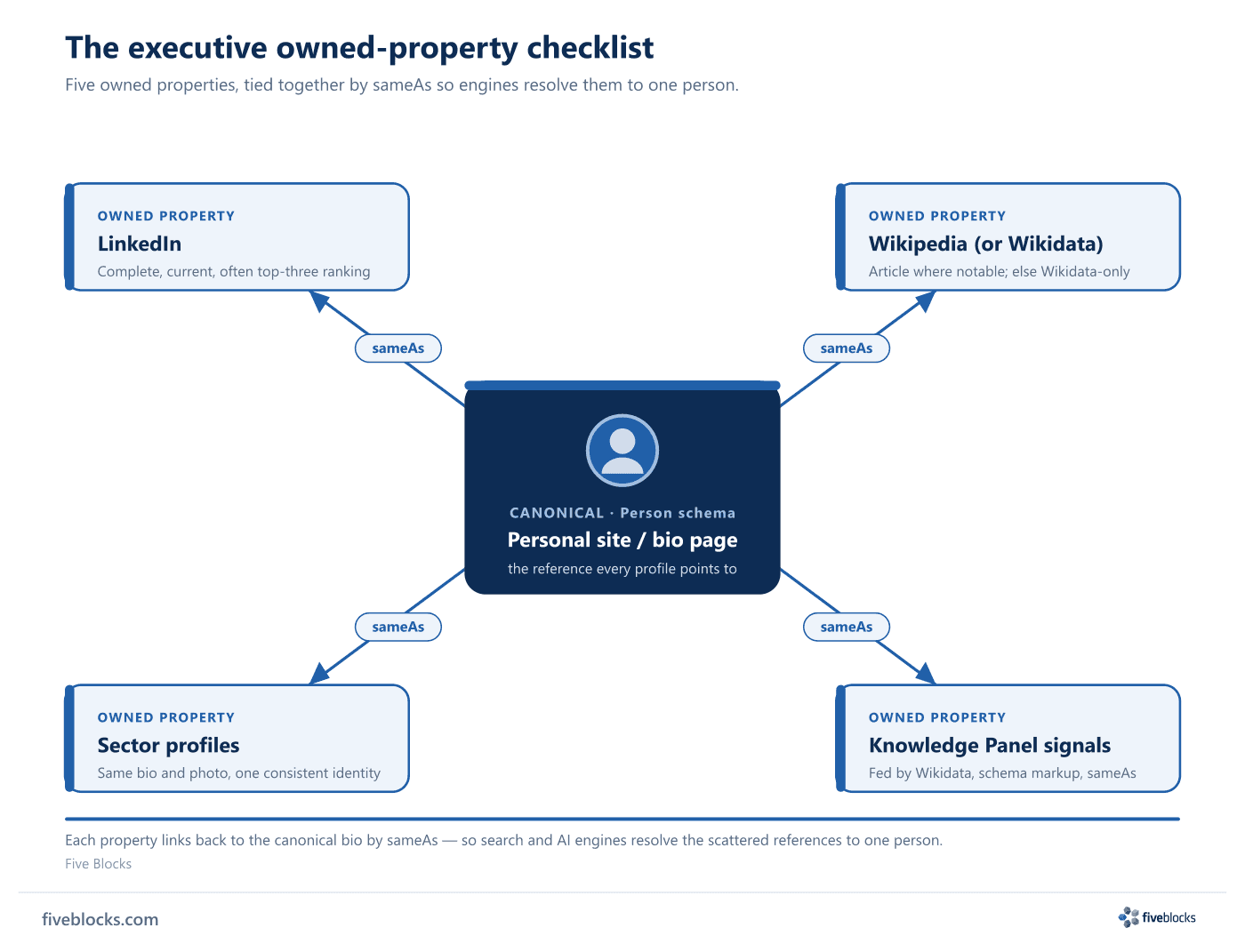
The five properties
- Canonical bio (personal site or corporate bio page)
- A personal site or a
Person-schema-marked bio on the corporate site, which is the canonical reference. Its URL appears in thesameAslinks from every other authoritative profile. - A LinkedIn profile that is complete, current, consistent with the canonical bio, and active enough to signal engagement. LinkedIn’s domain authority means the profile ranks consistently well, often top three, for executive name searches, so it is a reputation layer in its own right.
- Wikipedia (or Wikidata)
- A Wikipedia article, maintained accurately under disclosed conflict-of-interest rules, where notability supports one. Where independent notability does not support an article, accurate Wikidata-only presence is the substitute.
- Knowledge Panel signals
- Knowledge Panel signals fed by Wikidata, schema markup, and
sameAslinks, with the panel itself claimed and managed where possible. The panel’s substantive facts come from its underlying sources, chiefly Wikipedia and Wikidata, rather than from direct editing, so the signals have to agree with those sources. - Sector profiles
- Presence on the authoritative profiles relevant to the executive’s sector. Each one is verified accurate and uses the same canonical bio and photo, so the engines see one consistent identity.
Why the list stays short
Google and AI engines will not assume that a website, a LinkedIn page, a Wikidata entry, and a sector profile describe the same person. Signals such as consistent descriptions and sameAs links have to tell them so. Once the canonical anchors are in place and linked, adding more properties does not help.
Last reviewed: 19/05/2026
