What is the minimum digital presence every C-suite executive should have?
The C-suite minimum is five foundation pieces: a complete LinkedIn profile, a Person-schema-marked bio on the corporate site, an accurate Wikipedia article where notability supports one (accurate Wikidata otherwise), claimed Knowledge Panel signals, and baseline monitoring across Google search and AI engines. Every other reputation effort depends on these being in place.
The minimum is not a checklist you tick off and forget. It is the base that has to exist before any other reputation work holds up over time. Each piece adds consistent signals to the entity layer that search engines and AI engines read, and each one supports the others.
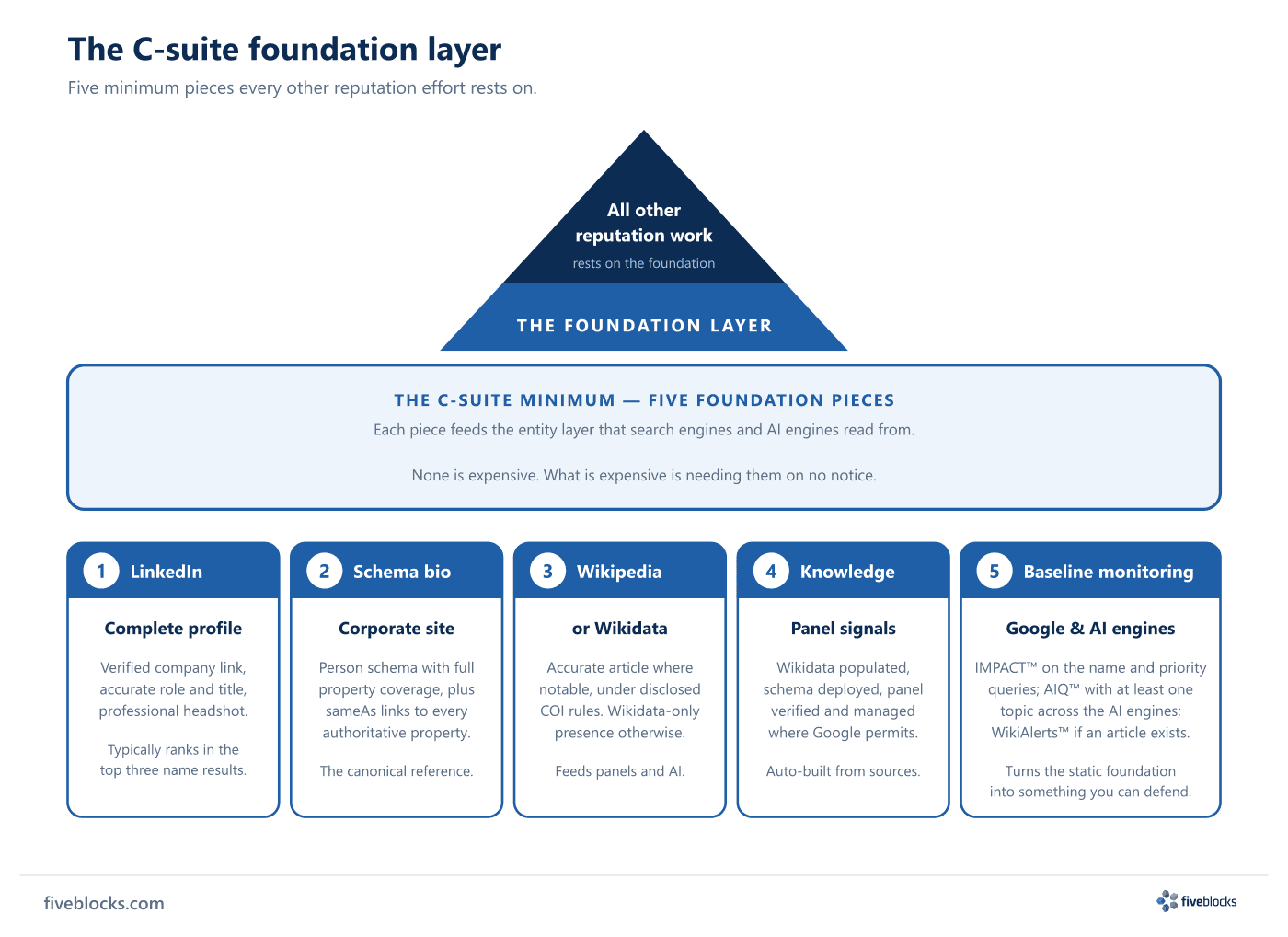
The five foundation pieces
- Complete LinkedIn profile
- Current employer linked to the verified company page, accurate role and title, a professional headshot, a structured headline that matches the canonical bio, and at least minimal activity. Because of LinkedIn’s domain authority, the profile usually ranks in the top three results for an executive’s name, which makes its contents a reputation layer in their own right.
- Person-schema-marked bio on the corporate site
- A bio page carrying Person schema with full property coverage, aligned with the LinkedIn and Wikipedia versions, and carrying
sameAslinks to every other authoritative property. This page is the canonical reference the rest of the structure points to. - Accurate Wikipedia article where notable
- Where independent notability supports an article, maintain it accurately under disclosed conflict-of-interest (COI) rules. For executives without independent notability, an accurate Wikidata-only presence is the substitute. Wikipedia and Wikidata feed both the Knowledge Panel and the AI engines, so accuracy here carries through everywhere.
- Claimed Knowledge Panel signals
- Wikidata fully populated, schema markup deployed, and the panel itself verified and managed where Google permits. Google generates Knowledge Panels automatically from sources across the web, drawing the description and main facts from Wikipedia and Wikidata.
- Baseline monitoring across Google and AI engines
- IMPACT™ on the name and priority queries, AIQ with at least one topic running across the AI engines, and WikiAlerts™ if a Wikipedia article exists. Monitoring is what makes the foundation defensible rather than static.
None of these is expensive. What is expensive is skipping them and then needing them on no notice.
Last reviewed: 19/05/2026