What is an entity home and why does every brand need one?
An entity home is the authoritative web property a brand or person controls, usually the corporate or personal website marked with Organization or Person schema, that every other signal points back to as the definitive source of its identity. It gives search and AI engines a stable anchor to tie scattered references (social profiles, directories, Wikidata, press) to one identity.
An entity home is the authoritative web property an entity controls and that everything else points to as the definitive source of its identity, typically the corporate website or a personal site, marked with the appropriate schema. Every brand and notable person needs one because entity recognition depends on a stable anchor that ties scattered references together.
What makes a property an entity home
- It is owned and controlled: the official corporate or personal site, not a third-party profile, so the entity governs what it says.
- It carries the right schema: clean Organization or Person structured data that the engines and Google’s entity layer read directly to understand what the page is about.
- It holds the canonical description: the definitive version of the identity that every other property should match.
- It is the link target: the address that
sameAslinks and consistent descriptions on other properties point back to.
Why it is the anchor
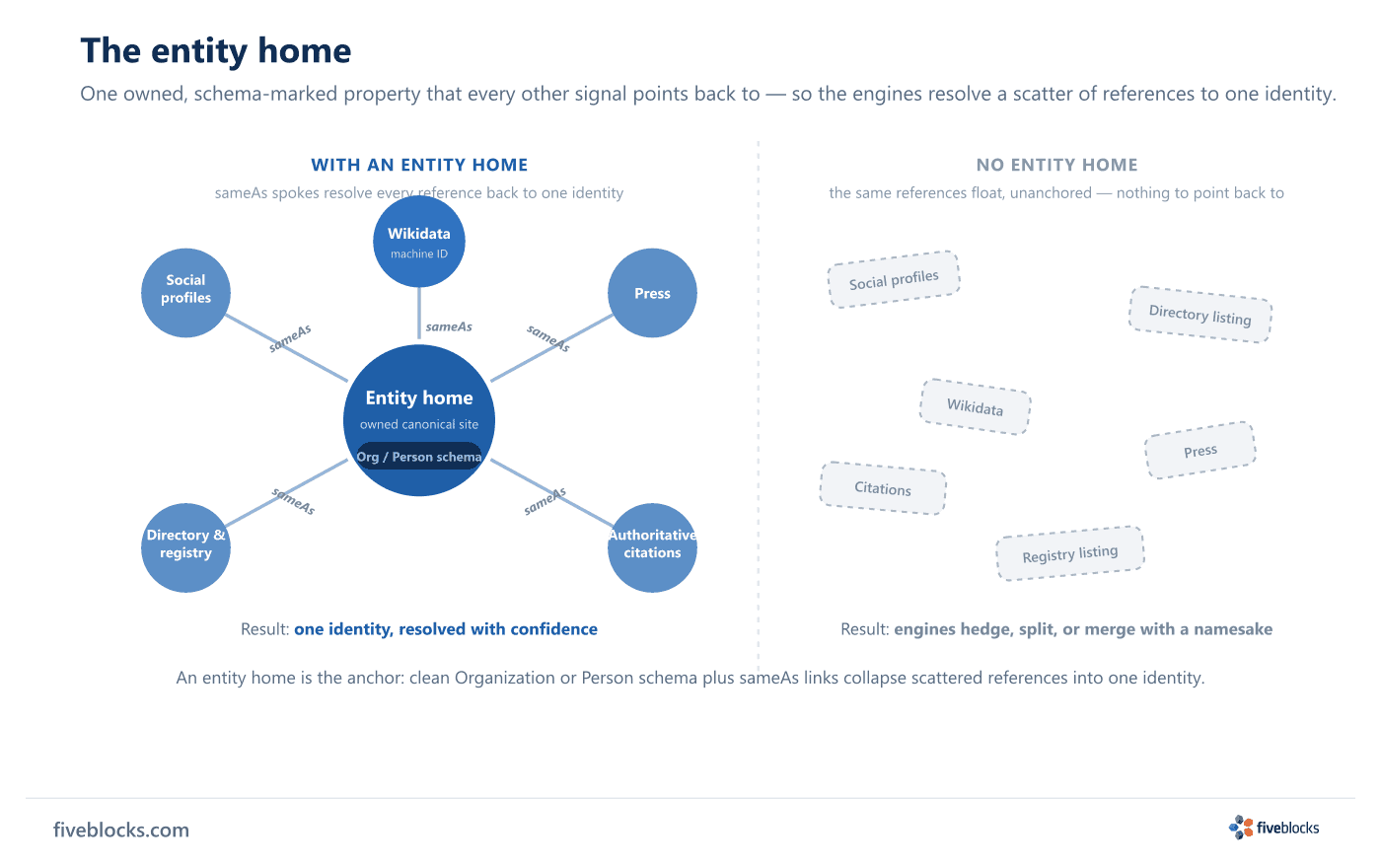
When the official site carries clean Organization or Person schema and the entity’s other signals link back to it, the engines can tie a scatter of references to one identity. The mechanism is the sameAs property: a schema link whose value is a reference page that unambiguously indicates the item’s identity, such as its Wikipedia page, Wikidata entry, or official website. Pointing sameAs from the entity home out to each authoritative profile states plainly that all of those references are one thing:
- Social profiles: LinkedIn and other major profiles, tied back through
sameAsand a consistent description. - Directory and registry listings: business directories and professional or regulatory registries that corroborate the identity.
- Wikidata: the machine-readable structured record, linked as a canonical identifier.
- Press and authoritative citations: third-party coverage that mentions and describes the entity.
With clean schema and consistent descriptions pointing back to one canonical property, Google and the AI engines can resolve all of those references to one identity with high confidence.
The failure mode without one
Without a clear entity home, the references float. The systems hedge on which ‘thing’ they are describing, and the entity stays fuzzy: the same name can be split into partial duplicates or merged with a namesake. This is why, in most engagements, the entity home is built and schema-marked first. It is what the rest of the entity layer attaches to, and where the canonical description lives.
Last reviewed: 20/05/2026
