What industries face the most complex AI reputation challenges?
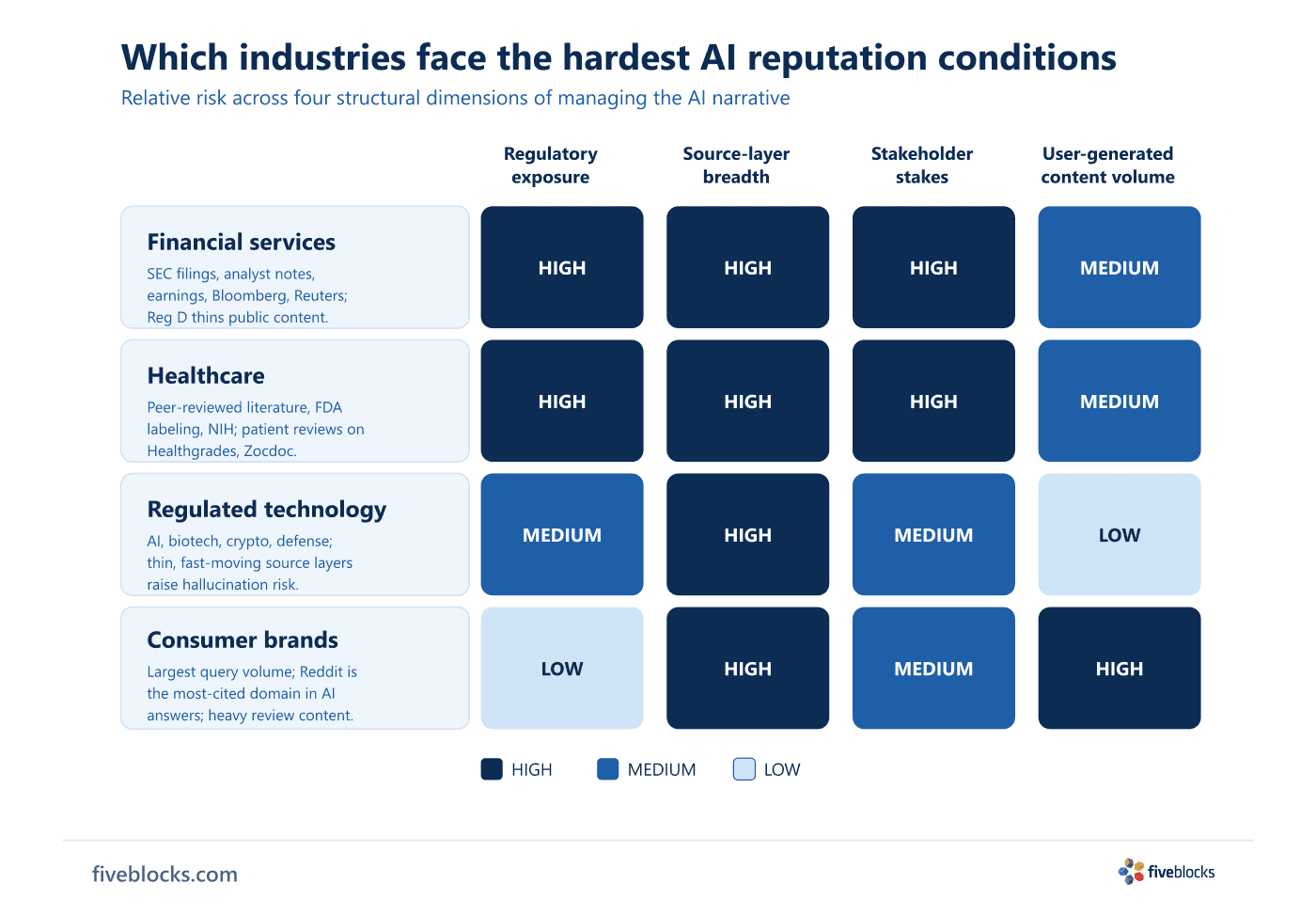
Financial services, healthcare, regulated technology, and high-profile consumer brands face the hardest AI reputation conditions. Each has a different structural cause: regulatory exposure that turns an AI mischaracterization into a compliance risk, a heavily weighted but uneven source layer, or a volume of user-generated content that gives the AI engines material the brand cannot control.
Some industries face harder AI reputation conditions than others. The reason is not that they attract more scrutiny; it is that their source mix, regulatory constraints, and stakeholder stakes combine to make the AI narrative much harder to manage.
Financial services
The main problem is the breadth and authority of the source layer. AI engines, including ChatGPT and Gemini, draw heavily on SEC filings, analyst notes, earnings transcripts, Bloomberg and Reuters coverage, and ratings databases when answering questions about financial firms. That is a wide, uneven surface. A single inaccurate analyst note or an outdated filing can anchor an AI response for months. Hedge funds and private equity firms have a further constraint: Regulation D and the SEC Marketing Rule limit what they can say publicly, so the public-facing content they can build to shape the narrative is thin, and the engines fill that gap with whatever credible-looking material exists, accurate or not.
Healthcare
AI engines weight high-authority medical sources for healthcare queries: peer-reviewed literature, FDA labeling, NIH resources, and professional society guidelines, alongside patient-review platforms such as Healthgrades and Zocdoc. For a healthcare organization or life sciences company, those sources sit largely outside its control, and a gap between what the engines treat as authoritative and what the organization actually does creates a real misrepresentation risk. An AI mischaracterization of a drug label or a clinical indication is not only a reputational problem; it carries compliance and liability exposure. FDA constraints on health claims further limit what the company can say publicly to correct the record.
Regulated technology
AI companies, biotech firms, crypto projects, and defense contractors operate where the AI engines face thin or fast-moving source layers. Hallucination risk is highest when entity signals are weak. Models have been shown to produce plausible-sounding false statements about companies when corroborating data is sparse or contradictory, delivered in the same confident tone as accurate claims. For a startup in a new category, the AI narrative may reflect speculation, pre-publication research, or forum commentary rather than authoritative primary sourcing, and the company has little owned content to anchor a correction.
High-profile consumer brands
Consumer brands face the largest query volume and the widest source layer, including user-generated content that lower-profile companies do not deal with at scale. Reddit now ranks as the most-cited domain in AI-generated answers, based on a study of 30 million sources, and AI engines weight forum and review content heavily for experiential and reliability questions. Engines also compress recurring review themes across platforms into confident summary phrases, “customers say” or “common complaints include”, and treat aggregated third-party review content as stronger evidence than brand-owned content. For a high-profile consumer brand, thousands of sources the brand did not author and cannot edit shape the AI narrative.
Last reviewed: 19/05/2026
