How does AI search affect financial services reputation?
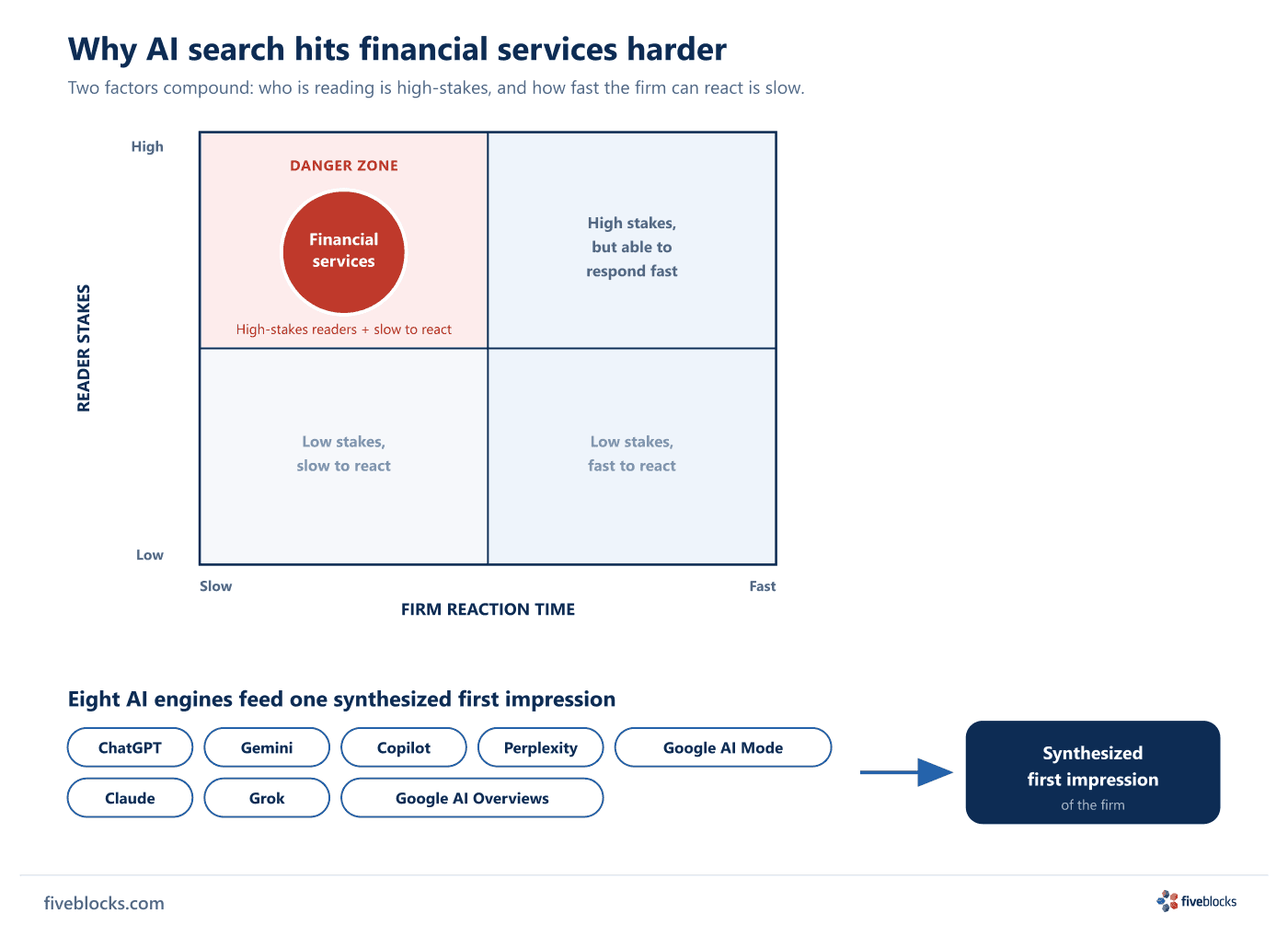
Allocators, regulators, and journalists are among the readers now screening financial firms through AI engines, and compliance rules limit how fast a regulated firm can respond. High-stakes readers plus slow reaction time is why a financial firm has to get its facts right at the source, before any query comes in.
AI search hits financial services harder than most sectors, for two reasons that compound each other: the readers are high-stakes, and the firm’s ability to react is slow.
Two reasons it lands harder here
- High-stakes readers. The audiences that matter in this sector – allocators, regulators, reporters, counterparties – are among the readers now using AI engines for a first-pass screen. That makes the synthesized answer the first impression a firm makes.
- Slow reaction time. A regulated firm cannot publish a fast rebuttal the way an unregulated brand can. Marketing rules, disclosure obligations, and counsel review all slow the response, so the firm is least able to react at the exact moment a narrative is forming.
High-stakes readers plus slow reaction time is a dangerous combination. The work has to happen before the narrative sets, not after.
The pre-emptive remedy: two layers
Give the engines accurate, compliant material to draw on before a query ever comes in. We first map what the AI engines currently say with AIQ, then build two things:
- The structured facts – schema, Wikidata, and the Knowledge Panel – so the canonical facts about the firm render correctly.
- The sources the engines trust – authoritative third-party coverage – so the engines have credible, on-message material to synthesize from.
The mapping covers the eight engines AIQ currently tracks: ChatGPT, Gemini, Copilot, Perplexity, Claude, Grok, Google AI Overviews, and Google AI Mode. These engines draw on overlapping source pools, so accurate entity and source signals built once tend to improve the answer across all of them at once.
Last reviewed: 20/05/2026
