How do compliance requirements limit what financial firms can do in reputation management?
FINRA, SEC, and FCA rules restrict testimonials, how performance can be presented, and forward-looking or promissory language. A compliant program therefore builds presence with accurate, authoritative content and credentialed entity signals instead of promotional tactics.
Compliance rules block the easy moves, which is why financial firms need a reputation program built for the constraint rather than around it. FINRA, SEC, and FCA rules restrict the promotional tactics an unregulated brand reaches for first, so leaning on those tactics adds regulatory exposure to the reputation problem.
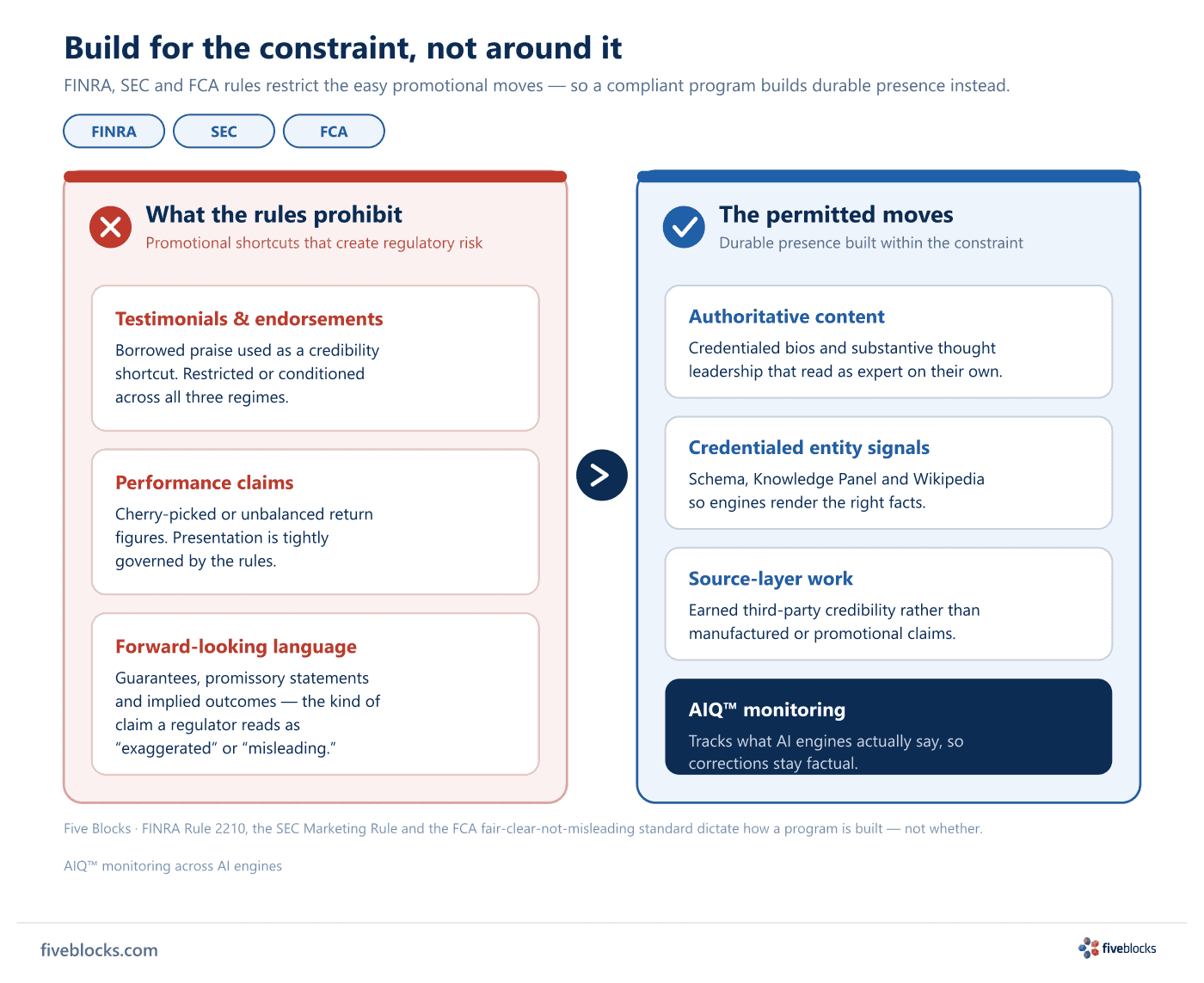
Restricted vs. permitted moves
| What the rules restrict | What a compliant program does instead |
|---|---|
| Testimonials and endorsements used as a credibility shortcut. | Authoritative, accurate content: credentialed bios and substantive thought leadership that read as expert on their own. |
| Performance presentation: cherry-picked or unbalanced return claims. | Credentialed entity signals: schema, Knowledge Panel, and Wikipedia where the firm is notable, so engines render the right facts. |
| Forward-looking or promissory language: guarantees and implied outcomes. | Source-layer work: third-party credibility that is earned rather than manufactured. |
Why this approach holds up
FINRA Rule 2210, which governs broker-dealer communications with the public, captures the spirit of all three regimes: no member may make any “false, exaggerated, unwarranted, promissory or misleading” statement, and communications must be fair and balanced and provide a sound basis for evaluating the facts. The SEC’s Marketing Rule applies parallel constraints to registered investment advisers, and the UK’s FCA imposes its own fair, clear, and not-misleading standard. None of this stops a reputation program. It dictates how one is built.
AIQ then monitors what the AI engines are actually saying, so corrections stay factual. The discipline costs some speed and flash, but it produces a presence that survives a regulator reading it.
Last reviewed: 20/05/2026
