How do banks and financial institutions approach reputation management?
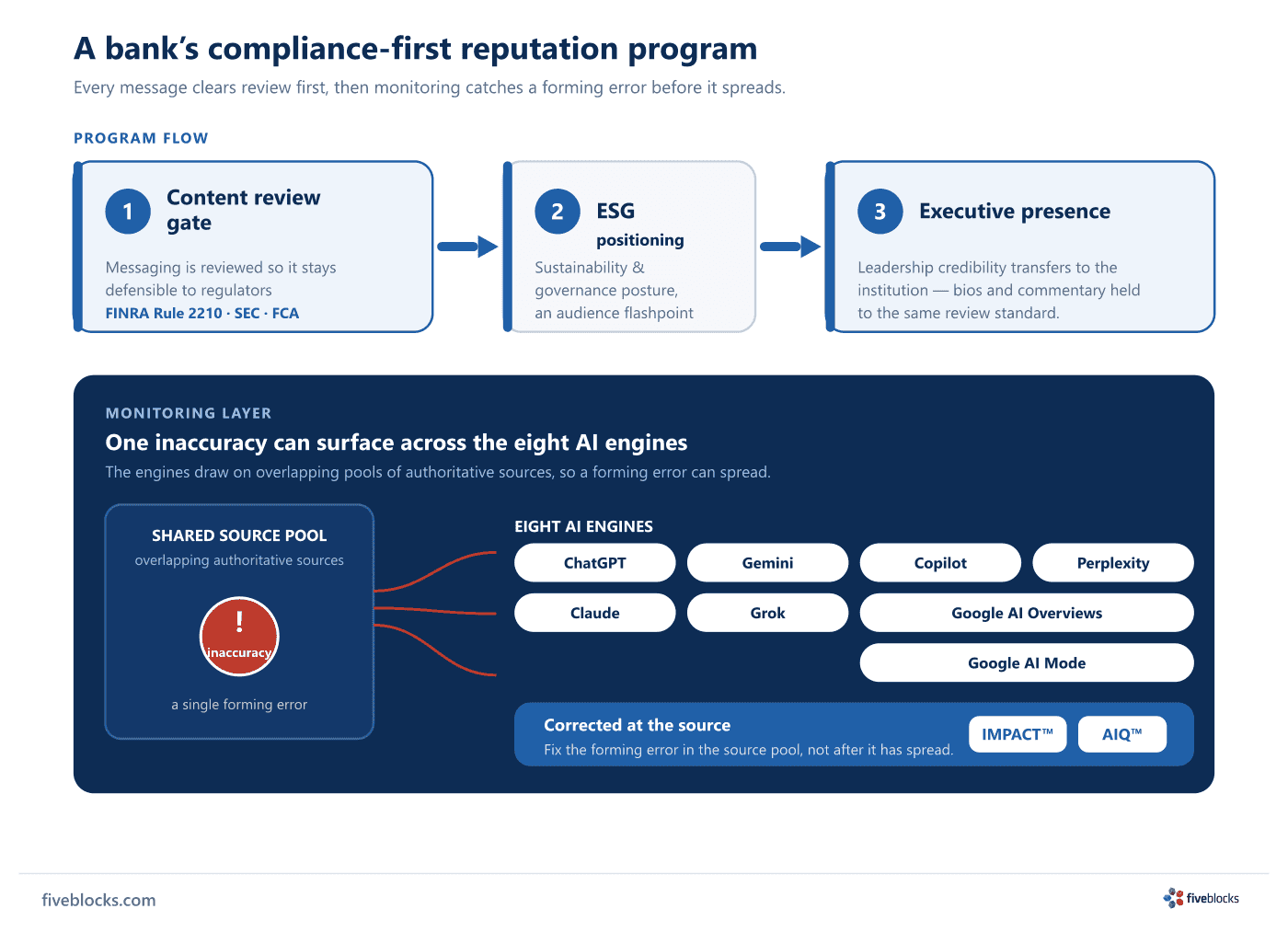
Banks and large financial institutions build reputation programs compliance-first: reviewed content, ESG positioning, executive visibility, and AI monitoring. Messaging is written to hold up under regulatory scrutiny first and to appeal to customers second.
Banks and large financial institutions manage reputation inside a regulatory perimeter, and that perimeter sets the terms for the whole program. Every message has to clear regulatory review before anyone judges it on customer appeal.
What a compliance-first program covers
- Reviewed content. Messaging goes through review so it stays defensible to regulators. FINRA Rule 2210, for example, bars any “false, exaggerated, unwarranted, promissory or misleading” statement in communications with the public, and SEC and FCA regimes impose parallel constraints.
- ESG positioning. Sustainability and governance posture is now a reputational flashpoint, and it can cut both ways depending on the audience.
- Executive presence. Leadership credibility transfers to the institution, and bios and commentary are held to the same review standard as everything else.
- AI monitoring. The part of the job the AI era changed most (see below).
The monitoring layer
An institution this large is described constantly across ChatGPT, Gemini, Copilot, Perplexity, Claude, Grok, Google AI Overviews, and Google AI Mode. The engines state inaccuracies with confidence, and because they draw on overlapping pools of authoritative sources, one forming error can surface in several of them instead of staying contained to one. We track those answers with AIQ and the Google layer with IMPACT™, so the institution can correct an error at the source instead of after it has spread.
Last reviewed: 20/05/2026
