How does search reputation affect capital raising for funds?
Search reputation affects capital raising because diligence has moved upstream of the first meeting. Before an LP or high-net-worth investor commits, they look the firm up. Three signals do most of the work: a clean Wikipedia article, the Google Knowledge Panel it feeds, and the AI-engine answers that now summarize a firm's strategy and reputation in a paragraph the allocator reads early.
Search reputation affects capital raising because diligence has moved upstream of the first meeting. Before an LP or a high-net-worth investor commits, they look the firm up, and what they find shapes whether the relationship advances. By the time a manager is in front of capital, the public record has already done part of the persuading.
Three signals do most of the work
- A clean, accurate Wikipedia article
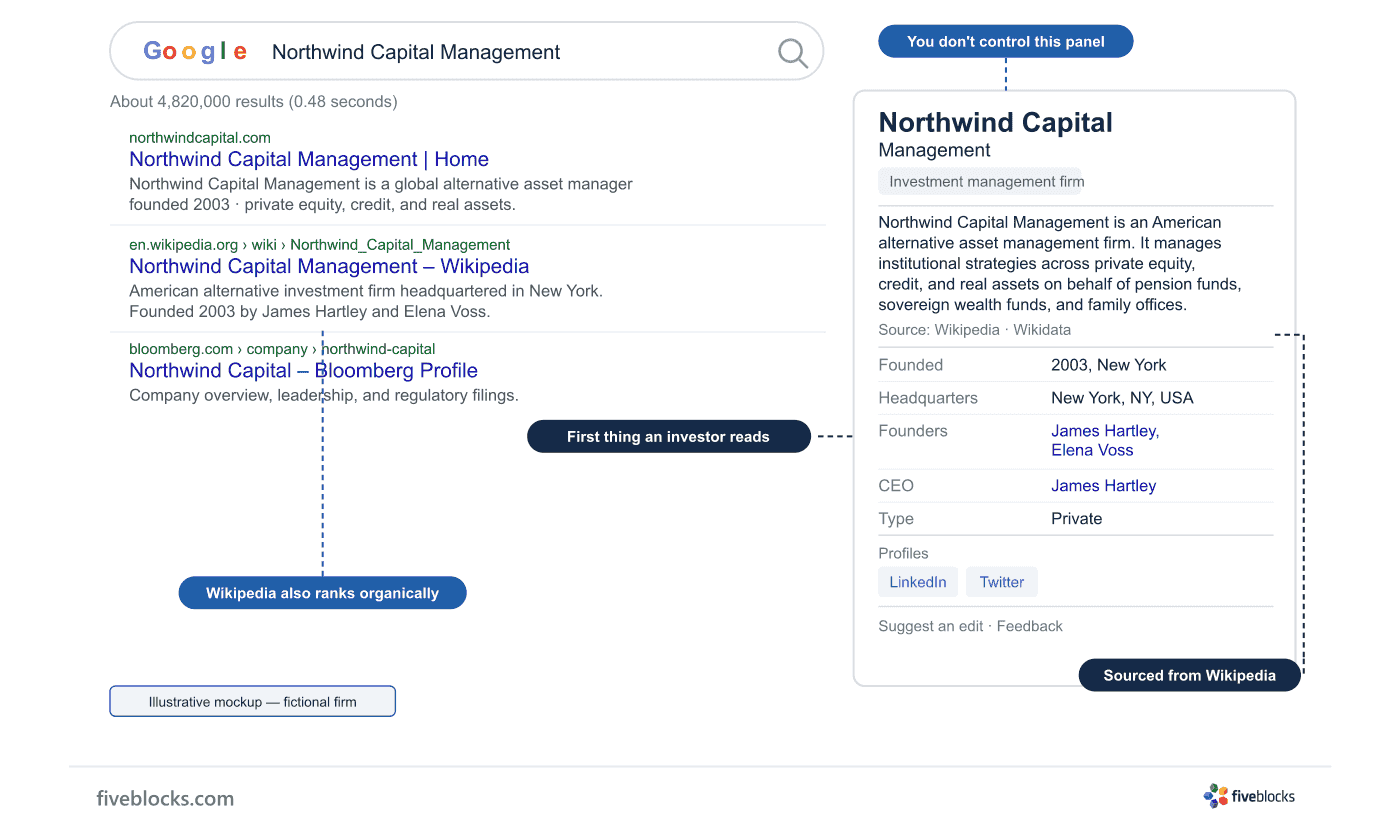
- Where a firm is notable enough to have one, its Wikipedia article ranks at the top of branded search and feeds the Google Knowledge Panel, so it carries outsized weight in what an investor sees first.
- The Google Knowledge Panel
- The panel renders the at-a-glance facts. Its description and main attributes are pulled from Wikipedia and Wikidata, which Google and the AI engines treat as canonical.
- The AI-engine answers
- ChatGPT, Gemini, Perplexity, and the other engines now compress a firm’s strategy and reputation into a paragraph an allocator reads early. They build that paragraph from the firm’s digital footprint: the Wikipedia article, the Wikidata entry, and the Knowledge Panel.
Managing the entity layer of a fundraising profile
These three signals are the entity layer of a fundraising profile, and we manage them deliberately with AIQ and IMPACT™. AIQ monitors what the AI engines say, so a manager knows what an allocator is reading. The entity work keeps the Wikipedia, Wikidata, and Knowledge Panel facts accurate, so they hold up under diligence.
Last reviewed: 20/05/2026
