How do LPs use search results during fund due diligence?
LPs use diligence search to check whether the data-room narrative matches the public record: management quality, undisclosed litigation or regulatory history, and whether the stated strategy and track record hold up. That check now runs through AI engines like ChatGPT and Perplexity as well as Google.
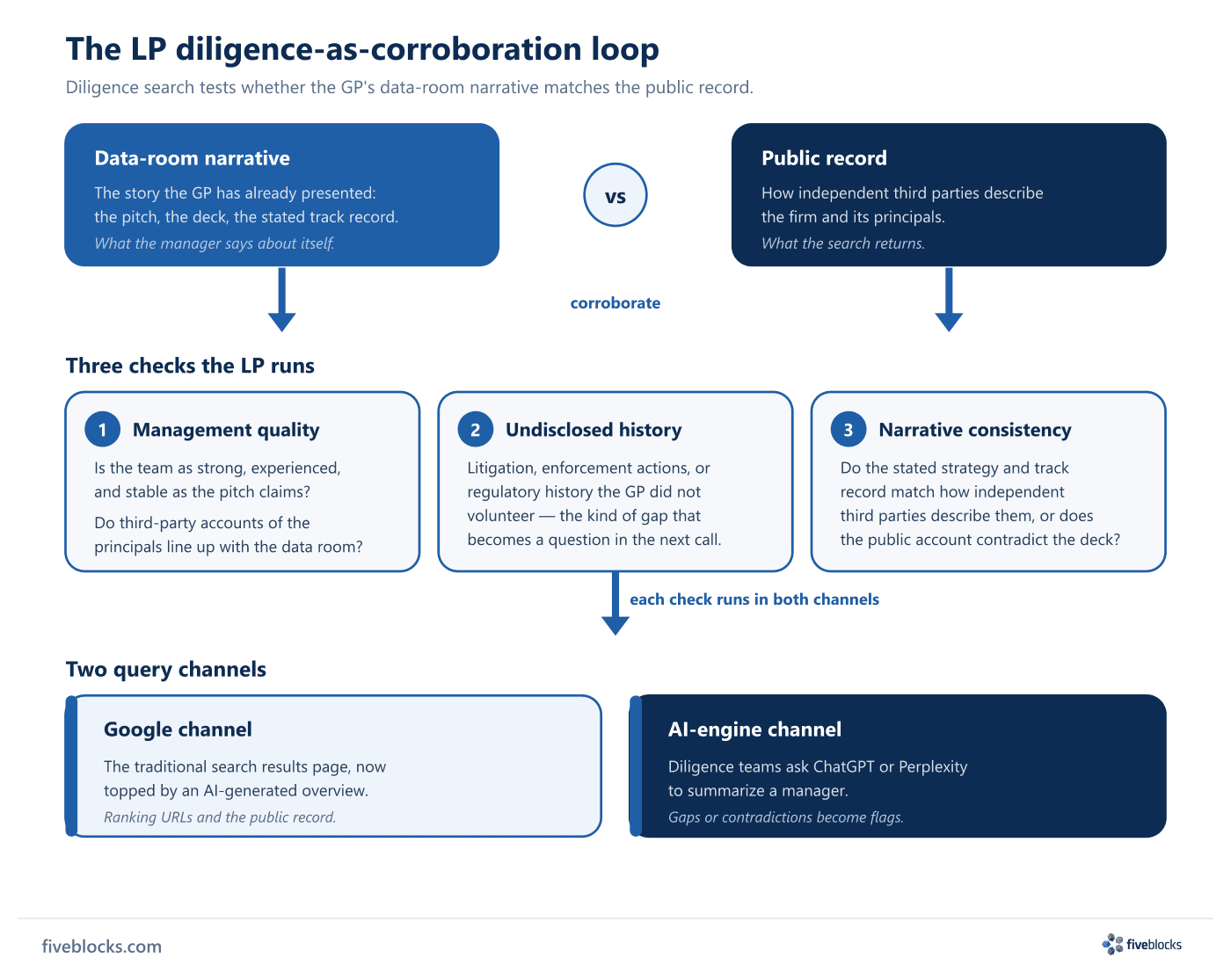
LPs use search during diligence to corroborate what the GP has told them. It shows whether the story in the data room matches the public record. The point is to pressure-test a narrative the GP has already presented, not to discover the manager from scratch.
Three things an LP is checking
- Management quality and stability
- Whether the team is as strong, experienced, and stable as the pitch claims, and whether third-party accounts of the principals line up with the data room.
- Undisclosed litigation or regulatory history
- Litigation, enforcement actions, or regulatory history the GP did not volunteer. That is the kind of gap that becomes a question on the next call.
- Strategy and track-record consistency
- Whether the firm’s stated strategy and track record match how independent third parties describe them, or whether the public account contradicts the deck.
The diligence query now runs in two channels
This no longer happens only in Google. Diligence teams also ask ChatGPT or Perplexity to summarize a manager, and they treat gaps or contradictions in that summary as flags worth raising. The same three checks run in both channels.
We monitor both channels for fund clients with IMPACT™ and AIQ, so a GP walks into diligence already knowing what an LP’s search will return and where the narrative needs reinforcing.
Last reviewed: 20/05/2026
