How does search reputation affect M&A due diligence?
M&A diligence now routinely covers the target's branded search results, AI engine responses, Wikipedia article history (including reverted edits and Talk-page disputes), review platforms, and named principals, not just the financial data room. Findings on any of these layers flow into the diligence Q&A, rep-and-warranty negotiation, valuation, and in some cases the decision to proceed.
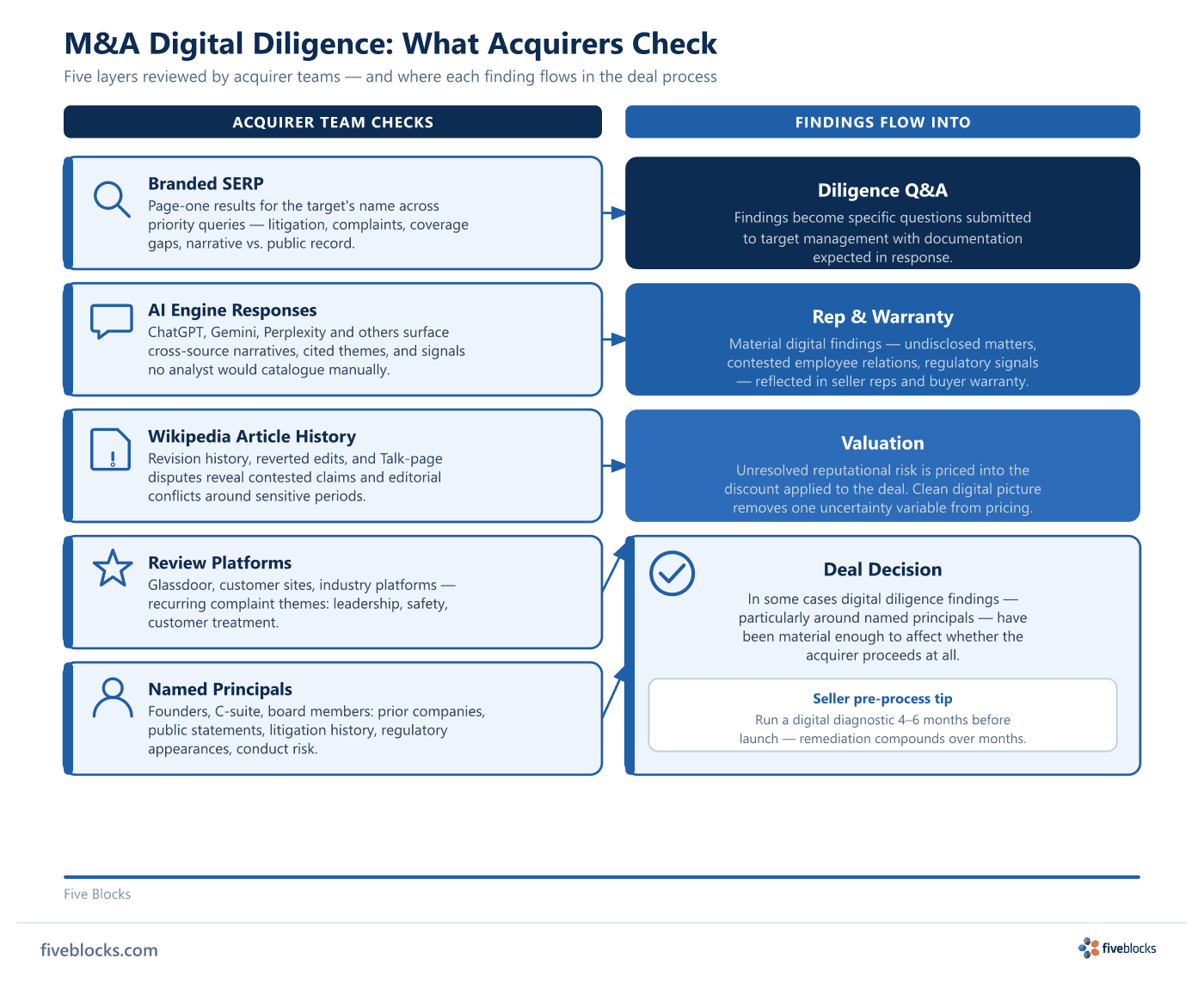
Digital diligence is now a standard part of M&A processes, particularly for sophisticated acquirers and their advisors. The layers each team checks, and what each one means for the deal, are set out below. Sellers who run a pre-process diagnostic can see what an acquirer will find ahead of time.
-
Branded SERP review
The acquirer team searches the target company’s name across priority queries and reviews what ranks on page one and beyond. The scan looks for undisclosed litigation, regulatory matters, customer complaints, hostile former-employee coverage, and any material disconnect between the company’s stated narrative and the publicly accessible record. Sophisticated acquirers do this across several geographies, particularly for cross-border transactions, because the picture can differ by market.
-
AI engine responses
AI engines such as ChatGPT, Gemini, and Perplexity pull together sources that no analyst would catalog by hand. Acquirer teams, particularly at PE and strategic acquirers using AI-enabled diligence tooling, now pull AI responses as part of early-stage research. KPMG has noted that AI tools speed up the review of management materials and unstructured documents in financial and commercial diligence (KPMG, 2025). What AI engines say about the target, the narrative they build, the sources they cite, and the themes they surface, is now a diligence input in its own right.
-
Wikipedia article history
Wikipedia’s article history is publicly accessible and shows more than the current article text. Diligence reviewers check the revision history for reverted edits (which can signal that contested claims were attempted and removed), Talk-page disputes (which surface unresolved editorial arguments about the accuracy of the article), and patterns of activity around sensitive periods. The Wikipedia page history tool makes every edit and every Talk-page thread available without login, so it is a free and detailed record for any acquirer willing to look.
-
Review platforms
Glassdoor, customer review sites, and industry-specific review platforms are checked for patterns rather than isolated negative reviews: recurring themes that signal cultural or operational issues at scale. A consistent pattern of complaints about leadership behavior, safety, or customer treatment raises questions that the diligence Q&A must address. Review platform findings also shape rep-and-warranty language around employee relations and customer satisfaction representations.
-
Named principals
Founders, C-suite executives, and board members get the same digital review as the company itself. The search covers prior companies, public statements, litigation history, regulatory appearances, and any coverage that suggests judgment, integrity, or conduct risk. For smaller targets where the principal is the business, this layer often carries more weight than the company-level scan.
Where findings flow in the deal process
- Diligence Q&A: findings become specific questions submitted to the target’s management team, with documentation expected in response.
- Rep-and-warranty negotiation: material digital findings such as undisclosed matters, contested employee relations, and regulatory signals get reflected in specific representations the seller must make and the warranty coverage the buyer requires.
- Valuation: unresolved reputational risk creates uncertainty that gets priced into the discount applied to the deal. A target with a clean, well-sourced digital picture removes one uncertainty variable from the pricing discussion.
- Deal decision: in a small number of cases, digital diligence findings, particularly around named principals, have been material enough to affect whether the acquirer proceeds at all.
Pre-process preparation for sellers
Sellers who expect a process can run a pre-process digital diagnostic to see what an acquirer will find before formal diligence begins. The diagnostic covers each of the layers above and produces a prioritized remediation list. Durable interventions such as Wikipedia article work, source-layer remediation, and authoritative coverage build-up take months rather than days, so preparation work ideally begins four to six months ahead of a formal process launch.
Last reviewed: 19/05/2026
