How should hedge fund managers think about their digital reputation?
Allocators check the public record before a capital-introduction meeting: an accurate Wikipedia article, the Google Knowledge Panel, schema-marked bios, and what AI engines like ChatGPT and Perplexity say about the manager. Hedge fund managers should treat those signals as diligence material and correct them before an investor forms a first read.
Hedge fund managers should treat digital reputation as diligence material, because that is how allocators use it. An investor checks the public record before a capital introduction or an allocation, and the manager wants that record to be accurate, current, and consistent with the pitch.
What an allocator actually reads
- Wikipedia and the Knowledge Panel
- Where the manager is notable, a clean Wikipedia article ranks at the top of a branded search, feeds the Google Knowledge Panel, and is among the most heavily weighted sources the AI engines draw on. Get these right first, because much of the rest is built on them.
- Authoritative, schema-marked bios
- A bio site carrying Person schema, with
sameAslinks to canonical profiles, lets Google and the AI engines tie scattered references to one identity and pull the right facts about the manager. - Proactive context
- Owned content that supplies context on strategy, the performance environment, and the team gives the engines current material to work with, without crossing marketing-rule lines.
- AI-answer monitoring
- Allocators ask ChatGPT and Perplexity to summarize a manager, so a stale or unflattering answer turns into an early question. We track those answers with AIQ, so a manager knows what is being read before the meeting.
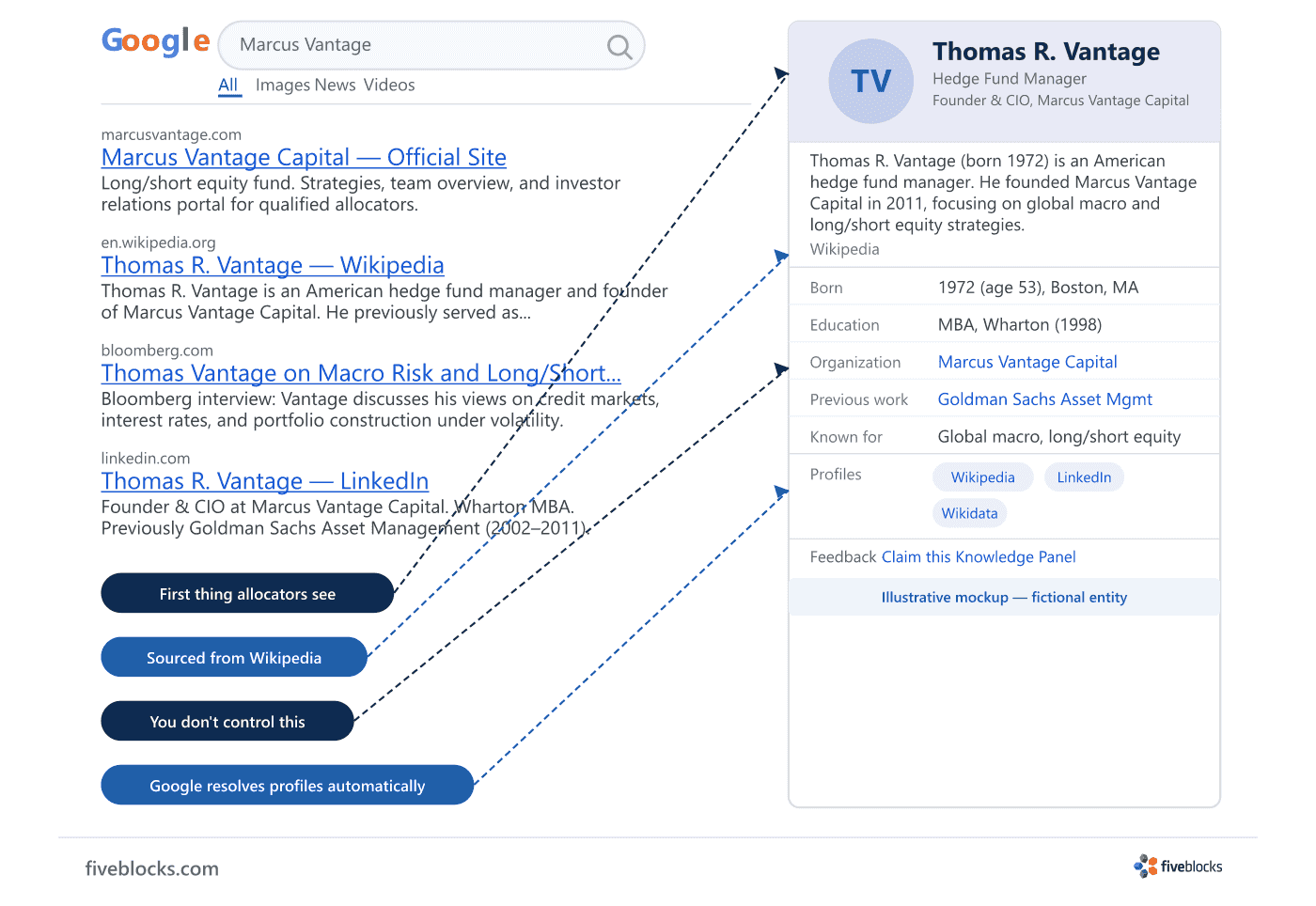
How the pieces connect
The Knowledge Panel draws its description and facts from Wikipedia and Wikidata, and the same Wikipedia entry, structured data, and third-party coverage are what the AI engines weight when they assemble a profile. One accurate, well-linked record therefore carries across every surface an allocator checks: branded search, the entity card, and the AI summary. That is the case for fixing it deliberately, before an investor has formed a first read.
Last reviewed: 20/05/2026
