What happens to a fund manager’s reputation when a fund underperforms?
The public narrative often overshoots the actual numbers, because perception compounds: allocators talk, journalists frame, and AI engines synthesize a "struggling manager" story from the coverage. Reputation work cannot manufacture returns, but it can supply factual context within marketing rules and post an early, accurate counter-signal so a temporary drawdown is not recorded as a permanent verdict.
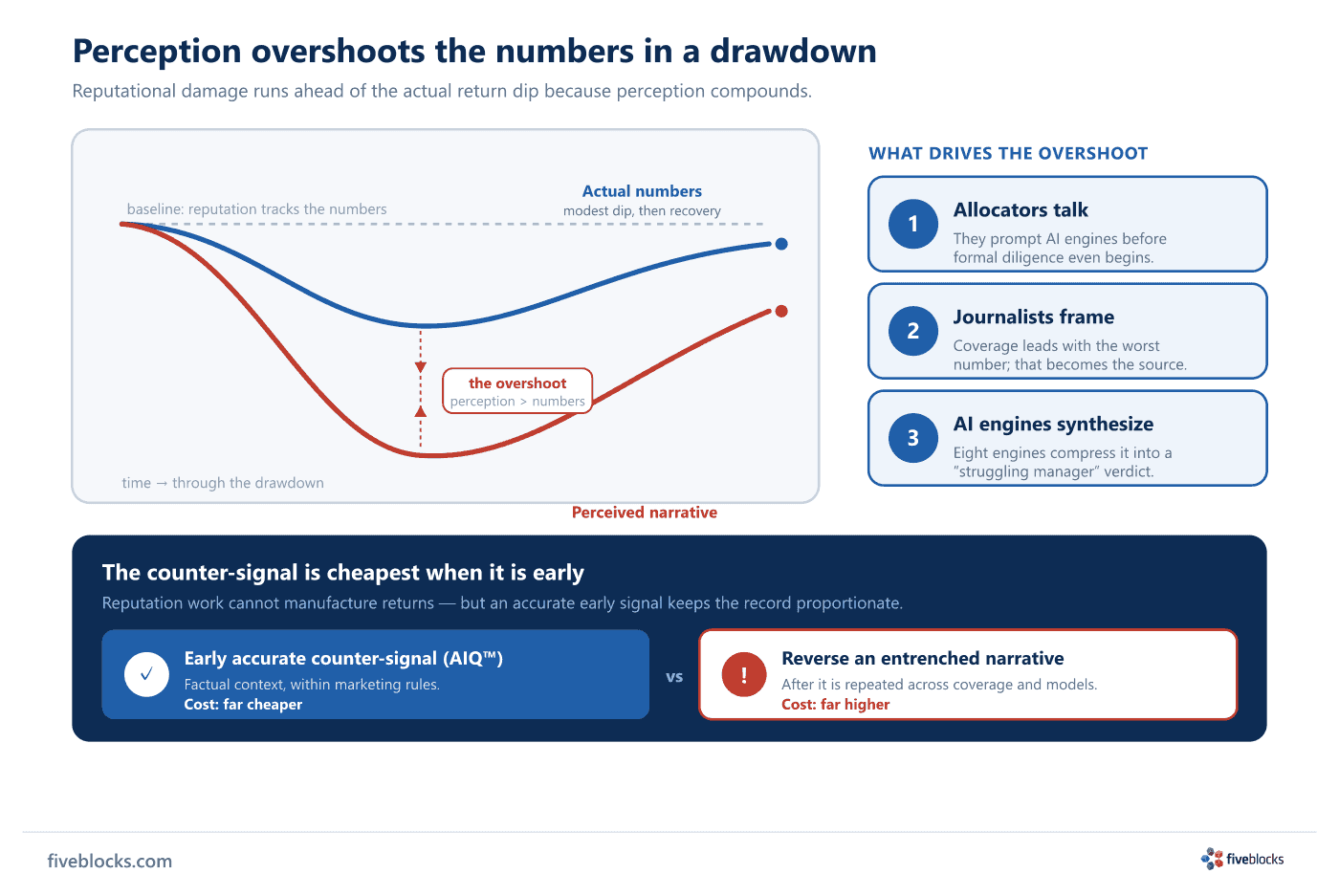
When a fund underperforms, the reputational damage often runs ahead of the actual numbers, because perception compounds: allocators talk, journalists frame, and AI engines synthesize a “struggling manager” narrative from the resulting coverage.
Why perception overshoots the numbers
A single bad period rarely stays a single bad period in the public account. Three forces amplify it, and they feed each other:
- Allocators talk. Investors and allocators increasingly prompt AI engines about prospective managers before formal diligence begins, so an early negative read can shape a relationship before anyone reviews the full record.
- Journalists frame. Coverage of a drawdown tends to lead with the worst number, and that framing becomes the source material everything downstream draws from.
- AI engines synthesize. Models pick up the negative framing quickly and repeat it confidently, compressing a complicated performance picture into a short “struggling manager” verdict.
What reputation work can and cannot do
Reputation work cannot manufacture returns. What it can do is keep the public account proportionate to the facts:
- Supply factual context, within the rules. Where it is appropriate, and inside the constraints on fund communications, we supply factual context on strategy, the performance environment, and the stability of the team, so the record reflects more than a single bad period. For private funds and registered advisers, Regulation D’s limits on general solicitation and the SEC’s Marketing Rule set the boundary: context is provided as fact, not as performance marketing.
- Counter-signal early. An early, accurate counter-signal is far cheaper than reversing an entrenched narrative after it has been repeated across coverage and models.
Why timing matters with AI engines
Retrieval-driven AI engines issue live web searches at query time and reflect new, credible content within hours or days, so an accurate counter-signal placed early can reach those answers before the negative framing hardens. During a drawdown we use AIQ to watch answers across the eight major engines and see how each one reframes the manager, so the response can be timed rather than left to chance. The goal is narrow: keep a temporary drawdown from being recorded by search and the AI engines as a permanent verdict.
Last reviewed: 20/05/2026
