How do you manage reputation for a financial firm during market volatility?
Monitor search and AI engine answers daily, publish measured factual content, and adjust as news-driven prompts shift. Volatility changes what people ask faster than a quarterly content plan can answer it.
During market volatility the reputation risk is speed. The questions investors and journalists ask change daily, and a static content plan falls behind the news. So the cadence has to change: near-real-time response in place of the quarterly calendar, without tipping into overreaction.
Why the usual cadence breaks
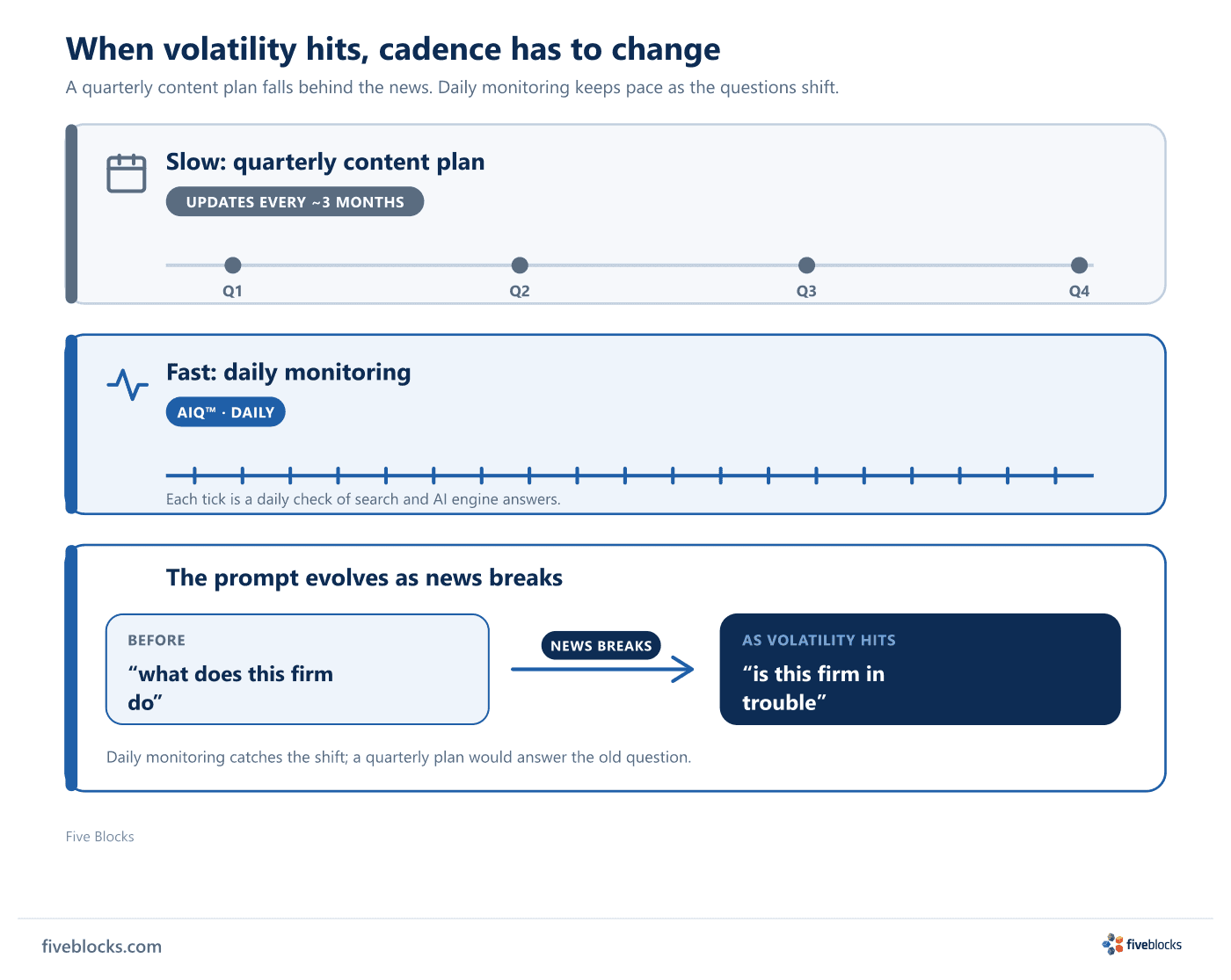
A quarterly content plan assumes the questions stay roughly stable between updates. Volatility breaks that assumption. Query volume spikes, and the engines start synthesizing fresh, sometimes speculative, material faster than a planned calendar can answer it. The prompt itself moves. A model that was answering “what does this firm do” last week may be answering “is this firm in trouble” this week.
What the faster cadence involves
- Daily monitoring of search and AI engine answers. With query volume spiking and the engines pulling in whatever is newest, the public record has to be checked daily rather than reviewed on a schedule.
- Measured, factual content. Bullish claims age badly in a downturn. The job is to give the public record an accurate account of the firm’s position.
- Tracking how prompts evolve with AIQ. When the questions turn from neutral to alarmed, the sources feeding the answer need to be current and on message so the model has an accurate, up-to-date account to work from.
The discipline is responsiveness without overreaction: move at the speed of the news cycle, but keep the content measured enough that it still reads well once volatility passes.
Last reviewed: 20/05/2026
