What role does search reputation play in fundraising and capital raises?
Capital raises trigger structured LP diligence on the firm and its named principals. Weak digital signals, no Wikipedia article, an inaccurate Knowledge Panel, or distorted AI narratives create friction or worse during that process, and the interventions that hold up (Wikipedia work, entity strengthening, authoritative coverage build-up) need four to six months of lead time before the formal fundraise launches.
Fundraising is one of the higher-stakes reputation moments for an investment firm. LPs run structured diligence on the firm and its named principals before they commit, and weak digital signals create friction at the wrong time. The workstream that protects a fundraise runs four to six months ahead of launch, not in the weeks before the first LP meeting.
-
What LPs check in digital diligence
Digital diligence by LPs is now routine. The layers reviewed before and during a fundraise usually include:
- Wikipedia: the firm’s article if one exists, and the articles for named principals. Wikipedia ranks in the top results for most branded searches and is the reference AI engines pull from most heavily. A thin, inaccurate, or absent article reads as a light institutional footprint.
- Knowledge Panels: the firm’s and named partners’ Knowledge Panels. Inaccurate or missing panels raise questions about how well the entity is established in public records.
- AI engine responses: LPs and their advisors now prompt AI engines (ChatGPT, Perplexity, Gemini, and others) about prospective fund managers before formal diligence begins. Research published on SSRN and industry data from Affinity (2026) confirm that AI tools are used for early-stage research on private firms. What those engines say, and which sources they cite, sets the questions LPs bring to the first meeting.
- Credentialed coverage: the firm’s track record as covered in authoritative financial press, industry publications, and association profiles. Thin or contradictory coverage raises questions the data room has to answer.
- Controversy and litigation signals: any coverage of regulatory matters, litigation, or public controversy involving the firm or its principals, including archived social media and old press coverage AI engines may surface.
-
Pre-launch phase: four to six months before the formal raise
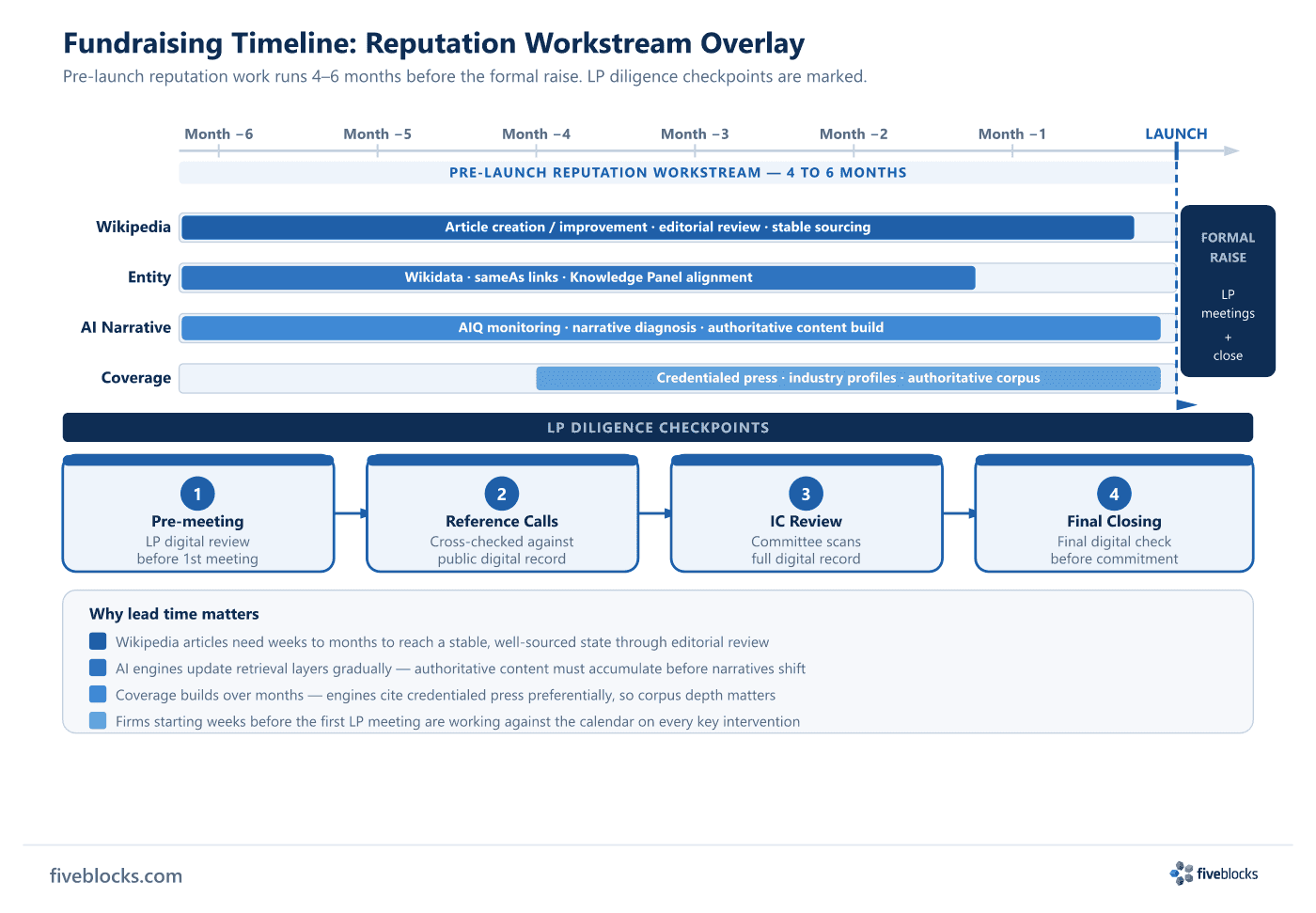
Most of the interventions that hold up cannot be compressed into a few weeks. The pre-launch workstream usually covers:
- Wikipedia article work: creating or improving articles for the firm and named principals through COI-disclosed edit requests. Wikipedia’s editorial process requires sourcing from independent reliable sources, and the article must reflect the public record, not the firm’s own materials. This takes weeks to months to reach a stable state.
- Entity strengthening: making sure Wikidata entries, sameAs links, and structured data across the firm’s owned properties are complete and consistent. This is the infrastructure that feeds Knowledge Panels and grounds AI engine responses.
- AI narrative remediation: running AIQ monitoring across the major AI engines to see what each one currently says about the firm and principals, diagnosing the source of problematic narratives, and building the authoritative content needed to move engine responses over time. AI engines update their responses gradually as new authoritative content accumulates in their retrieval layer.
- Coverage build-up: developing credentialed third-party coverage of the firm’s track record, investment philosophy, and named principals in authoritative publications. AI engines cite credentialed press and industry sources preferentially, so building a corpus of accurate authoritative coverage works on both the SERP and the AI narrative.
-
LP diligence checkpoints
The formal fundraise creates several points where digital reputation signals are reviewed directly:
- Pre-meeting research: before the first LP meeting, the LP team runs its own digital review. What they find sets the questions they bring and the level of scrutiny applied.
- Reference calls: references are now cross-checked against the public digital record. Gaps between what references say and what the public record shows create questions.
- Investment committee review: at larger LPs and institutional allocators, the committee review often includes a scan of the public digital record for the firm and named principals. A contested or thin digital presence becomes a committee-level risk flag.
- Final closing diligence: before commitment, many LPs run a final check to confirm the digital picture has not changed materially since the initial review.
-
Regulation D and the SEC marketing rule
Private funds operating under Regulation D cannot use general solicitation or advertising to market their securities, and SEC-registered advisers face constraints under the modernized Marketing Rule. Reputation work for funds in this setting focuses on the passive digital footprint, what the engines surface about the firm without any active solicitation, rather than on promotional content. Wikipedia, Knowledge Panels, and AI narratives sit outside the marketing-rule perimeter because they reflect the public record rather than the firm’s own promotional communications.
Why lead time matters
The interventions that hold up, Wikipedia article work, entity-layer strengthening, AI narrative remediation, and coverage build-up, compound over months, not days. A firm that starts this work four to six months before the fundraise launch gives Wikipedia articles time to reach a stable, well-sourced state, gives AI engines time to update their retrieval layers as new authoritative content accumulates, and gives coverage time to build into a corpus the engines can cite. Firms that start in the weeks before the first LP meeting are working against the calendar on every intervention that matters.
Last reviewed: 19/05/2026
