How do search results affect a company’s stock price?
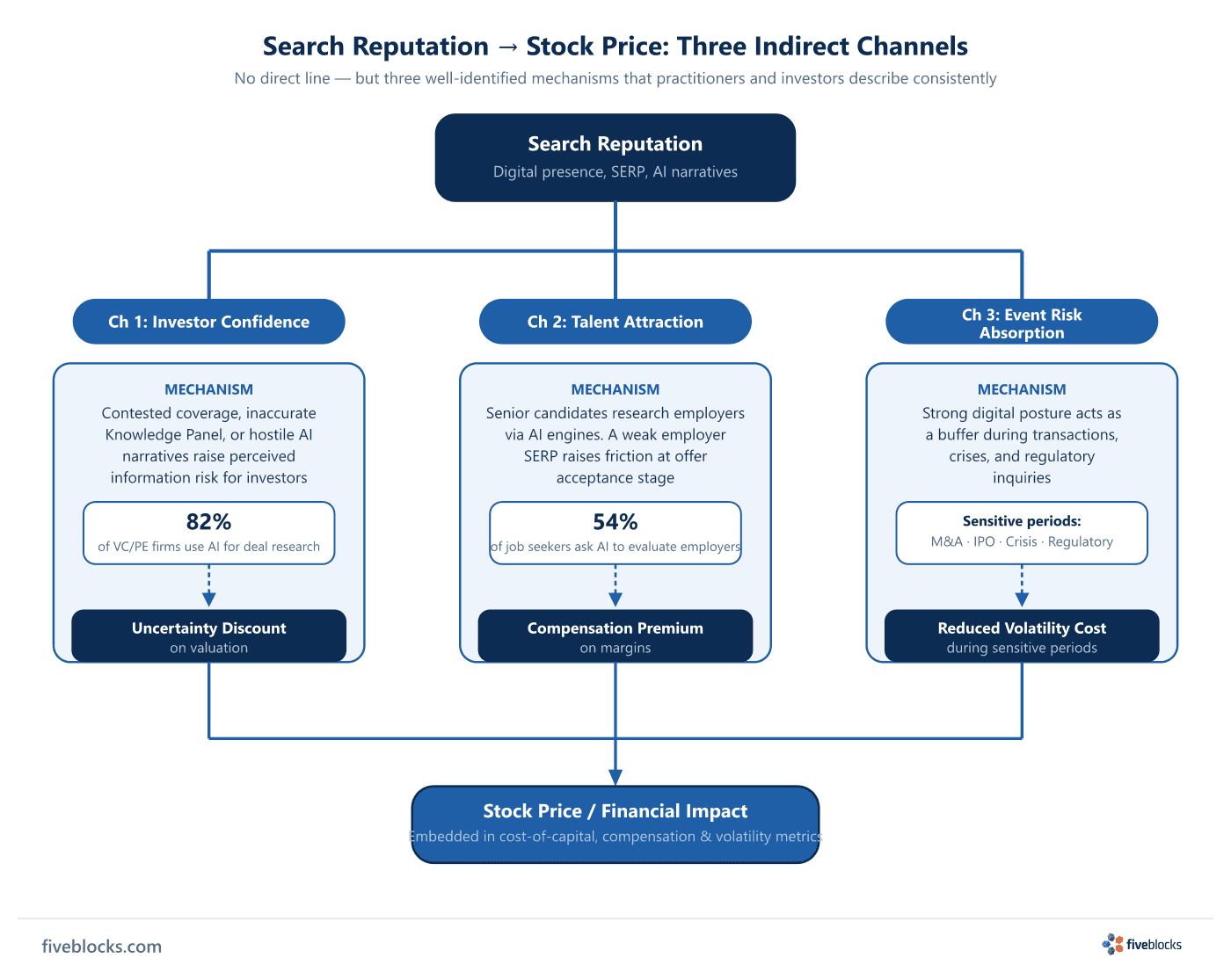
Search reputation reaches a company's stock price through three indirect channels: investor confidence (a contested or inaccurate digital picture creates uncertainty that can weigh on valuation), talent attraction (a weak employer-brand SERP raises the compensation premium needed to close senior hires), and event-risk absorption (a company with strong digital posture absorbs negative news more cleanly during transactions, crises, and regulatory inquiries). None of these channels shows up cleanly in a daily stock chart, but all three come up regularly in IR conversations and pre-deal diligence.
The connection between search reputation and stock price is indirect. No study has mapped a clean one-to-one relationship. It runs through three channels that practitioners and investors describe consistently, and each one works differently and carries a different type of financial cost.
- Channel 1: Investor confidence and the uncertainty discount
-
Institutional investors and analysts run digital diligence on companies they hold or are considering. A branded SERP filled with contested coverage, an inaccurate Knowledge Panel, or hostile AI narratives introduces uncertainty at a moment when clarity is expected. That uncertainty does not vanish because the underlying business is sound. It adds to other risk factors and can widen the discount investors apply to forward earnings. A harder-to-trust digital picture raises perceived information risk, and perceived information risk gets priced in.
Investors now routinely prompt AI engines about companies before formal diligence begins, with 82% of VC and PE firms reported to be using AI tools for deal sourcing and early research (Affinity, 2026; Krause, SSRN, 2023). What those engines return shapes the questions that go into the formal meeting, and an inaccurate or hostile AI narrative can set the frame before the company speaks.
Note: the specific magnitude of any valuation discount attributable to search reputation alone has not been independently quantified in published research reviewed for this article. The mechanism is described as it operates in practice, not as a measured coefficient.
- Channel 2: Talent attraction and the compensation premium
-
The strongest senior candidates research employers before accepting offers, and they increasingly do this through AI engines rather than just through search. A 2026 HR Executive survey found that 54% of job seekers ask AI to evaluate whether a company is worth pursuing (HR Executive, 2026). A weak or contested employer-brand SERP, whether in Google or in the AI response, adds friction to the offer-acceptance process. To close the hire anyway, companies pay a compensation premium. That premium flows through payroll costs, and at scale and seniority it is material to margins.
The inverse also holds. A company with a clean, credible digital presence narrows the field of candidates who decline without engaging, which reduces the cost-per-hire and the time it takes to fill senior roles.
- Channel 3: Event risk and reduced volatility cost during sensitive periods
-
During transactions, crises, regulatory inquiries, and public controversies, the company’s existing digital posture acts as either a buffer or an amplifier. A brand with a strong, accurate, well-sourced digital presence tends to absorb negative news more cleanly: the authoritative sources provide context, the AI narrative does not collapse into the worst-case framing, and investors have more signal to work with. A brand without that foundation faces the same negative event with less context available, which can produce sharper sentiment and volatility responses.
This channel is qualitative by nature, but it comes up consistently in investor relations conversations during and after sensitive periods. The reduction in volatility cost is real even if it is hard to isolate from other event-period variables.
What this means in practice
None of these channels produces a line item in the financial statements labeled “search reputation cost.” The effects sit inside cost-of-capital, compensation, retention, and volatility metrics that are each influenced by many variables. But the channels are understood well enough that pre-IPO programs, pre-fundraise programs, and M&A preparation programs are now standard, and their purpose is to remove digital friction before it enters the pricing conversation.
Last reviewed: 19/05/2026
